

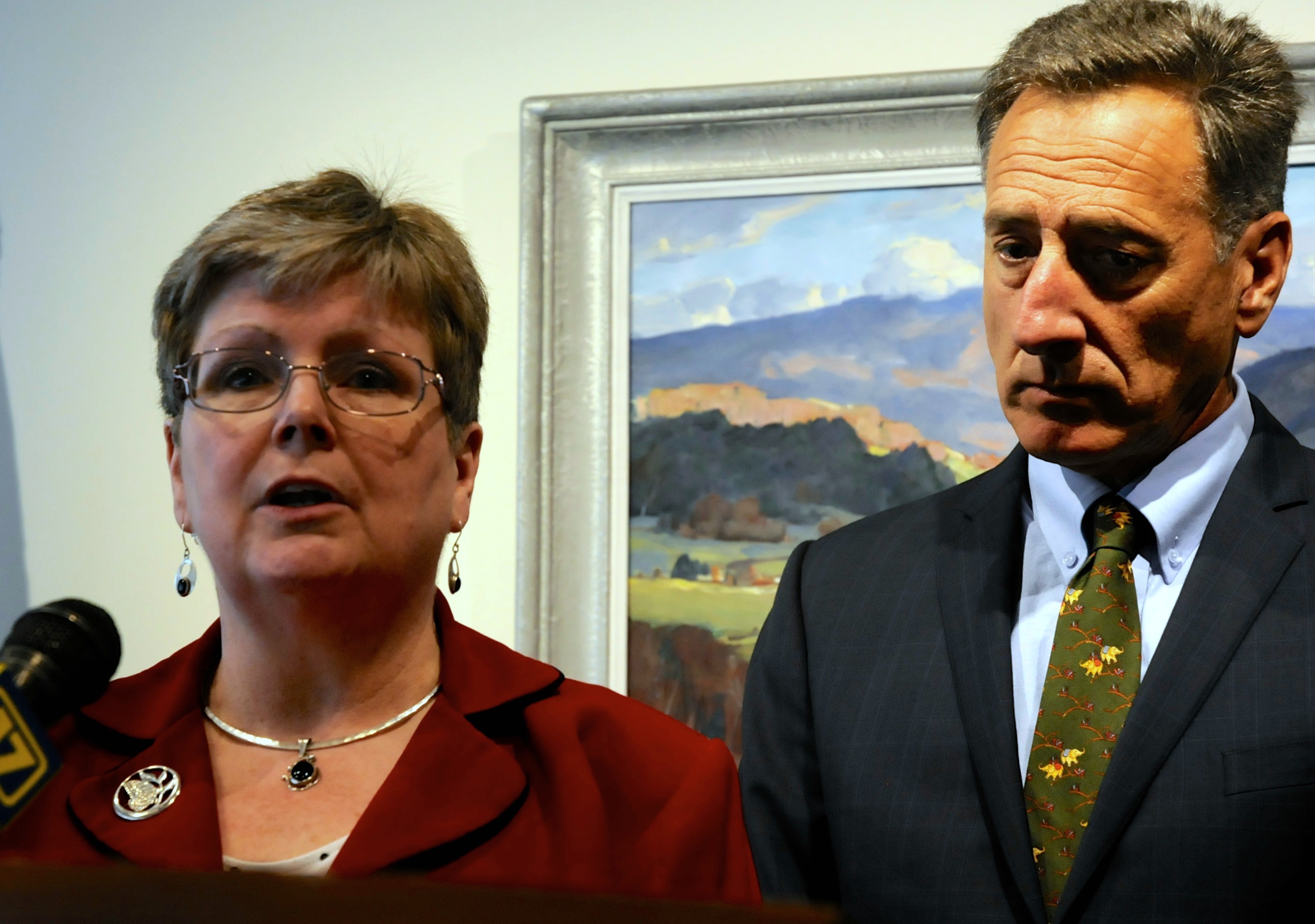
The latest in Vermont’s long line of state government accountability programs was officially adopted Wednesday. Gov. Peter Shumlin signed S.293 into law in Montpelier. He and the bill’s supporters say they’re optimistic that conditions are ripe for this new data-driven approach to stick, though many previous attempts to objectively evaluate the effectiveness of state programs have waned or failed.
Shumlin said that too often government doesn’t have the right data to assess the efficacy of state programs.
“We rarely ask the question, ‘As we continue to throw more money at these programs, are we getting the data-driven results that we believe we’re getting when we give you more money?” Shumlin said.
He said at its core, the process laid out in the legislation — most of which takes effect immediately — is to ask three questions: How much are we doing? How well are we doing it? And is anyone better off because of it?
Sue Zeller, the state’s new Chief Performance Officer and former deputy commissioner of finance and management, said S.293 is the third such program she’s seen in her nine years in state government.
“I know there have been several efforts in the past, too numerous to name, where one group or another group tries to look at performance,” Zeller said. “But this time … I really do think that the groundswell is here to move forward for the first time.”
Zeller attributes the propitious timing to collaboration from three major sectors: the state’s executive branch, Legislature and nonprofit service community. She said in the past similar efforts did not have buy-in from the sectors that carry out so much of the state’s service work.
More state employees and nonprofit leaders are also trained now in results-based accountability, a methodology for program evaluation.
Nonprofits are involved as contractors and grantees providing ground-level services. Both the state’s official efforts and those of its contractors and grantees will be subject to the new initiative.
Within three to five years, Zeller said, “most of the major programs (will be) able to report on at least a certain number of outcomes and measurements that are tied to their strategic plans and budgets.”
It will take still more time to loop more programs and services into the same evaluative model. It’s a necessarily incremental process, she said.
“This is the first time I think we’re starting at ‘go’ before starting half-way down the road,” Zeller said. She thinks taking time to set up performance expectations and appropriate measurements will pay off in the long run.
Lauren-Glenn Davitian, of the nonprofit network Common Good Vermont, underscored that the initiative is not meant to be punitive.
“This is meant to track how we’re doing in order to make better decisions about programs that could be working more effectively, and programs that are working very effectively that could use more investment,” Davitian said.
So far, Zeller said, about 60 liaisons from roughly 30 departments have been selected to start aligning program management with population-level outcomes.
She said in many cases, the state already collects sufficient data, but doesn’t manage it in a way that allows robust analysis. In other cases, data collection overlaps. Elsewhere, it’s lacking.
Her goal is to make reporting more efficient so agencies and nonprofits can free up time to focus on program work. To help build longevity into the system, she requested that no more than one of the two liaisons from each department be a political appointee.
