

BURLINGTON — A new co-working space is opening in downtown Burlington this summer, city and state leaders announced Monday morning.
The incubator is conceived as a headquarters for high-tech startup companies, a workspace for other professionals and a technology and business support center for all. Co-working is a model for sharing space and fostering collaboration among creative professionals.
“It’s basically designed for the startup, the student, the researcher, the remote working professional,” said David Bradbury, president of the Vermont Center for Emerging Technologies. The nonprofit connects entrepreneurs with the mentorship, venture expertise and financial resources they need to grow businesses in Vermont.
VCET now operates two incubator and co-working spaces at UVM and Middlebury. Soon it also will manage the new VCET @ BTV, to be housed on the second floor of a FairPoint Communications facility at 266 Main St. in Burlington.
Bradbury said the location was key for entrepreneurs, who have voiced a desire for space with proximity to downtown.
FairPoint will provide one-gigabit Internet service to the 11,000-square-foot facility. The phone and data service provider also will cover overhead utility costs for a combined monthly rent of $1, Bradbury said. VCET will furnish the new space, and he hopes to keep rent “as close to zero as possible” for the occupants.
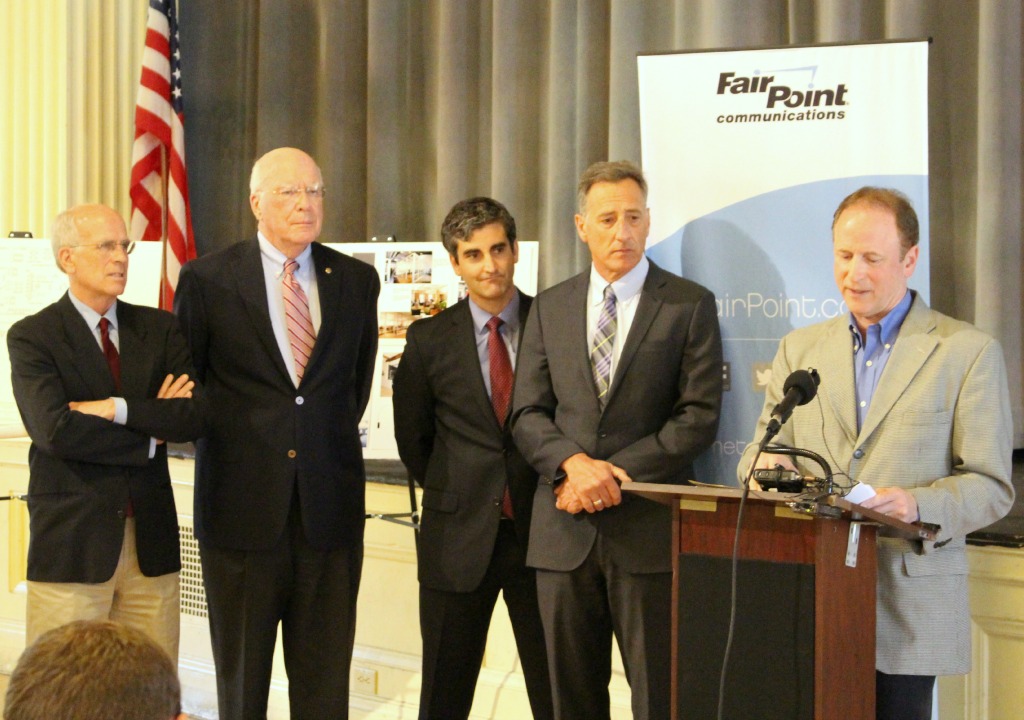
The VCET @ BTV announcement at City Hall drew appearances from Vermont Sen. Patrick Leahy, who helped establish it, as well as Rep. Peter Welch, Gov. Peter Shumlin and Burlington Mayor Miro Weinberger. FairPoint Vermont president Beth Fastiggi and UVM provost David Rosowsky also were on hand.
Frank Cioffi, president of the Greater Burlington Industrial Corp., introduced them one at a time, emphasizing the collaborative effort that has made the new space possible. The sentiment was echoed by Welch.
“One of the things we understand in Vermont that seems to elude us in Washington is that you can actually make progress through collaboration, not just endless conflict. It’s pretty elemental,” Welch said.
Bradbury said in an interview after the event that he is confident VCET could rent the new space to capacity right away. However, he believes it’s important to build the culture of a co-working space carefully, so he will be taking it slow. He expects it could grow to 100 full-time and part-time members.
Twenty-four-year-old Vermonter and Champlain College graduate Marguerite Dibble runs one business that will be in at the ground level. Birnam Wood Games makes mobile video game applications and consults for businesses looking to boost their own market engagement.
Dibble grew up in Landgrove, the daughter of painting contractors. She said the collaborative environment of a co-working space is appealing because she wants to help other people make their businesses self-sustaining.
Vermont transplant Paul Budnitz is the entrepreneur behind two startups: Budnitz Bicycles and a forthcoming social networking platform called ello. He’s received some funding from VCET, as well as Fresh Tracks Capital of Shelburne and other investors, too.
Budnitz said he and his partner looked all over the country for places to move the bicycle business.
“We just like it here,” he said.
He compared Vermont to the San Francisco Bay area of California, where he’s from. Despite Vermont’s relative lack of racial diversity, Budnitz said, he finds communities here more socio-economically diverse. It’s a mix he enjoys and wants to raise his family in, and one he believes is good for business, too.
A similar ethos drives co-working spaces like VCET @ BTV, where collaboration among diverse tenants is encouraged.
Bradbury said co-working spaces are growing in popularity around the state, with active sites in North Bennington, White River Junction and Montpelier, in addition to VCET’s operations in Burlington and Middlebury and the Generator Maker Space in Burlington.
More groups in other towns and around the world are finding helpful guidance from VCET’s white paper on co-working, Bradbury said.

