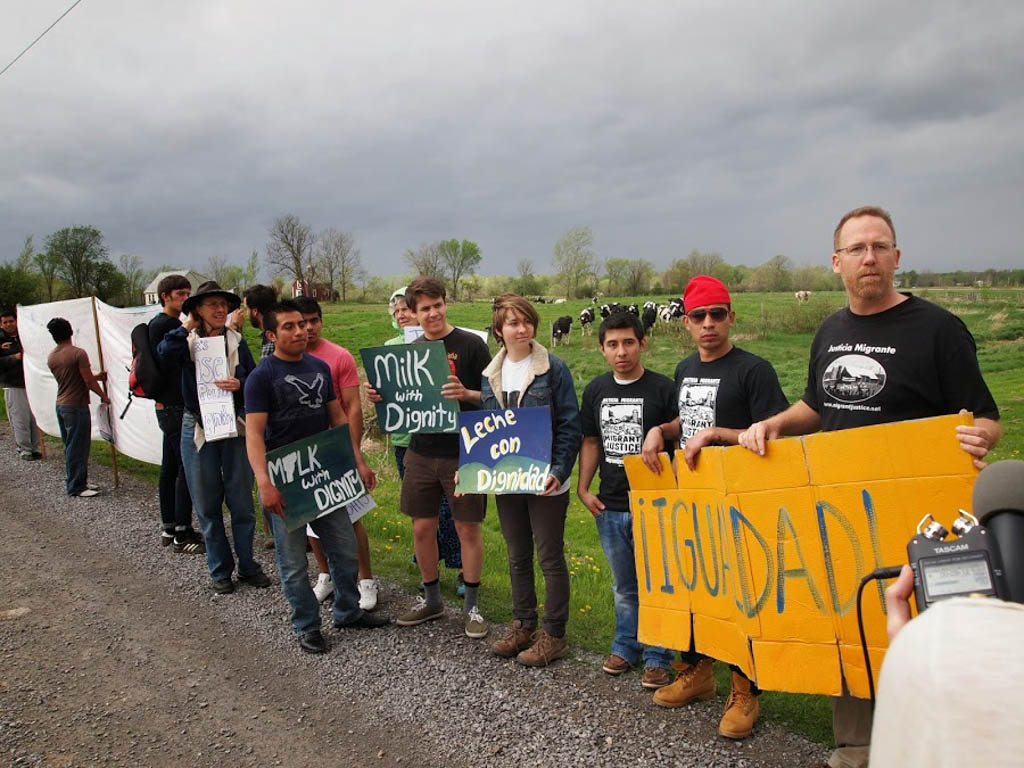
After two years of living in a leaky camper at the farm, sewage in his new dwelling was the last straw. Victor Diaz and his co-worker asked the farmer to fix the problem, but after two weeks of nothing, they walked off the job Thursday.
Then, with the support of workers’ rights advocates, Victor Diaz returned Friday, demanding back pay owed to him and two other workers. The farmer, Ray Brands, paid them more than $1,800.
The rally Friday arose from one incident, but is part of a larger goal of the advocacy group Migrant Justice, which campaigns for the rights of more than 1,500 migrant dairy workers in Vermont, many of whom are undocumented and send much of their wages to Mexico to support their families.
After a successful push this legislative session to update the statewide police policy on racial profiling, and a victory last year securing driving privileges for undocumented immigrants, Migrant Justice organizers say this summer they want to draw attention to unfair housing and working conditions.
“It’s always been on the agenda to improve the housing and working conditions on the farms,” said Brendan O’Neill, an organizer for Migrant Justice.
In an interview Monday at Migrant Justice’s Burlington office, other workers shared their stories of poor living conditions. One worker said his housing was bad but he bought paint and repaired it himself.
Another, Carlos Diaz, 19, told how his boss continued to cram workers into one house until they approached the farmer and asked him for more space. Instead, the farmer decided to fire a worker, but changed his mind after workers insisted all they needed was more room.
Carlos Diaz said at a previous farm, he lived in a house where the faucet spewed dirty water and workers had to buy bottled water.
During Friday’s rally, Victor Diaz pointed to the leaky camper where he used to live with three other workers. At one point they slept under a tarp to keep the water off, he said.
Victor Diaz, 22, has worked at the farm since March 2012, he said. A man who transports workers abandoned him there and he had no choice but to start working, he said.
Victor Diaz made about $9 an hour milking cows for two hours each morning and caring for the cows and other animals, he said. He sends between $600 and $700 a month to his family in Mexico, he said.
Reached by phone Monday, Brands declined to discuss the situation, saying “the community that I work and operate in understands. I don’t feel that I have to validate or respond to anything that they’re putting forth,” he said.
O’Neill on Monday said the conversation with Brands on Friday during the rally was respectful.
“Respect is a two-way street. I feel like I’ve been somewhat abused here, too,” Brands said Friday, according to Vermont Public Radio.
The Ferrisburgh workers plan to file a complaint with the town health officer, O’Neill said.
Migrant Justice plans to conduct a survey this summer of migrant workers and develop a concept of what constitutes a good job and good living conditions.
“The first step is really for the (migrant) community to define what that means,” O’Neill said.