

Editor’s note: Jon Margolis is VTDigger’s political columnist.
“I was the one that knocked her down,” said W.C. Fields in the 1940 classic “My Little Chickadee.”
Not so, said one of his buddies, claiming that he was the one who had knocked Chicago Molly to the floor.
“Oh yes, that’s right,” admitted Fields. “He knocked her down. But I was the one started kicking her.”
There is, of course, nothing funny about kicking someone who has been knocked to the floor, even if knocking him (or in this case, her) to the floor was justified. What was funny was that Fields was not merely admitting that he had started the kicking; he was bragging about it, singing praises of his own indecency.
A lesson, perhaps, to those pondering one of the current quarrels in Vermont politics, the one stemming from the decision by Gov. Peter Shumlin and the Democratic leaders of the Legislature to support another increase in the state’s minimum wage and to abandon – for now – the proposal to require employers to grant paid sick days to their workers.
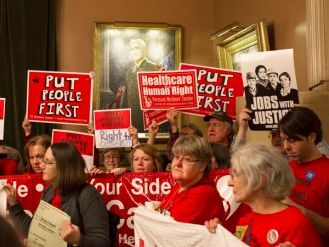
The decision has enraged many liberals. Their dismay is understandable because they had put a lot of time and effort into gathering support for the sick leave bill, H.208, and it was overwhelmingly approved by the House Committee on General, Housing and Military Affiars last year. The bill seemed to have some chance of getting passed.
But then Shumlin met twice – once in Washington and once in Connecticut – with President Barack Obama and some other Democratic governors. From these meetings, and probably at the president’s urging, a political strategy apparently emerged: Let’s push a minimum wage increase, in as many states as possible if Congress won’t approve it nationally. Shumlin, always an advocate of a higher minimum wage, happily agreed to support raising Vermont’s minimum, now $8.73, to $10.10 in increments over three years.
This strategy could be described as a political ploy. It could also be described as elected officials deciding to pursue a policy they think is wise and which most people support.
Isn’t that the way democracy is supposed to work?
To be sure, much the same could be said of the sick leave bill. There’s little doubt that most Vermonters support it. So, in principle, does Shumlin, though he’s expressed some concern that if Vermont goes it all but alone here (only Connecticut has a mandatory sick leave law) the state might become less attractive to business.
So why don’t he and the Legislative leaders support both bills?
Well, for one thing, there seems to be less support for the sick leave bill than for the minimum wage hike. So House Speaker Shap Smith would have to do a fair amount of convincing and cajoling (Smith doesn’t do much threatening) without a guarantee of success.
A smart legislative leader is selective about how much convincing and cajoling he does. A member who has been convinced/cajoled on one bill becomes a tougher sell on the next one. Smith may prefer to save those efforts for bills he thinks are more important.
“At this point in time there really isn’t enough support to pass the bill,” Smith told Vermont Public Radio. “And we don’t want to bring it to the floor if it’s not going to pass.”
But there may be another reason Shumlin, Smith et al. have decided to hold off on the sick days bill, and it is probably not because they are “prepared to put the profit interests of a few businesses over the well-being of thousands of workers and their families,” as suggested by James Haslam of the Vermont Workers Center.

Not that elected officials are or should be indifferent to business profits. Without profits, businesses could not pay decent wages to their workers or provide the tax revenue that supports social programs. That helps explain why American liberals have always been in favor of profitable businesses.
In this case, the Democratic leaders may simply have decided that while they have to knock their opponents down, they need not start kicking them while they’re on the floor. That’s both good politics and good governing.
Granted, taking this above-the-battle, political science angle is easier for those of us who are not and never have been low-paid convenience store clerks who don’t get paid when they can’t come to work because they or one of their children is sick.

But elected officials have a broad mandate, and one of them is to maintain comity, both in the Statehouse and in the community at large. The opponents in this case are the several organizations that represent the business community – the Chamber of Commerce, the Retailers Association, the Grocers Association, Associated Industries of Vermont. They oppose both bills assiduously, if not bitterly. To pass either bill, the Democratic leaders will have to beat these opponents (knock them to the floor). They need not humiliate them (kick them while they’re down).
These organizations are legit. They represent real constituencies that are and ought to be part of the political discussions. Their legislative lobbyists are decent people with whom Shumlin, Smith, Senate President Pro Tem John Campbell and several committee chairs regularly consult, negotiate with, sometimes support, sometimes oppose. Maintaining cordial relations with them is part of an elected official’s job. So there is a limit on how badly those officials should want to beat up on them in any one year.
There’s also an economic consideration. Like raising the minimum wage, requiring paid sick days will cost some businesses money. In effect, passing both bills means passing a higher minimum wage. Absorbing both extra costs all at once increases that cost, perhaps too quickly for some businesses to make the adjustment. Even if they can – and almost all of them probably could – many businesspeople would probably resent the combined burden for years to come.
Creating resentment is not a healthy outcome either for the state’s elected officials or for anyone else. If it is necessary to offend and annoy a key constituency, there is something to be said for doing it in incremental doses.
Just as there is something to be said for paid sick leave, which many businesses already provide. Without them, more employees come to work sick, infecting others. Almost every other capitalist democracy requires a week or even two of paid sick days, and the requirement has not ruined any of their economies. It would be no surprise if over the next few years several states, including Vermont, follow their example.
But right now in Vermont, there is also a reasonable case for holding off on paid sick leave while increasing the minimum wage. The state’s Democratic leaders are not nearly as funny as was the late William Claude Dukenfield (even when he was sober, which was rarely). But they’re better than he would have been at governing.


