

In This State is a syndicated weekly column about Vermont’s innovators, people, ideas and places. Candace Page is a freelance writer from Burlington.
EAST CHARLESTON – It would be hard to find a less likely place for a nonprofit environmental center than this stretch of cut-over forest in Vermont’s poorest, least populated corner.
Yet here stands the NorthWoods Stewardship Center, a collection of log buildings in a 1,480-acre forest, where four home-grown environmental stewards share their knowledge and love of the land with their neighbors in three counties.
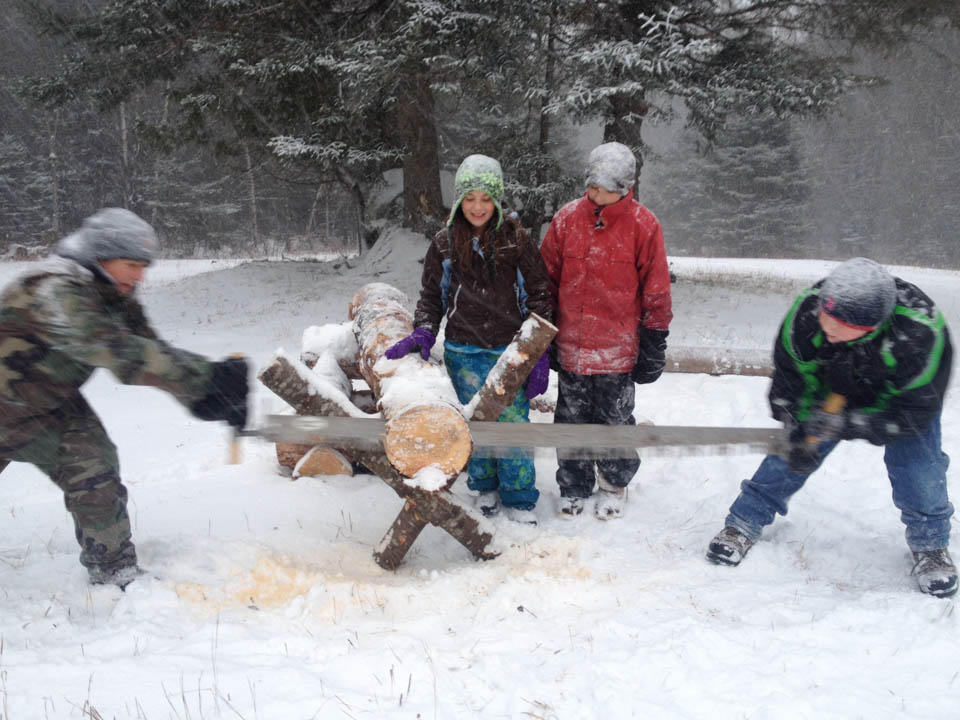
At NorthWoods, just west of Island Pond, a child can learn to track a snowshoe hare, use a cross-cut saw, tell one kind of maple from another. A teenager can join the center’s summer Conservation Corps and earn a paycheck while building recreation trails and removing invasive species on public land. Landowners can attend workshops to better understand the flora and fauna of their woodlots and how to manage that forest sustainably.
“We do a lot of different things, so people think this place is complicated. It’s not,” said Trails Director Luke O’Brien, who grew up on his family’s farm in nearby Walden. “Everything we do at NorthWoods is about connecting people to the land in a way that does no harm.”
NorthWoods — originally the for-profit Vermont Leadership Center — was founded in 1989 by former Sterling College President Bill Manning. It later became a nonprofit, and in 2009, former board member Lydia Spitzer gave NorthWoods its greatest physical asset, more than 1,000 forested acres

Nevertheless, the center lives as precarious a financial life as a 40-cow dairy farm. It has survived several near-death experiences as grant funding ebbed and flowed.
In this, its 25th anniversary year, the nonprofit is aimed at building a more secure future.
Carol Moore, former president of Lyndon State College, was hired last month as a part-time executive director to focus on fundraising. A capital campaign is in the works, along with plans to more effectively spread the word about NorthWoods’ Forest Stewardship Institute, Conservation Corps, summer camps, in-school programs and more.
“This is an isolated place, and we want to keep that sense of remoteness,” said Nancy Engels, a former board president. “But we’ve hidden our light under a bushel. More people need to know who we are.”

Deep local roots
On a blowy February afternoon, a dozen day-camp students slurped cocoa in NorthWoods’ central meeting room as they recounted the results of their ice-fishing excursion – a rainbow trout — to Education Director Maria Young, 33, a West Glover native.
In the staff offices, trails director O’Brien, 38, was trying to determine how to raise the money to build a training building for the 50-student Conservation Corps.
Ross Stevens, 42, an Island Pond native, came in shaking snow from his jacket after a noontime ski through the center’s woods. He was preparing for a recruiting trip in search of candidates for Conservation Corps crews.
Across the hall, Jayson Benoit, 45, East St. Johnsbury-raised, had returned from repairing one of the center’s snowmobiles and was making calls to line up sites where crews will plant saplings in the spring to reforest and stabilize riverbanks.
The four NorthWoods leaders share remarkably similar histories – rural childhoods spent exploring the woods on skis or snowmobiles, departure to distant colleges, a period of roaming in their 20s. Then all four answered the pull of the Northeast Kingdom and came home to stay.
“I knew I wanted to come back to the Kingdom, but I didn’t think it would be possible in my field,” said Stevens, who studied environmental science in college.
O’Brien added, wryly, “We are all pretty well invested in living in the Northeast Kingdom, and there aren’t a lot of job possibilities up here – so we all have a big stake in making sure the center succeeds.”
Benoit arrived first, nearly 20 years ago, followed by Stevens in the mid-1990s, O’Brien in 1998, Young in 2009. Theirs has been the steady presence through the environmental center’s ups and downs.
Their roots in the northeast corner of northeastern Vermont give NorthWoods important credibility in a rural area where some people remain suspicious of the word “environmental.”
Young fizzes with enthusiasm; the three men are quieter, speaking with understated pride in their work reconstructing an historic cabin atop Bald Mountain in Westmore; establishing a demonstration forest on the Spitzer land; guiding hundreds of teen-agers through their first work experiences.
Running an $800,000-a-year environmental center in Charleston, population less than 1,000, requires the kind of adaptability that has long been the pride of Northeast Kingdom residents.
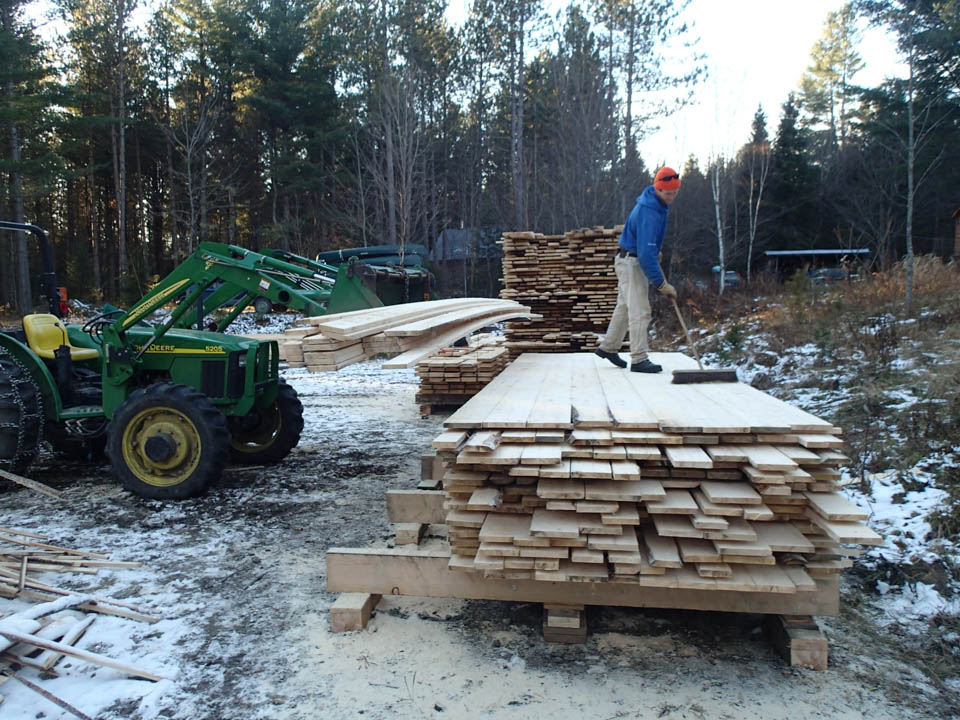
When NorthWoods lost a foundation grant that provided up to a quarter of its budget, Stevens and O’Brien saved the Conservation Corps program by contracting to provide trail crews on federal wildlife refuges in five New England states.
When the budget could no longer afford an executive director in 2010, Benoit and the others divided up leadership duties. The four spend most of their time teaching and doing environmental science, but they also help the center’s eight other full- and part-time employees to stoke the wood boiler, plow the drive, repair machinery and, if necessary, sweep the floor.
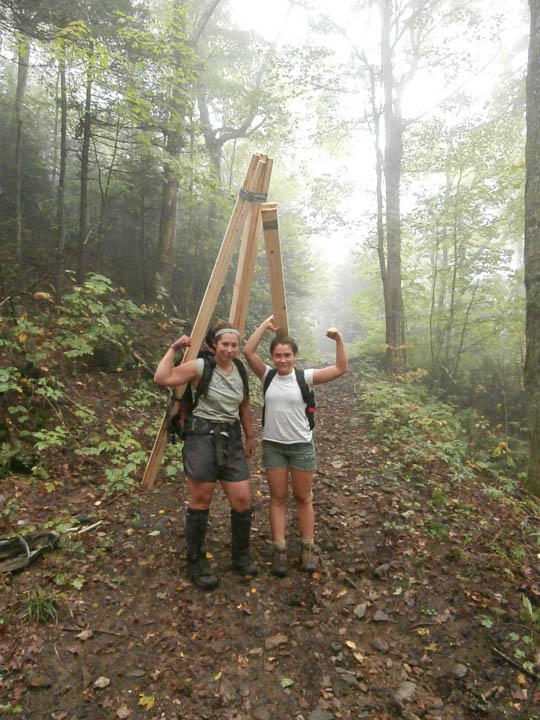
Last year’s big trail project, rebuilding the cabin atop Bald Mountain, involved carrying 16-foot-long hemlock stringers more than a mile up the mountain, on foot. Stevens hauled along with his crew. O’Brien, in the midst of treatment for non-Hodgkin’s lymphoma, hiked up the mountain, too, to supervise and help pound nails.
“It’s hard to come up with words to capture their spirit and dedication,” Walter Medwid, a former executive director, said of the NorthWoods staff. “They are so in love with the Kingdom and trying to make the world a better place.”
Setting foot in the natural world
Game warden Jeff Whipple says his teenage summers on a NorthWoods Conservation Corps launched him in the direction of his career. Geoff Whitchurch, a St. Johnsbury parent, drives 40 miles twice daily to take his two sons to the center’s nature camps. Barnet School sends seventh- and eighth-graders 60 miles to NorthWoods for campouts.
“Even though these kids live in a rural area, many of them haven’t camped out, paddled a canoe or gone on a hike,” Barnet teacher Cindy Mosedale said. “Going to NorthWoods takes them outside their comfort zone. NorthWoods doesn’t just take them paddling. They learn what they are going to see and why the land looks the way it does. It is just excellent.”
While NorthWoods earns kudos from those who know its work, that circle is too small, say members of its governing board.
“If we sent our Conservation Corps to the streets of Burlington instead of the Nulhegan Basin, we’d be better known,” said board president Bill Bevans of Craftsbury. “That’s not going to happen.”
The answers to this challenge aren’t yet clear – NorthWoods is in the midst of writing a new strategic plan – but will include a new bunkhouse for visitors; collaborations with schools like Lyndon State College; and better marketing of NorthWoods’ attractions like its cross-country, nature and history trails.
“Other organizations thrive on exciting new programs, but if you have a good model, maybe you don’t need that,” Luke O’Brien said. For him, and his compatriots, that model aims to enrich the lives of their neighbors through a better connection to the natural world.
“Every community wants to improve its quality of life. You just have to work harder and longer in this corner of Vermont than in Norwich or Stowe,” he said.
