


“Don’t GMO me, bro!”
Al Walskey’s remark drew laughter, but also summarized the feelings of almost all of the 50 speakers at a Senate hearing on GMO labeling Thursday night at the Statehouse.
Walskey, a Vietnam veteran from Berkshire, raised concerns about Monsanto Corp., the agricultural chemical giant that produces some of the nation’s genetically engineered seed. He cited the health effects of another Monsanto product, Agent Orange, which sickened many soldiers in Vietnam. (Dow Chemical also produced the defoliant agent for the U.S. military.)
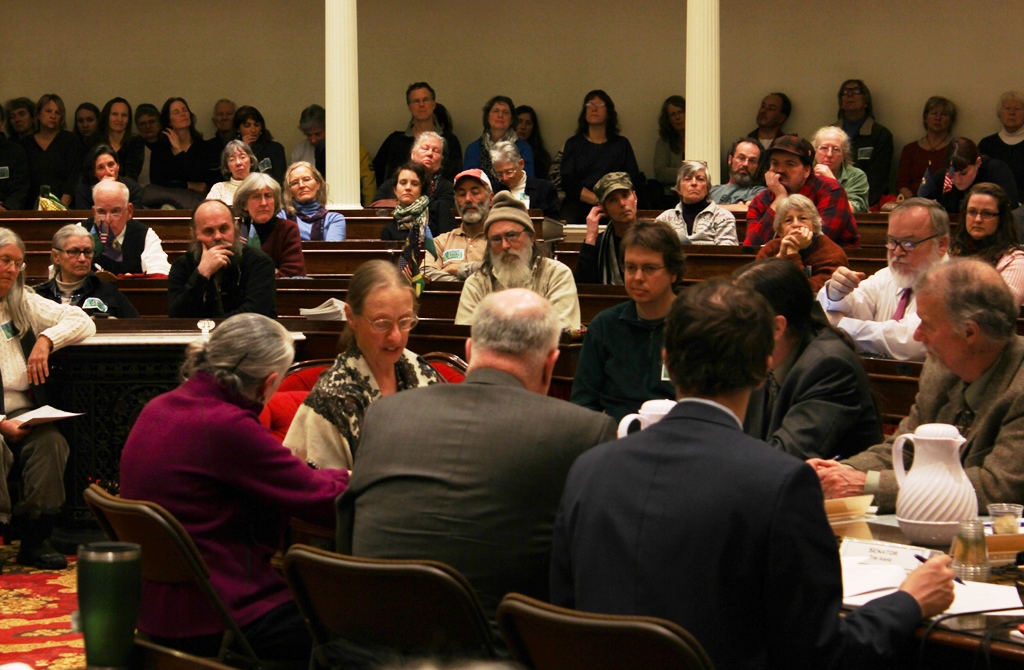
More than 200 people filled the floor of the House chamber for the joint hearing by the Senate Agriculture and Judiciary committees on H.112, a bill that mandates the labeling of foods containing genetically modified ingredients.
The House passed the bill in May, and the Senate Agriculture Committee took the bill up beginning first week of the legislative session this January.
Sen. David Zuckerman, P-Chittenden, vice-chair of the committee, said Friday that the panel approved the bill, 4-1, without a trigger clause that would delay implementation of GMO labeling until other states pass similar bills. H.112 now goes to the Senate Judiciary Committee.
During two hours of public testimony Thursday, only one person opposed the bill.
“I appreciate all the hard work that’s gone into (the law) … but I think it should be stronger,” said Michael Bald of Royalton.
The bill aims to help Vermont consumers “avoid the potential risks associated with genetically engineered food,” noting concerns about human health and environmental impacts of GMO crops.
While 88 percent of the nation’s corn crop and 93 percent of its soybean crop is grown from seeds engineered to tolerate harsh conditions or resist herbicides, surveys nationally and in Vermont have found that the majority of consumers support the labeling of foods containing GMO ingredients. A 2004 University of Vermont survey found that more than 75 percent of Vermonters supported GMO labeling.
At Thursday’s hearing, the message of most of the speakers, who identified themselves as farmers, doctors, veterans, parents and scientists, came down to one point: They want more information about the food they are buying at the grocery story.
“I’m concerned, and I want to know what’s in my food,” said Alton Smith of Wolcott.
Speakers drew comparisons with past human health and environmental cases, including DDT, cigarettes and dioxin.
“Prior to 1964, cigarette manufacturers assured the American people it was safe. Today, we know that’s ridiculous,” said Claudia Rose of Enosburg Falls.
Though Rose said there is no conclusive evidence that GMO foods cause human health problems, she called for labeling as research continues.
“I want to be able to choose,” she said.
Morgan MacIver, a student at Twinfield Union High School, also said GMO labeling is a knowledge issue, particularly as she prepares to graduate and make choices about her health and the food she eats.
“It’s important that I gather all the information I can in making healthy and informed decisions, like I’ve been encouraged to do,” MacIver said. “This is why I want to see labels on genetically engineered foods.”
Paula Schramm of Enosburg Falls said she recognizes the scientific advances that GMO seeds have made and could make, but that she is concerned by corporate ownership of these technologies.
“I’m sure there’s an important place for these technologies,” she said, “but I’m alarmed about the way big corporations have managed to co-opt and control the narrative about using these technologies in this country.”
Elizabeth Howard of Norwich is concerned about the use of GMO seeds and herbicides in general. She said Roundup, an herbicide used together with the popular “Roundup Ready” corn seeds, kills milkweed, which is the primary food source for monarch butterflies. She said she hopes to see action on the bill before the monarchs fly back into the U.S. from Mexico in just a few weeks.
“Please, allow those of us who care about monarchs and other pollinators to really make a choice,” she said.
Since many GMO seeds are developed and patented by private companies, however, lawmakers and consumers have acknowledged the potential for a lawsuit from an industry group or from grocery associations, whose members would have a role in implementing a labeling law. The threat of a lawsuit reminds some of the 1995 court case against the state’s labeling law for milk from cows treated with rBST, a hormone that increases milk production. The U.S. Court of Appeals, second circuit, overturned the law on the basis that it violated federal free speech and interstate commerce laws, costing the state millions of dollars in legal fees.
Bald, the sole opposing voice, reminded the crowd of that legislative process and the ensuing court case, cautioning that a lawsuit would almost certainly carry a high price tag.
“That was not legal cavalierism by the state of Vermont,” he said. “That was corporate retribution.”
But many others, like Michele Robbins of Williston, told the senators that Vermont is a state for firsts — the first to label compact fluorescent lightbulbs as containing mercury, and the first to legalize civil unions.
Several speakers said Vermont should be the first state to pass a bill requiring GMO labeling, adding that the bill should not include a “trigger clause” that would delay implementation of labels until other states pass similar bills. The House version does not contain a trigger, but Senate Judiciary might add that clause.
Stuart Smith of South Strafford told the lawmakers, “Show that courage and dispense of the trigger.”
“We want you to stand up for us, and we will stand with you,” said Steven Barry of Manchester.

