

Editor’s note: Tom Slayton is a writer in Montpelier and editor emeritus of Vermont Life magazine. In This State is a syndicated weekly column about Vermont’s innovators, people, ideas and places. Details are at www.maplecornermedia.com.
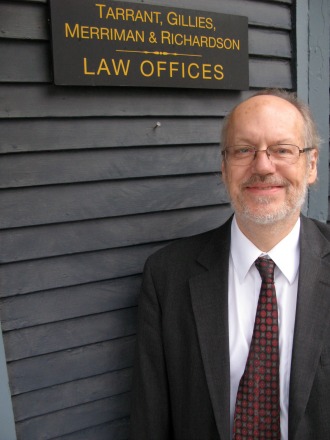
A feeling of controlled disorder attends Atty. Paul S. Gillies’ office in Montpelier. Small framed portraits of 18th and 19th century dignitaries pepper the walls, and nearby there’s a large print of the famous Elias Hicks painting, “The Peaceable Kingdom,” in which the lion lies down with the lamb.
It looks as much like a writer’s office as the office of a lawyer. And Gillies confirms, indirectly, the accuracy of that impression.
“I never wanted to be a lawyer,” he says. “I wanted to be a writer. From the age of 12, I wanted to write.”
He says this quite happily, without a hint of regret. And that may be because in his lengthy legal and governmental career, Gillies (despite its spelling his name is pronounced “Gillis”) has successfully combined writing and the law.
Virtually all lawyers write, of course – legal documents, briefs, commentaries on the law and so on. But Gillies writes better than almost all of them. His writing is witty, erudite, energetic and anecdotal, even when he writes on legal subjects.
“I’m usually more interested in the story than the law,” he says.
Both law and story are combined in his regular essays on Vermont legal history for the Vermont Bar Association Journal. Earlier this year, Gillies put his passion for writing and understanding of law into a book published by the Vermont Historical Society, in a collection entitled “Uncommon Law, Ancient Roads and Other Ruminations on Vermont Legal History.”
It is a fascinating book, filled with historical oddities and good writing.
For example, in a profile of Nathaniel Chipman, 18th and 19th century lawyer, legal philosopher and chief justice of the early Vermont Supreme Court, Gillies points out that Chipman had at one time closely observed some stones on the bottom of a pond near his Tinmouth home. The stones moved, from year to year, and Chipman watched until he discovered how and why: it was the shifting of the ice in the pond each spring that transported the rocks.
At the end of an essay detailing Chipman’s career and summarizing his importance, Gillies adds a brisk, insightful paragraph:
“Easy as it is to idolize Chipman, to do so is to treat him as a statue, and he deserves more than that. Go back to Tinmouth Pond and look at those stone trails. Nathaniel Chipman waited patiently to see the rock move. He took the time to marvel at the order he saw in nature. He saw the same order in the law.”
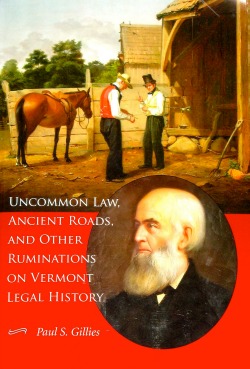
Because the book is replete with passages of that sort, “Uncommon Law” is sprightly and enjoyable reading, something that cannot often be said of essays on legal history. Its subjects range from the regulation of mills and the peculiarities of ancient roads to the sexual proclivities and towering pomaded wig of famed Vermont jurist and playwright, Royall Tyler.
At a launch party for the book, Gillies asked rhetorically what the point of the book might be. In answering, he gave an insight into his fascination for both history and the law:
“In my view,” he said, “in the obscure, there is meaning. In systems of law that no longer have practical value, there is historical weight. In the faces of the early judges, there is the personality of the law, created out of whole cloth at a time when there were few precedents …”
In other words, history always has something to tell us, something that Paul Gillies often finds fascinating.
His interest in history began, he says, on Sunday drives around Vermont with his parents, who, according to Gillies, “never passed a green plaque” without stopping to read about notable historical locations or people. A native Vermonter, he was raised in South Burlington, and acquired an early fascination with books and movies – both of which, of course, tell stories. “I spent every nickel in the Everyday Book Shop and the State Theater,” he recalls.
When it came time for higher education, he studied English at Case Western Reserve University in Cleveland, but returned to do graduate work in English at the University of Vermont. He did his master’s thesis on Nathaniel Hawthorne and at the time fantasized that he might be like Hawthorne, creating dark, literary tales during his writing life, discovered as a writer only after his death.
But an adviser at UVM suggested he leave literary study, which, the advisoer said would pollute Gillies’ natural, winsome style of writing with scholarly obfuscation and jargon. Go to law school, he told Gillies; there, they’ll teach you how to think.
Three years later, armed with a law degree, Gillies returned to Vermont and sought a job in the administration of Gov. Richard Snelling. He was hired to be the governor’s speechwriter, a position which gave him wide-ranging experience throughout state government, and a lot of writing opportunity. He wrote some 250 speeches. He also met a young, up-and-coming Republican named Jim Douglas.
Shortly after Douglas was elected secretary of state in 1980, Gillies became his deputy. He remained there until Douglas moved on in 1993, and says that he liked the position, in part, because it was largely invisible. “I have tried hard to remain anonymous in life,” he said at the book launch party. He notes also that he enjoyed his years working with Douglas and felt they were his most productive.
But by 1993, he felt he needed courtroom experience, and so he left state government and became a partner in the Montpelier law firm of Tarrant, Gillies, Merriman & Richardson. The firm specializes in municipal law, Act 250, general civil litigation, and government relations among other areas, so Gillies fit right in. Even so, he is modest about his contribution to the firm.
A plaque on his office wall declares him to be “The Dean of Obscurity,” and Gillies, at the age of 65, seems to relish the title. “I am the world’s leading expert on some of the most minute subjects you can imagine,” he declares. “The little curlicues and flourishes around the edges of the law.”
However, history of any sort is usually far from drudgery for Gillies. The advance notice for a recent talk he gave at the Mount Independence Revolutionary War site in Orwell epitomizes both his approach and his enthusiasm.
Noting that Gillies planned to start his talk with a broken spoon found at Mount Independence in the 19th century, the notice says that he “will begin to burrow into the magic of subterranean discoveries over time, the urge to dig up treasure, the nostalgic worship of relics, the role of sacred places and their preservation and of their gift shops, the ratiocination or rationalization of booty, the spoils of war, the defacement of ancient structures, the discovery of the elephant skeleton in Mount Holly, the night gold-diggers of Fayston, what St. Clair meant when he decided to evacuate the Fort in 1777, and before the ride is over, (Gillies) will with luck return to that spoon, to answer, simply and finally, why we care for historic places.”
The notice, like most such notices, is anonymous. No author is listed. But it is hard to believe that it was written by anyone other than Paul Gillies.
