


Contract negotiations between the Vermont State Colleges and some staff disintegrated in July. The standstill remains, and it’s recently spawned a petition, a legislative proposal, and a rally Monday on the Statehouse steps.
After the impasse was officially declared, the Vermont State Employees Association (VSEA), which represents the approximately 250 administrative and service employees, eschewed a closed-door approach in favor of a full-fledged public campaign, with support from two other unions active at the Vermont State Colleges (VSC).
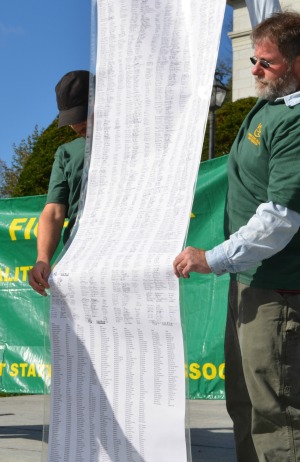
On Monday, more than 80 people from several different unions made repeated calls — through microphones, megaphones and call-and-response chants — for salary increases that would bring all staff up to a livable wage. The median salary for the VSEA-represented staff is $14.74.
Chancellor Tim Donovan released a statement on Sept. 6 that briefly outlined the VSC’s stance.
“The joint declaration of impasse is a disappointment. Nonetheless, we have confidence in the process established in Vermont labor law and do not intend to negotiate through the media,” the statement said.
Mediation is scheduled for the end of September. If that fails, the Labor Relations Board will conduct a fact-finding mission. As a last resort, the board will impose a contract. Until an agreement is reached, the old contract, which expired June 30, will stay in effect.
Negotiations stalled, according to VSEA policy analyst Adam Norton, when the VSC sought to cut its contribution to retirement benefits for staff from 12 percent of salary to 9 percent, and require retired staff to start paying 50 percent of their health care premiums.
According to the chancellor’s statement, those steps are necessary because the VSC needs to address its “underfunded” and “not sustainable” post-retirement health insurance fund, which hovers at about $144 million.
“In our negotiations, the union sought salary increases that were almost triple anything aligned with the VSC’s revenue projections and urged the VSC to ignore the realities of its post-retirement health insurance obligation to its employees,” the chancellor’s statement said.
But VSC staff say the chancellor’s office has been fiscally imprudent because it didn’t address the liability earlier, and, as low-paid employees, they shouldn’t have to pay the price.
“This is something they should have been paying for all along,” Billie Langlois, an acquisitions coordinator at the Castleton State College library, said at the rally on Monday.
Sandy Noyes, a faculty assistant at Johnson State College, said the changes “would mean getting a job after I retire.”
Representatives from two other unions at VSC — United Professionals, which represents professional administrative and technical employees, and the Faculty Federation — came to the VSEA rally with their own banners.
VSC and the United Professionals are also at an impasse in their negotiations, which stretched on for two years. Faculty contracts expire next summer, and the health insurance liability is expected to surface during those collective bargaining negotiations as well.
In response to the impasse, the VSEA launched what it’s calling a “livable wage campaign” to call attention to what it describes as unacceptably low salaries for VSC staff and to urge the chancellor to support pay increases. A petition in support of their efforts has 1,200 signatures.
According to the VSEA’s calculations, 60 percent of the unionized staff don’t make a livable wage, which the Joint Fiscal Office identifies as $15.74/hour for a single person; 24 percent make less than $12.50/hour.
VSC officials dispute that percentage, arguing that it assumes staff have single-person households, and doesn’t take into account a generous benefits package. Norton acknowledged that the figure is an approximation, but, he said, the exact percentage is beside the point. “Regardless, these folks really need a raise and they really need to get off public assistance.”
The chancellor’s statement emphasized past salary increases and benefits, citing an average annual salary increase of 5.5 percent over the last four years, “excellent health insurance benefits,” with staff paying an average of less than 7 percent of premium costs, and the 12 percent retirement contribution.
But VSC staff at Monday’s rally said the solid benefits package compensates for a paltry salary. Langlois said the retirement benefits at VSC were a “huge factor” in her decision to take her job, and VSC, by putting them on the bargaining table, has broken a promise. “We’ve taken a lower salary because we were promised these retirement benefits.”
Another salary has entered the discussion — that of the chancellor. Donovan makes roughly $200,000 a year, plus $70,000 in benefits, and the use of a car. Speakers at the rally compared the “lavish golden parachutes” that administrators receive to the $9.64/hour salaries earned by the lowest-paid VSC staff.
According to a VSC official, Donovan’s salary is modest compared to those at other state colleges.
More state funding desired
A backstage culprit in the dispute is low state funding. Both the chancellor’s office and VSC staff agree that the VSC deserves more state dollars, and an infusion of money from the Legislature could solve their dispute.
One lawmaker was present at the rally — Rep. Susan Hatch Davis, P/D-West Topsham. She outlined a legislative proposal that members of the Working Vermonters Caucus plan to introduce in January. It would set a minimum wage of $12.50/hour for VSC employees, and limit the difference in salary between the highest and lowest paid employees to a factor of eight. There was no mention, however, of an additional appropriation.
