

The Vermont Legislature is looking into adopting a new framework to make sure that government money is well spent.
The model, called “Result Based Accountability” (RBA), would teach lawmakers how to question advocates and how to get the most accurate information before making funding decisions.
The proposed RBA program would reach every Vermont legislator through training in the committees they sit on, said Anne Lezak, project coordinator for Benchmarks for a Better Vermont, a project that is partly federally funded.
Benchmarks for a Better Vermont (BBVT) has used the RBA model to train 16 Vermont nonprofits in how to measure and improve their impact. The 16-month-long program ends in October. Lezak has also worked on RBA with the Vermont Agency of Agriculture and the Agency of Human Services. The Connecticut Legislature has adopted the RBA model as well.
RBA was created by Mark Friedman, and is explained in his book “Trying Hard is not Good Enough.” Last year the Legislature got a one-day course from Friedman, but the joint House and Senate Government Accountability Committee is now looking into further education in the program for Vermont lawmakers.
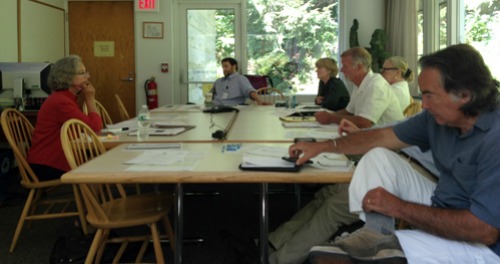
On Wednesday the committee decided to set up a subgroup to look into how the program could be adopted by the Legislature in the 2014 session. No decision has been made yet, but committee members spoke positively about adopting the new system.
“We’re certainly moving in that direction,” said Sen. Anthony Pollina, P/D-Washington, who sits on the committee. “And we certainly have to think differently about the budget.”
“Right now we’re told that there is so many dollars to be spent and everybody wants them, but there is never enough time and not enough focus on whether or not the money is spent wisely,” Pollina said.
The RBA program starts with ends and works back to means by asking questions: What do we want? How will we recognize it? What will it take to get there? Before extending funding to programs, legislators should ask: How much did we do? How well are we doing it? Is anyone better off?
Lezak says that even if some legislators know how to ask such questions, advocates don’t know how to answer them, and that’s why part of her organization’s goal is to also educate the nonprofits.
At the committee meeting Wednesday Lezak proposed that the Legislature should use RBA to set legislative practices, make funding decisions and track progress on high-level goals.
Lezak uses the education committees as an example. They face issues such as preschool funding, technology funding, high school graduation requirements and how to educate students who are juggling school and parenting. People with all sorts of agendas come and argue their cases. The legislators should be trying to determine what is the best investment and what is best for the students. But even if they ask the right questions, the nonprofits don’t know how to answer them, said Lezak.
Members of the Government Accountability Committee nodded in recognition as Lezak explained the complex scenarios that lawmakers deal with.
“We can increase the number of kids getting science education or we have can add more preschools, but what really matters and what we don’t have data on is how are kids in their preschools better off?” Lezak said.
“It’s about asking questions,” she said. “We want to know what percent of those kids are at kindergarten readiness levels and what percentage of those kids have developed social skills that allow them to make friends.”
What tends to happen is that the legislators fund what’s already been funded, they go with the latest fad or are touched by some big news, like a school shooting, and make decisions even if there is not enough information available, Lezak said.
“We feel that we have a responsibility and great potential role to offer this training to all the different levels,” she said. “To state officials, to nonprofits, to the Legislature and to the philanthropic community so that they can all work together and have some consistent measures.”
Rep. Tristan Toleno, D-Brattleboro, also proposed that nonprofits that receive government money should be required to have RBA training.
There is no budget set for RBA training for the Legislature, but members of the committee don’t think it would need much.
“It is not a very big project, two trainers or so would be enough,” Lezak said.
“We would not take funding for us as legislators for using this model, but what it would take is us legislators to set some time aside for everybody to learn it, to understand it,” said Pollina.
“It’s culture change more than anything,” said Toleno. “It’s less about a budget right now, and more about getting people to understand what this is and what it can do for the state.”
The Government Accountability Committee agreed that in order to learn the RBA method, the committees need real life exercises.
“If we’re trying to get this out to all of the committees,” said Rep. Anne O’Brien, co-chair of the Government Accountability Committee, “it’s not going to be an easy task.”
“We would have to practice, practice, practice,” Toleno added.
