


Controversy on Capitol Hill this week shined a national spotlight on one of Vermont Sen. Patrick Leahy’s signature economic development initiatives — a program that plays a key role in Vermont’s business strategy.
Monday, the Department of Homeland Security Office of the Inspector General revealed to a lawmaker an ongoing investigation into Alejandro Mayorkas. The director of U.S. Citizenship and Immigration Services is President Barack Obama’s nominee to fill the No. 2 position at the Department of Homeland Security.

Mayorkas, a tip from an FBI analyst alleged, had helped secure approval for a visa for someone whose application had previously been denied once, then again on appeal. The visa application was filed through the federal Immigrant Investor Program, also called “EB-5” for the type of visa it affords.
Further allegations implicated Mayorkas in mismanagement of the EB-5 program, and extended to other USCIS officials suspected of obstructing a program audit by the Securities and Exchange Commission.
In a letter to a staffer for Sen. Chuck Grassley (R-Iowa), the Inspector General’s Office indicated that the preliminary investigation had found no criminal activity, but it also referenced a separate, ongoing audit of the EB-5 program that was in its “final stages.”
Leahy is in the process of pushing Congress to make EB-5 permanent after 20 years in a pilot stage. The program — until Monday — had remained fairly obscure by national standards, despite a recent spike in use. But in Vermont, EB-5 plays a prominent role.
Concerns and counter-accusations
For Grassley and other Republicans who have responded most strongly to news of the Mayorkas investigation, the allegations underlie potential national security risks.
Some FBI facilities had been constructed, at least in part, using EB-5 funding from Chinese investors. One Chinese technology company suspected of espionage had applied for EB-5 status. And if a high-ranking immigration official was suspected of skirting visa protocols for one applicant, it follows that a similar breach could have occurred with others.
But many observers dismissed the controversy as optimally timed political shenanigans.
Not only would allegations against Mayorkas potentially freeze his confirmation hearing for the Homeland Security post, but the specific visa he was accused of finagling happened to be for a client of Anthony Rodham, brother of former Secretary of State and potential 2016 presidential candidate Hillary Rodham Clinton. And the business to which that investor wanted to give money was a firm associated with former Democratic National Committee chairman Terry McAuliffe, a candidate in Virginia’s high-profile gubernatorial race.
Leahy’s spokesman David Carle said it’s highly unusual for an inspector general to publicize the nature of an investigation before it’s complete.
The timing of the leak about the investigation — just days before Mayorkas was to receive a Senate confirmation hearing for his Homeland Security nomination — heightened some sources’ suspicions that the allegations were politically motivated.
Mayorkas did get a hearing Thursday with the Senate Homeland Security and Governmental Affairs Committee, as scheduled. Not a single Republican senator attended, however. Sen. Tom Coburn (R-Okla.) helped lead a Republican boycott in protest, on the principle that a hearing should not be conducted for a man under investigation.
The Inspector General’s Office did not respond to a press inquiry, and Leahy’s office said he would not issue a statement about an ongoing investigation.
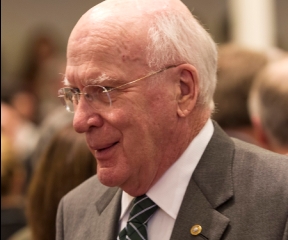
Carle, the spokesman for Leahy, did say, however, “Congress is moving forward on EB-5 reforms to improve oversight and administration of the program.”
Leahy’s proposal to make the Immigrant Investor Program permanent, along with new anti-fraud and oversight measures, is tied to the comprehensive immigration reform bill currently making its way through Congress. The program was initially approved for a 10-year period, and since then has undergone reauthorization every three years.
Immigrant investment in Vermont
Vermont’s EB-5 director, Brent Raymond, said he’s already seen improvements to the federal program in Mayorkas’ short time at the helm of the state-run regional center.
Vermont’s EB-5 program is designed to be a significant gear in the state’s economic development engine. Nearly the entire state qualifies for EB-5 investment — a process whereby immigrants can earn green cards by investing $500,000 in American businesses, so long as the investment creates at least 10 jobs in two years.
A set of ongoing projects in the Northeast Kingdom is estimated to draw $600 million in foreign investment to the business plans of Jay Peak ski resort owners Bill Stenger and Ariel Quiros. The two plan to expand operations at Burke Mountain, another ski resort they recently acquired, and develop a biomedical research park, a waterfront hotel and conference center and a mixed-use block near the Canadian border in Newport, Vt.
EB-5 also is a point of pride for Vermont, which is the only state government that wholly operates the investment program; most are run by private investment firms. Leahy often points out that Vermont’s EB-5 Regional Center is a “gold standard” nationwide.
That’s not to say its been without its kinks. The Vermont EB-5 Regional Center this spring repealed its earlier approval for a resort-style retirement development, over concerns that some of the information in the application could not be verified.
The strength of recipient investment businesses, Raymond explained, is crucial to the program’s overall success. Visa applications from immigrant investors can be denied not just for personal reasons, such as suspicion of criminal activity or affiliation with the Communist Party. The businesses in which immigrants invest also must be legitimate and poised for success.
Raymond said his office vets the businesses in Vermont’s EB-5 program, but the federal immigration office has final say over whether the investments are credible and conform to all requirements. The business plans are reviewed not just once, but every time an immigrant applies for a visa on the basis of investing in that business.
In the past, these reviews have been less than consistent.
“You could have 10 investors approved for the same project, but the 11th might not be,” Raymond said. “Not because of anything about the individual as a national security threat, or funds obtained through criminal activity. But all of the sudden somebody’s questioning something … about the business plan that previously had been fine.”
Raymond said he’s pleased that the review process — which he considers EB-5’s most significant, because it affects not just the investor but also the investment projects — has been streamlined under Mayorkas’s tenure. The reviews have become “more predictable,” he said.
It’s that type of progress, and further improvements Raymond believes will come from Leahy’s proposals, that leave him feeling confident in the program’s future, despite the current controversy surrounding it.
“I think for EB-5 and the Vermont Regional Center, long term it will have no effect on the program,” he said.
The fate of Leahy’s EB-5 amendments on the immigration reform bill, however, remains to be seen. The EB-5 program was last reauthorized in September 2012, leaving a little more than two years before it would expire or come up for another approval.
