

This story and the following interview with Michael Hastings were first published in Vermont Business Magazine.
Former Vermonter and award winning journalist Michael Hastings, 33, died early Tuesday morning in a car accident in Los Angeles. According to the LA Times, the coroner was not immediately able to identify the body as Hastings, but did so Thursday through his fingerprints. Cause of the accident is under investigation. His employer, BuzzFeed, announced his death Tuesday. Hastings had opened BuzzFeed’s LA office just last fall.
Hastings was a Rice Memorial High School grad who gained prominence as a journalist for his coverage of the wars in Iraq and Afghanistan. At 25, he was assigned to Iraq as a reporter for Newsweek. Hastings wrote a well-received book about the death of his girlfriend in Iraq in 2007 and in 2010 wrote a piece for Rolling Stone about General Stanley McChrystal. McChrystal’s criticism of the president and the Obama Administration over the war in Afghanistan led to the general’s dismissal. Hastings’ reporting began a string of unflattering news reports about the military, which until then had enjoyed a cozy relationship with the national media from the days of the first Iraq war. Those reports include the demise of CIA Director and former General David Petraeus and the ongoing rape scandal within the US Army.
Hastings was born January 28, 1980, in Malone, N.Y. He graduated from New York University in 2002. Hastings is survived by his wife, Elise Jordan.
An obit in Friday’s Burlington Free Press said his parents live in Milton and that, “A celebration of his life will be held, where his family will greet friends, on Sunday, June 23, 2013, from noon to 2 pm in the Minor Funeral and Cremation Center, Route 7, in Milton, with a prayer service offered by Mike’s uncle, Father Dennis Mahon at 2 pm. Immediately following will be a reception at the Eagle’s Club on Bombardier Road in Milton. Online condolences may be made at www.minorfh.com.”
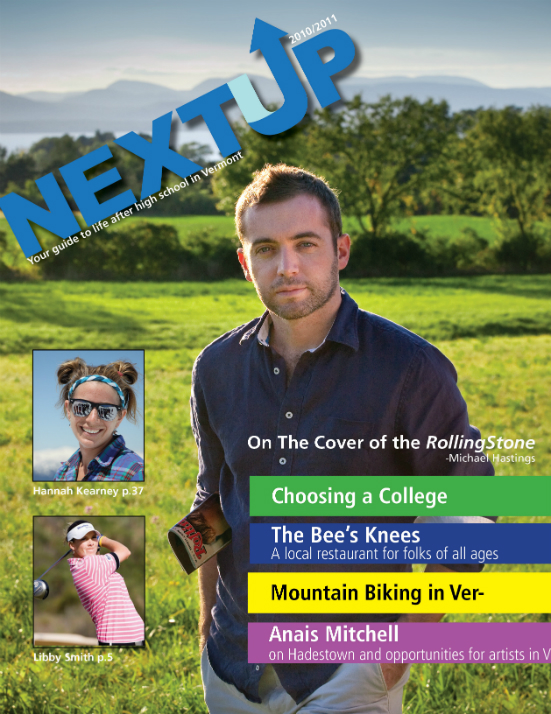
In the summer of 2010, Hastings was living in Burlington and agreed to sit down with Casey Hurlburt for an interview for NextUp, an annual magazine for Vermont high school students (and an imprint of Vermont Business Magazine). The full interview is below.
An earlier version of this story indicated that Hastings was born in Vermont. He was not.
***
Vermonter Michael Hastings, on the cover of the Rolling Stone
Story by Casey Hurlburt, Editor. Photo by Glenn Moody. Cover design by Kayla Mellen, Vermont Business Magazine.
Michael Hastings is the author of the Rolling Stone article titled “The Runaway General,” which prompted General Stanley McChrystal to lose his position as Commander of US Forces Afghanistan. The controversial article has also brought about a wide variety of responses from the media, ranging from praise to disparagement.
Hastings does not remember a time when he was not interested in the news, and he traces his journalistic beginnings back to the day when General Norman Schwarzkopf was to give a press conference at the beginning of the Gulf War in 1990, when Hastings was in fifth grade. Instead of going to Phys Ed, he asked his teachers if he could watch the press conference, “So I was sitting alone in the classroom taking notes on the Gulf War while the rest of my classmates were in gym class,” he recollected.
He also has a bit of a record getting on the bad side of authority figures. He went to two different high schools. In the first high school he went to, he had a column where he was “very critical of the high school’s administration, which annoyed the headmaster,” he said.
In 1997, he moved to Vermont as a junior in high school. He went to Rice Memorial High School in South Burlington, where he was banned from the school newspaper, “because” he said, “I compared the principal to, I think I said he looked like Jabba the Hut – which was true – but that did not endear me to them.” At the end of his junior year, he ran for class president, and won, on an anti-administrative platform, “which didn’t sit well with Jabba the Hut,” he laughingly recalled, “But they couldn’t stop it, they can’t stop democracy,” he added.
Everything was going well until one day; about six months after Austin Powers first came out, he was advertising over the intercom “for Roses, or some sort of Valentine’s Day thing.” He said of the product, “This sounds pretty shagadelic.” He explained that this was before Austin Powers had become main stream, and so the word was not part of the vernacular yet, “This sent shock waves through the school… the school launched an investigation on the meaning of shagadelic. This is Rice, a Catholic school” He was called into the vice principal’s office.
“There’s a pattern here establishing throughout my life,” he said, smiling. “I was impeached. It was more like a coup than an impeachment, really, because there was no actual trial.”
He was suspended and banned from student council.
“That was actually quite devastating to me at the time. I learned a valuable lesson… choose your battles wisely.”
Despite getting into a little trouble, his memories of Rice are fond, “Rice is a great school. I like picking on it, but it is a really great school – great teachers there. It’s a wonderful school and I’m really glad I went there.” He played sports – lacrosse and soccer – and he also performed in school plays. Among his favorite teachers, Mike Paro, who taught contemporary history, stands out to him, “Mr Paro was one of those guys that you really look back on. He made us read Newsweek. He pushed us. I was always interested in that stuff, but he encouraged the news. And he came to a book reading I had here.”
Hastings also added that he was supposed to go on a trip to Venezuela with Mr Paro his senior year of high school, but was banned from that as well.
“That was painful,” he recalled, “and it was all in the wake of the shagadelic incident. It’s like something out of Glee, some ridiculous kind of high school drama.”
After high school, Hastings got a job working for Scholastic magazine, an educational magazine for young adults. Later, in his last year at NYU in 2002, he “was lucky enough,” as he put it, to get an internship at Newsweek.
“I realized, ‘Wow, journalism is a way to get paid to write. And that’s what I love to do.’ I figured any profession where I get to call interesting people up and talk to them and then write about it is a pretty good way to do things. I was very fortunate that that happened. I started as an unpaid intern.”
He received an email asking if anyone would like to work Friday and Saturday nights for free at Newsweek.
“I think I was the only one who actually responded. I wasn’t partying or anything at that point. So I started working Friday and Saturday nights at Newsweek for free,” he said, “and there was this heat wave that summer and my apartment didn’t have air conditioning, but the office did. So I was in the office a lot – and they mistook that for hard work and dedication.”
By the end of the summer, he had a temporary three-week contract, which continued to extend to a six-week, three-month, and one-year contract, until he was put on staff at Newsweek. After expressing quite a bit of interest in going overseas, he was finally appointed Baghdad correspondent. He eventually left Newsweek to write for other magazines, a risk that he felt was important for him to take.
“I had a great run at Newsweek. It’s where I learned how to be a professional writer and journalist. I loved the place. But sometimes you have to move on and try something different.”
As a journalist, Hastings travels a lot, “Over the past year I’ve probably been overseas half the time, maybe more,” he said. “On the one hand it’s great because you get to go to really interesting places, but on the other hand, some of the places you go to are not the nicest places in the world to visit… it can certainly have its toll, and take a sort of emotional impact.”
He says leaving Vermont is one of the hardest things about traveling.
“This is the problem with the traveling. Once you’re in Vermont you don’t want to leave. It’s hard to give up Lake Champlain and boating to go be in 130 degree heat in Southern Afghanistan where people are trying to, you know, kill you.” But while he admits that leaving Vermont is difficult, he acknowledges his privilege as a journalist.
“As a journalist, I get to leave. I get to go and leave and that’s a very privileged position to be in. Whether it’s the Vermont National Guard, the soldiers who are over there on a 12-month deployment – who are over there right now – they don’t get to leave when they want. Or if you’re a soldier in the Afghan army, or an Afghan civilian who lives there. These people who have to live in these war zones and are there under orders – they don’t get the luxury to stay for a month or two or three, then go to Dubai, and then go back to Vermont.”
“It is tough to leave Vermont. That is one of the big challenges. At first you are so excited, then the more experience you get, you realize how special and precious peace is; not only peace and quiet but just living in a stable society where you can drive down the road and people aren’t trying to kidnap you and blow you up. And Vermont qualifies as a stable society… I highly recommend Vermont.”
Hastings’ favorite place in Vermont?
“Well, I don’t know if I should say because it’s such a cool place, sort of undiscovered. On Lake Champlain, in Milton, is, I think, the greatest undiscovered gem in all of Vermont. Grand Isle and North Hero and all those places are really cool, but if you are on the lake in Milton… I like all parts of Vermont, but my favorite spot is Milton. I’m for the Milton renaissance.”
So it isn’t too surprising that the kid who had a history of telling it like it is and bumping heads with administration in high school became the young professional journalist who “turned the news and American politics and the war effort upside down,” according to Rachel Maddow of MSNBC the day after his article on Stanley McChrystal was published in Rolling Stone. Only this time, instead of being punished by the administration, the administration changed.
His article received a wide spectrum of reviews by fellow journalists. Some accused him of breaking the rules, some criticized his ability to portray McChrystal accurately, some said he revealed problems and tensions in American politics, and one praised him as one of the only journalists left in existence.
Hastings views the impact of his article with a sort of “being in the right place at the right time” mentality. There is no doubt that he put time and research into his back story, but as he put it, “Like they say in NASCAR, you need to make your own luck.”
He said, “People have said this stuff or written about it before, and it builds and builds and builds, and then there’s a story that all the sudden draws attention on these things, and at Rolling Stone you can do that in such a way that is a little more blunt.” He added, “But it also shows how sometimes the media narratives that get constructed are much more fragile than they appear.”
Hastings believes that his job as a journalist is to always question the conventional narrative, “What is the media narrative? Is it an accurate one? Is it worth while? How well does it stand up?”
He acknowledges that these narratives can change over night, as it did for General McChrystal. Hastings himself was surprised at the impact of his article.
“I knew the material was strong and I knew we had a pretty solid story. I imagine a lot. I have an active imagination, but I never would have imagined what happened. I didn’t think General McChrystal would be fired. I thought he was pretty secure in his job. I wasn’t alone, I don’t think. That was the conventional wisdom – that he was pretty secure in his position. That conventional wisdom changed within 48 hours.”
A week after Michael Hastings’ article appeared in Rolling Stone, John Pilger, investigative journalist and documentary film maker, was interviewed on DemocracyNow! He responded to a critical comment that Lara Logan, Chief correspondent of foreign affairs for CBS, made during an interview, “Michael Hastings has never served his country the way McChrystal has.”
Pilger’s response: “Michael Hastings is serving his country. This country tells the rest of the world about its magnificent beginning, about its magnificent Constitution, about its magnificent freedoms. At the heart of those freedoms is the freedom of speech – and the freedom of journalism. That is serving your country. That is serving humanity… Hastings has proved – God bless him – that journalists still exist.”
When asked what advice Hastings had for high school students, he said, “My advice is clichéd and it’s simple: do what you love to do… No matter what job you end up having, or profession you’re in, or anything in your life, you’re not going to please everybody. It’s impossible, anyway, especially if you’re taking risks and doing things that are not considered conventional or are a little different than what other people are doing. You’re going to expose yourself to a lot of criticism. But at the end of the day, as long as you know the motivations for what you are doing, and that those motivations are good and honest and have integrity, then I think it’s worthwhile to do.”
