

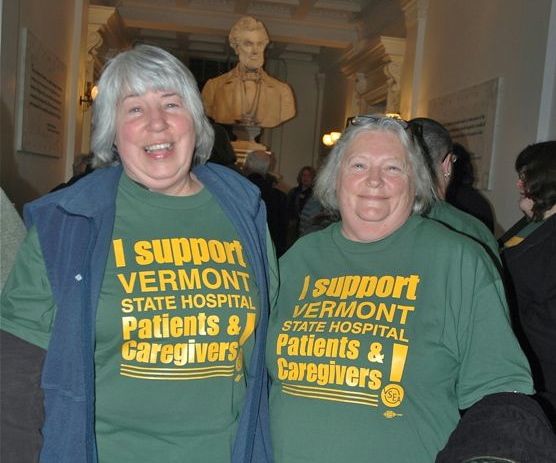
Members of the public gave input to lawmakers on a bill that would levy fees on non-union members for the services they receive from unions.
The Senate passed the so-called “fair-share” bill, S.14, by a 24-5 vote in early February. It’s now in the hands of the House Committee on General, Housing and Military Affairs.
The committee chair, Rep. Helen Head, D-South Burlington, said members planned Thursday’s public hearing in response to a deluge of requests from people who wanted to weigh in.
“We heard from a number of people in committee who wanted to be heard and we realized given the time available to us to work on this and other Senate bills that we really needed to give people a public hearing to give people an opportunity to come out. It’s just the most efficient way of hearing from people.”
If S.14 becomes law, it would require 2,100 teachers and school support staff, 542 state employees, and 31 municipal employees to pay a fee to unions. The amount is capped at 85 percent of union dues. This would cover union services that nonmembers receive, including collective bargaining and grievance representation.
Supporters of S.14 say it’s a matter of principle that nonunion members should pay and not get a free ride. Those against the bill—the Vermont School Boards Association is among them— say it unjustly compels nonunion members to support an entity they’ve chosen not to join.
Members of the state’s two most prominent unions, the Vermont State Employees Association (VSEA) and the Vermont National Education Association (NEA), comprised the bulk of the crowd Thursday, giving a long string of speeches in favor of the bill.
Nearly everyone who testified—both opponents and proponents of S.14— was a longtime state or school employee.
Union members summoned metaphors, from potlucks to public radio, to explain why they felt their nonunion coworkers were obligated to pitch in to cover union costs. The phrase “one shouldn’t get something for nothing” was cited at regular intervals.
The cast of S.14 supporters included Jay Hoffman, the 2013 teacher of the year, who asked the committee to “help me model for my students what is right and what is fair” and the 2013 Education Support Professional of the year, who said she advocates for union and nonunion members alike, but she thinks the latter ought to be pitching in for the service.
A handful of the people opposed to S.14 brought the committee’s attention to the plight of about 500 state employees, who were explicitly exempted from agency fees in a 1998 contract, but would now once again be subjected to the fees.
Ray Danis, a state employee of 16 years, said unions “are constantly preaching about being fair, but what they are doing is not fair.” Danis and others suggested the Legislature would be reneging on the terms of this agreement if it passes S.14.
Sherry Martin, a state employee for 17 years, urged the committee to vote against the bill, arguing that the agency fees are “equivalent to extortion.”
Union members countered that these state employees had lucked out in getting a “free ride for the last 15 years.”
When asked about her reaction to the testimony, Head replied, “We heard some strong arguments tonight in favor of the fair share agency fee from Vermont state workers as well as our school workers.” Head said the committee wasn’t leaning one way or another right now—they still have more testimony to hear over the next several days— but she expects they will vote on the bill sometime next week.
