


Editor’s note: This story by Sarah Brubeck was first published in the Valley News.
HANOVER, N.H. — When C. Everett Koop wrapped up his tenure as the surgeon general, he had his pick of academic institutions to settle into. But he chose Dartmouth College, where he once fell in love with the region’s mountains, skiing and his first wife, Betty.
Throughout his career as a pediatric surgeon, and later during his service as the U.S. government’s top medical officer in the 1980s, Koop always came back to the Upper Valley, where he kept a vacation home in Etna and where two of his sons eventually raised their families.
Koop would later attribute his career path to decisions he first made as a Dartmouth student more than 70 years go.
“I can’t imagine that any incoming Dartmouth freshman prepared with greater enthusiasm than I did,” he wrote in Koop, his 1991 autobiography. “I knew every Dartmouth song as well as those of the other Ivy League schools.”
Koop died in Hanover yesterday at the age of 96. He had been in declining health for several months and suffered kidney failure last week, said Lester Gibbs, Koop’s personal aide.
At Dartmouth he earned the nickname “Chick,” and played on the football team, where he received a head blow that damaged his vision which required him to wear glasses the rest of his life.
After stepping down as surgeon general, Koop’s two sons, Allen and Norman, urged their father to leave Washington and return to the Upper Valley.
Joe O’Donnell, a senior scholar at Dartmouth’s C. Everett Koop Institute, had been admiring Koop’s career for years, and was encouraging Dartmouth medical students to take his cue and become involved in public service.
“When he came here, it was like I died and went to heaven,” O’Donnell said.
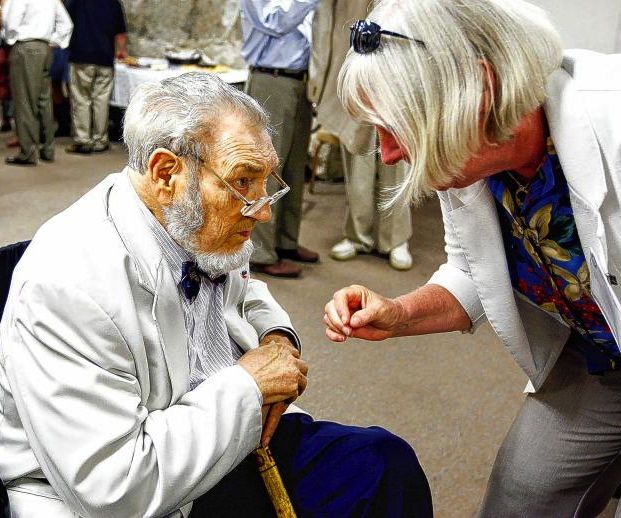
Toward the end of his life, Koop lived only a block from Dartmouth’s medical school and would still wear his trademark bow ties. (He had more than 100.)
Despite Koop’s stern face, Captain Ahab beard, natty bow ties and intimidating accomplishments, he was an approachable man, O’Donnell said, with a surprising sense of humor. O’Donnell related how Koop was once sitting on a plane when another passenger turned to him and remarked, “Has anyone ever told you that you look like Dr. Koop?”
“Yeah, all the time,” Koop responded with a straight face.
Another time in Hanover, Koop approached the medical school and motioned to a group of students sitting outside. He challenged them to figure out what was wrong with him as he walked to his car with a limp, according to O’Donnell.
The medical students looked frazzled as they tried to solve a problem presented by an authority many called “America’s family doctor.” But then Koop exclaimed to the puzzled aspiring doctors that he was suffering from only a blister, and laughed.
While at Dartmouth, he taught a number of classes and lectures and always made time for office hours with students.
“He thought young people were the future and making time for them was really important,” O’Donnell said. “When you were with him, you felt like he was paying full attention to you.”
Koop was always concerned about educating the next generation of health professionals, and the medical school is steadily working to include Koop’s lessons into its curriculum, O’Donnell said.
Those lessons, or “Koopisms” as O’Donnell calls them, typically encompass the large public health stances Koop took while surgeon general, such as his campaign against tobacco use and his advocacy on behalf of patients with AIDS.
Koop was also a strong believer in building trust during a physical exam and relying on a “physical diagnosis,” meaning that doctors rely on their hands, ears and nose instead of only using the latest high-tech equipment to examine a patient.
“I never could have envisioned restaurants in New York City banning smoking — or a diner in Colebrook, New Hampshire, not having ashtrays on the tables,” Koop once told the Dartmouth Alumni Magazine.
He was also a senior scholar at the C. Everett Koop Institute at Dartmouth, a think tank that promotes education and research around the art of medicine. The institute supports an annual anti-tobacco conference and convenes the leading authorities in medicine.
Religious faith also turned out to play an important role for a man who had dedicated his life to science.
After his son, David Koop died in a mountaineering accident in 1968 in New Hampshire while a student at Dartmouth, his entire family turned to faith for consolation and healing, said his son Norman Koop, who is now a minister at the First Congregational Church in Woodstock. Both of Koop’s sons are ministers, as well as a grandchild.
In the Upper Valley, he loved the AVA Gallery in Lebanon, where his collection of political cartoons were once on display. The gallery is where he had his 95th birthday.
He grew so close with his personal assistant of 10 years, Mary Beth Albright, that he escorted her down the aisle during her wedding. And when Koop learned that Albright’s fiance had never been to New Hampshire, her boss was flabbergasted: Koop scheduled a trip and drove the couple around the White Mountains, where they stopped to sample maple syrup.
“He wanted to make sure Craig understood the beauty of New Hampshire,” Albright said.
Koop also became great friends with Woodie Kessel, who was working as an assistant surgeon general when Koop moved to Washington. Kessel was from Philadelphia, where Koop had previously spent much of his career as a pediatric surgeon, and they shared a fondness for the city’s famous cheese steaks and hoagies.
When the duo walked down the streets of Philadelphia, Koop was treated like a celebrity — passersby would recognize him, shake his hand and ask for a photo, Kessel recalled. The person shaking his hand would thank the doctor for operating on him and saving his life.
“Sometimes in medicine you lose track of the ultimate outcomes, but he would stop and was always generous with his time,” Kessel said.
Toward the end of his life, Koop lived only a block from Dartmouth’s medical school and would still wear his trademark bow ties. (He had more than 100 of them, Gibbs said.)
There was always a constant stream of letters from former patients thanking Koop for a surgery he performed in their childhood. A medical student once told him that his grandparents stopped smoking as a result of Koop’s constant warnings.
It was the kind of outcome Koop had hoped for, even if he didn’t always expect it.
“I never could have envisioned restaurants in New York City banning smoking — or a diner in Colebrook, New Hampshire, not having ashtrays on the tables,” Koop once told the Dartmouth Alumni Magazine.
Funeral arrangements are planned for 10:30 a.m. March 9 at the First Congregational Church in Woodstock.
Sarah Brubeck can be reached at sbrubeck@vnews.com or 603-727-3223.
