

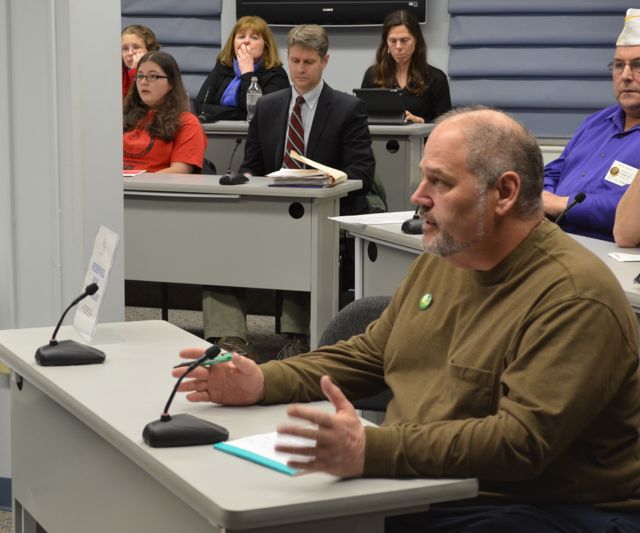
Two hundred and twenty-nine Vermonters tuned into a teleconference last night to give feedback to lawmakers on the state’s 2014 budget. Many were single mothers, veterans, or people with disabilities who called on the legislators to carve out more financial support for them than Gov. Peter Shumlin had allotted in his budget proposal. Dozens of them spoke out against Shumlin’s proposal to reduce the state’s Earned Income Tax Credit and limit Reach Up benefits for families.
The House and Senate Appropriations committees orchestrated the conference from 13 Vermont Interactive Television sites throughout the state. A law passed last year requires that public input be sought during the budget formulation.
The majority of the two minute testimonies came from members of the Vermont Workers’ Center — a key backer of the legislation that established the more transparent budgeting process — and the refrain most likely to have been ringing in lawmakers’ ears afterwards was, “Put people first.” The simple-sounding demand is also the name of a campaign, organized by the Vermont Workers’ Center, to push the Legislature to provide adequate health care, education, housing, and employment for low-income people.
The Put People First members — many of them single mothers dependent on Reach Up — offered lawmakers a sobering picture of how they would fare if their welfare assistance were to be terminated after five years. Shumlin’s budget proposal calls for cutting off Reach Up benefits after three years and then allowing them to resume for two additional non-consecutive years, before terminating the assistance completely.
A single mother named Colleen living in Bennington said Reach Up was “instrumental” in helping her get a job after she was disabled from a car accident. “It would be shame to take away that chance for others in similar situations,” she said.
A single mother from St. Johnsbury with two boys and twins on the way said the Reach Up benefits are “absolutely necessary for me to support my family” and the proposed time limits would “break my family apart.” “How will I buy diapers, how will I pay my light bill or my phone bill or my rent?” she asked.
Michelle Rock, an employee at BROC Community Action, which works with the Reach Up program to address poverty issues in southwest Vermont, said some Reach Up participants need time to get their lives in order. “Herding them into one container and cutting off their life supply isn’t going to save money if they are just not yet ready to get to market.” She predicted that many of these Reach Up participants will end up homeless. “As a society, we can’t throw children on the street, so there must be some shuffling of money that going to protect them somewhere.”
Put People First members also asked lawmakers to reject Shumlin’s proposal to use two-thirds of the state’s Earned Income Tax Credit to fund an expansion of the child-care subsidy program. A man named Tim testifying from Randolph called the plan a “deceptive, shallow, quick fix.”
A single mother with more than $58,000 in student loans asked lawmakers to set up a college loan forgiveness program. Others asked legislators to make sure Vermont’s health care does more to cover co-pays for low-income Vermonters. They reminded lawmakers that legislation passed last year, require that “The state budget should be designed to address the needs of the people of Vermont in a way that advances human dignity and equity.”
Several individuals with disabilities and parents of disabled people asked lawmakers to sufficiently fund developmental services.
A handful of American Legion members sought to dissuade the Appropriations committees from following through on Shumlin’s proposal to put a 10 percent excise tax on “break-open tickets.” The veterans, each wearing a cap conspicuously marked with the Legion insignia, recited long lists of the charitable causes that, they said, will suffer in the wake of such a task. Ed Brown, a member of the American Legion in White River Junction, contested the Shumlin administration’s claim that the ticket proceeds are illegally diverted rather than donated to charities. “Every penny of that … goes to charities,” Brown said, and he rattled off a number of causes — scholarships, housing homeless veterans, maintaining cemeteries — that that he said would be endangered by the new tax.
A deaf and blind man testifying from Montpelier had a succinct and straightforward request: he said blind and deaf people had been put in a bind after it was discovered in December that federal grants could not be used to provide direct services like a one-on-one attendant who can communicate in sign language. “We need some support,” he said. Legislators could fill that gap and provide those services with an appropriation of $60,000, according to his calculation.
Dave Belllini, a state employee in Montpelier, strayed from the dominant pattern of testimony and offered lawmakers a suggestion for saving money rather than a request for spending it. Convert 25 to 50 of the temporary positions hired in the Corrections Department to permanent positions, and the state could save millions of dollars in turnover and overtimes hours, he said. Bellini described a system in which temporary workers aren’t compensated enough and quit, forcing other workers to work overtime. “This is a vicious cycle and, frankly, it’s stupid,” he said.
