

The state began construction on a seven-bed psychiatric facility in Middlesex this week despite a pending appeal of its zoning permit.
The residential facility is part of the state’s mental health overhaul, started after Tropical Storm Irene destroyed the state’s 54-bed psychiatric hospital in Waterbury. Since then, state officials have scrambled to find open beds to treat psychiatric patients, and they say the facility is meant to temporarily meet patient needs until a permanent fix is found.
The sooner the facility is available for patients, say mental health officials, the more money it will save the state and taxpayers. It costs $1,500 a day to house the kind of low-risk patients who would be treated in Middlesex in acute care hospitals.
Director of Mental Health Services Frank Reed is overseeing the planning of the residential facility in Middlesex. He said that the state estimates the new facility will save the state roughly $500 a day per patient. That figure includes construction and operational costs.
Brian Hannon, who is appealing the zoning permit for fear that the facility’s patients might pose a threat to his children, lives next to the site of the facility. Earlier this week, he received a letter from the state. “About a half hour later they started to do what they’re going to do,” he said.
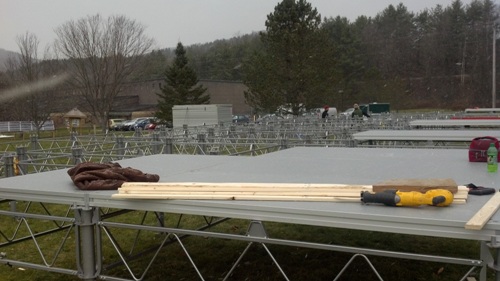
On Thursday afternoon, the state began moving the modular units into place next to the Middlesex State Police Barracks. Construction is slated for completion in mid-January and state officials hope to have the facility up and running by early spring.
The reason the state is able to push forward with the project is that the permit issued by the Middlesex Zoning Board of Adjustments is now valid.
Hannon and his lawyer could have motioned to “stay,” or make the permit invalid, during the appeal process, but they didn’t file a motion during the allotted window. After 15 days, Vermont statute allows such permits to take effect if no motion to stay has been approved. For that reason, the state has a valid permit to proceed with the project.
A pre-trial conference between Hannon and the state is slated for Dec. 10 in the Vermont Superior Court Environmental Division.
Jeff Lively, who is the legal counsel for the Vermont Department of Buildings and General Services, said that the state would ask for an expedited trial. The court will treat the appeal like a fresh case, and Lively is optimistic that the state will receive the same permit it received from the zoning board, or at least one very similar in nature.
Last week, Charles Merriman, the Middlesex zoning board chair and a Montpelier lawyer, said that the facility slated for the state’s land safely met the necessary criteria to be permitted.
Lively said on Thursday that although there’s a chance that the environmental court could impose new conditions — like extra fencing, a tree barrier or other measures — the state cannot afford to wait to begin building.
“The state does do a cost-benefit analysis and we weigh all of these policy decisions and impacts, and, of course, we don’t take lightly spending taxpayer money we don’t need to spend,” he said. “Our hope and belief is that this permit will be approved as is.
“If it isn’t, and there are additional conditions, we believe they’ll be reasonable and relatively inexpensive alterations. When you weigh that against the costs we’re incurring every day, for sure, it made sense for us to move forward.”
Mary Moulton, who is taking over as commissioner of the Department of Mental Health, said the decision would help relieve some of the financial and infrastructural stress on the state’s mental health system.
“There’s no doubt that it’s extremely important to move ahead,” said Moulton. “We continue to have pressure in the system based on a lack of inpatient hospital beds and we do have patients that just don’t need that level of higher acuity care.”
Patients who are on the cusp of moving back into communities will be treated at the Middlesex facility, Moulton said.
On Thursday afternoon, Hannon did not share the state’s enthusiasm.
“I told them in the zoning board meeting that I was going to be forced to move, and I wasn’t kidding,” he said. “That’s still how I feel.”

