


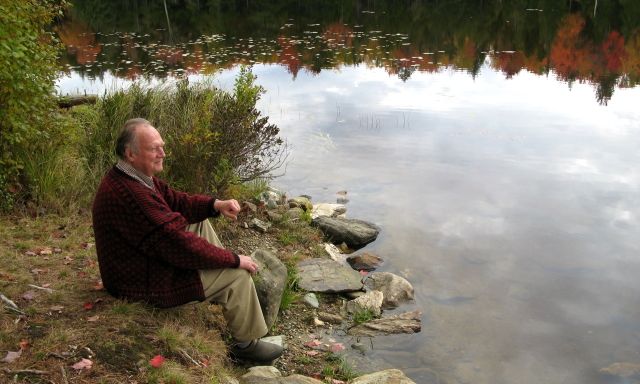
Now 74, Dr. Steve Young’s academic interests led him to travel all over the northern regions and become a seminal thinker and writer about northern studies, which has become an important research field in no small part due to his efforts. Photo by Tom Slayton
In This State is a syndicated weekly column about Vermont’s innovators, people, ideas and places. Details are at http://www.maplecornermedia.com/inthisstate/. This article is by Tom Slayton, a Montpelier freelance writer and editor emeritus of Vermont Life magazine.
Steve Young’s interest in science began early in his life.
“When I was a kid, I was interested in archaeology, but everyone told me that I couldn’t make a living at that,” Young recalls. “So I became a botanist — and discovered that you can’t make a living at that, either!”
Nevertheless, Young has done all right for himself. Founder of the Center for Northern Studies more than 30 years ago, he is a highly educated, widely respected botanist and anthropologist whose work spans the northern regions of the globe. He knows as much about the life of the far north as almost anybody, his botanical research taking him to Alaska, Siberia, northern Mongolia, and the Aleutian Islands.
Throughout the years, he has become a leading international authority on his research specialty, paleoecology, a study of how plants and humans have recovered from the last disastrous episode of climate change suffered by the planet – the ice ages some 10,000 to 14,000 years ago.
Now semi-retired at 74, Young thinks globally and botanizes locally. A large and vigorous man with a florid face and an easy smile, he is gentle and self-effacing, with a wry sense of humor. He clearly loves walking the 100 or so acres of woodland he owns near his home, keeping in touch with the lives of the trees and plants that are his neighbors there.
The land is chilly and acidic, not much good for farming, but very good for anyone interested in the plant life of the north – which Young has been, his entire life.
As a youth, he became interested in Labrador and other northern places. And so he shaped his college career, both undergraduate and graduate, around those interests. He has biology degrees from Middlebury College and the University of Alaska Fairbanks. He received his Ph.D. from Harvard, specializing in the flora of the Bering Strait region, where he lived on St. Lawrence Island, studying the plants there.
Most Vermonters will know of him from the Center for Northern Studies, which he founded in 1977. It educated students in Wolcott for several years, then moved to Middlebury College, and finally went to Sterling College in Craftsbury, where it failed to attract enough students to survive. He is now serving as adviser to a new Center for Circumpolar Studies, but has largely retired from academic duties.
That extended and interesting career has led him to his main work these days, which is the book he is working on. The subject is paleoecology and the working title is “Ice Age and Stone Age.” It will be a study of the history and changing methods of study in that highly specialized field.
When Young began his career, northern studies hardly existed as a discipline at all. Serious archaeology was classical archaeology: Greeks, Romans, Egyptians and so on. Many scientists felt that the northern regions of the globe were inhabited by – well – uninteresting barbarians.
Steve Young was one of the people who helped change that misconception. Today, study of the polar regions is as serious a science as archaeology in any other area of the world. He notes that the development of computer-based and Internet technology has revolutionized science in every field, including his, and gives an example: “They (paleo-archaeologists) dug an ancient tomb in Norway, and there they found a bronze pot with cremated human remains inside and wrapped in a fabric that they thought was linen.”
The archaeologists knew that the person who had been cremated was important, because the ashes were buried in an expensive bronze pot. But when they did a digital analysis of the fabric, they discovered it wasn’t linen – it was actually made of stinging nettle. Even more surprising was that the nettle fabric came from Austria – or the place we would today call Austria.
What the strange fabric suggested, thanks to the wonders of sophisticated tools that allow scientific fabric analysis, was that travel and trade, even over very long distances, flourished thousands of years ago.
“This incredible technology just kind of blows you away,” Young says. “About every week, something new shows up.”
Although his professional life has taken him, literally, to the far ends of the earth, Young’s anchor and home base has always been the 100 or so acres on which he lives in Wolcott. His affection for the property shows as he walks its trails and woods roads.
Bracken, hay-scented fern, mosses, and groundpine carpet the forest floor. A lone wolf-spruce rises darkly above the smaller trees and golden, frost-bitten ferns. The vegetation indicates that this is cold, infertile soil, very acidic.
“You can tell that this was pasture long ago, by that old spruce. It was a pasture tree.” Young says. “It must have been just miserable, farming here.”
A visitor asks Young about the groundpine’s scientific family name: Lycopodia, which translates as “wolf-foot.” Why are these ground-hugging clubmosses called that?
“Well, it helps to have a good imagination,” says Young, who, is a botanist and an expert on northern plant life.
Then, he steps off the path, begins looking at a particular spot of ragged mossy turf, and says, half to himself: “Let’s see if we can find that wolf’s paw …”
It’s obvious that he’s looking for a single, specific plant, one he has seen in this spot previously. “Here it is,” he says, and points down.
Sure enough, there is a groundpine, reaching upward for the light. It really does look vaguely like a tiny, furry-green paw. Nearby, Young points to another specimen of the same plant, which is raising aloft a delicate, branch that looks like a tiny tan-colored pitchfork. When Young brushes it with his fingers, tannish dust – spores—waft across the mossy ground. New groundpines are being created.
Young’s land borders Wolcott Pond, a largely undeveloped upland pond now fringed with colorful fall maples. Walking along woods roads, Young points out individual trees that he likes. He seems to be on a first-name basis with just about every tree on his property.
He has been coming back to the property ever since he was 10 years old, living in Connecticut. Eventually, he decided to make it his home. It might have been better for his academic career, he thinks, if he had moved to Alaska after earning his doctorate. But the ultra-conservative politics of that state turned him off, and the Wolcott land kept calling to him. “I felt right away that this place was where I ought to be,” Young says.
Despite its rugged nature, it is a pretty piece of woodland property, especially alongside the pond in fall. And there are always minor scientific mysteries to tease out. Sitting on a point of land that extends into Wolcott Pond, he points out a few lily pads.
“When I was a kid, only yellow water lilies grew here,” he says. Then later, a neighbor planted white-blossoming water lilies, and for awhile that’s all there were. “But every now and then, the yellow ones will fight back. It varies from year to year.”
Ever the scholar with an inquisitive mind, he says with a smile, “There’s probably a really good master’s thesis in that.”
