

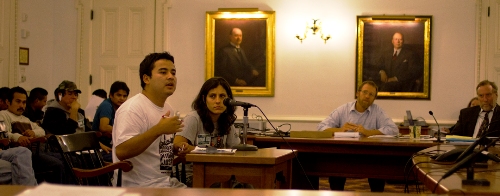
Can the state issue driver’s licenses to undocumented migrant workers without running afoul of state and federal laws? That was the question lawmakers, state officials and advocates wrestled with in a daylong session at the Statehouse.
Experts who testified on Wednesday said there are no legal obstacles to the proposal.
“The single message I have for you is that there is no impediment in federal law to getting this done,” said Dan Barrett, an ACLU-VT attorney. “The only question is whether or not we can fashion something within the parameters” required by the Department of Motor Vehicles and the Secretary of State’s office, he said.
A special legislative committee took testimony from a banking industry representative, national human rights groups and research nonprofits, a Secretary of State official, and Vermont farmers, the chief employers of the state’s more than 1,000 migrant workers.
In impassioned testimony, migrant worker Danilo Lopez said through a translator that without licenses, migrant workers were subjected to “modern slavery,” unable to travel for health care, groceries, or other errands in rural Vermont.
Five Vermont farmers also testified in favor of the licenses, saying that their hard-working employees deserved the dignity of easy mobility.

Representatives from the National Economic and Social Rights Initiative, a New York human rights group, presented legal research that underscored precedents in New Mexico and Washington in which neither federal law, nor issues over residency and identity, made for insurmountable challenges.
Elections chief Kathy Scheele, also saw no problem in principle with issuing driver’s licenses to undocumented workers, even amid concerns they could misuse the license to vote. So long as licenses clearly indicated that a driver isn’t a U.S. citizen and therefore couldn’t vote, she said, “I think we don’t have any problem.”
Vermont’s estimated 1,200 to 1,500 undocumented workers mostly work on dairy farms and have been lobbying for licenses for about 18 months now, according to Brendan O’Neill, a migrant rights advocate with Migrant Justice and committee member. Now they are trying to muster the political will to pass legislation, he said.
The Vermont Migrant Farmworkers Solidarity Group also succeeded in pressuring state law enforcement to adopt bias-free policing protocols a year ago after members of the group made formal complaints about racial profiling incidents.
Though there appear to be no regulatory and legal barriers, questions remain about how licenses for undocumented workers could increase identification fraud.
Chris D’Elia, the president of the Vermont Bankers Association, said Vermont banks prefer an alternative driver’s permit instead of official identification.
“The banking industry understands the need for migrant workers to have mobility … the question is: How do we get there without creating unintended consequences?” asked D’Elia.
Rob Ide, commissioner of the Department of Motor Vehicles, said the chief obstacle is preserving the integrity of Vermont’s license as a form of ID. He is concerned about migrant workers’ use of the Vermont ID in other states and for federal identification.
“We want to be absolutely sure that we do nothing to impact the integrity of the Vermont driver’s license as an identification instrument,” said Ide.
Andrew Meehan, a policy analyst for the Washington, D.C.-based Coalition for a Secure Driver’s License, warned of rising fraud in states where undocumented workers could easily apply for licenses.
“You’re going to essentially create a magnet for folks trying to obtain a license under a lesser [legal] standard,” said Meehan. “You have a large number of out-of-state applications, where people are presenting a minimum amount of documents to obtain a driver’s license.” Meehan cited New Mexico as a state with massive levels of driver’s license fraud.
He said Tennessee and Maryland stopped issuing driver’s licenses to undocumented immigrants after thousands of license applications based on false identities were linked to criminal activity.
The committee also heard testimony about what kind of ID migrant workers should present to Vermont law enforcement, and potential Canadian border control issues. Public Safety Commissioner Keith Flynn said he wants to clarify people’s identities through the best means possible, but the Vermont State Police are focused on safety and crime, not immigration status.
State Sen. Peg Flory, R-Rutland, who chairs the committee, couldn’t say whether draft legislation might see the light of the day in the next session. “All of us recognize the service that these workers provide for us: I don’t think that’s in question,” Flory said.
