

Editor’s note: On the Trail is an occasional analysis of 2012 campaign events and developments.
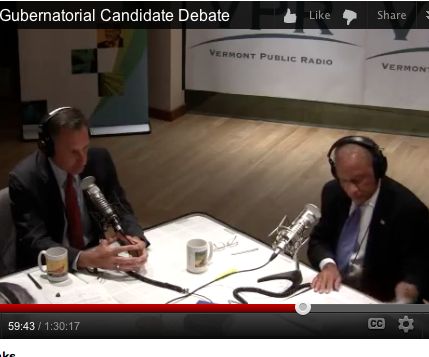
The first gubernatorial debate between Gov. Peter Shumlin, a Democrat, and state Sen. Randy Brock, a Republican, was a dignified matchup. Neither candidate was knocked down or even stunned by questions from the hosts, from each other or from listeners.
But Shumlin got a few more punches in than Brock was able to land over the course of the 90-minute debate, as they politely traded jabs within the strict guidelines of the Vermont Public Radio format.
The two candidates, predictably, disagreed on health care, renewable energy and whether the state should have a moratorium on industrial wind. They agreed that the F-35 fighter jet should be based at Burlington Airport and they both oppose the renewable portfolio standard for renewable energy projects.
Questions they posed to each other about nuclear power and industrial wind generated the most revelatory remarks. Though Brock scored points on renewable energy and the real jobless rate, he had a tough time answering Shumlin’s barbed queries on social issues, namely about his gay marriage stance (he voted against it) and the governor’s assertion that the Franklin County senator stood idly by as Gov. Paul LePage compared IRS agents with Nazis at a press event in June. Shumlin, for his part, more often fell back on rhetoric instead of answering Brock’s questions directly.
Round 1: Nuclear power
Shumlin, who has long sought to close Vermont Yankee, the state’s sole nuclear power plant, asked Brock about a Newport Daily Express story in which he said he favored building a new nuclear power plant. Shumlin asked where he intended to do that.
“One of the places to build it is … on the current site in Vernon that does appear to have sufficient space to do that,” Brock said. He explained that he was proposing “a new state-of-the-art plant” that reprocesses nuclear fuel (so it wouldn’t have to be stored on site) like the facilities in France that President Barack Obama supports. “Hopefully, it wouldn’t take as long as the Walmart in St. Albans (to build),” Brock said.
Shumlin shot back: “The math doesn’t work. Even if it were a good idea … It takes five years to cool down a nuclear plant and 10 years to take the carcass of that plant away.” He said it would be 15 years before a new plant could be built in Vernon, and he doubted it could be constructed even then. “A new plant hasn’t been built in America for 35 years,” Shumlin said.
Later, Brock needled Shumlin about the Vermont Yankee lawsuit.
Shumlin said he was confident that “in the end justice will prevail” and the plant will be shut down. The governor was talking both about the Second Circuit court appeal Vermont Attorney General Bill Sorrell has filed and the Vermont Public Service Board, which has to issue a certificate of public good for the continued operation of the plant. Vermont Yankee’s license to operate expired in March of this year.
In a third salvo, Shumlin took Brock to task for supporting a new plant now, when as a state senator he opposed the relicensing of Vermont Yankee in 2010. As he did on several instances in the debate, the governor asked Brock if “he would vote now as he did then.” The response each time was “yes.”
Brock said he voted against the continued operation of Vermont Yankee because he believed “Entergy Louisiana” couldn’t be trusted.
Round 2: Industrial wind
The governor is perhaps no more vulnerable on any issue than industrial wind, which has stirred the ire of communities in the Northeast Kingdom and Rutland County.
Brock asked the governor if there should be a “two-year moratorium on industrial wind, the particular kind of wind (that) uses 400 foot towers that blast off the tops of our ridgelines and require interstate highway lanes up the sides of the mountains.”
“We need to do more study,” Brock said. He also said he wanted to “look at the regulatory environment that allows this to happen.”
Several times, the Republican said he had heard from Vermonters “who feel the governor isn’t listening to them” because he is willing to protect the scenic views of certain parts of the state at the expense of others.
Shumlin said “no on a moratorium,” but called himself “a big believer in local control (so if) “a community votes against it I will be against it.”
“I told Liz Miller to go to the PSB and tell them we won’t support it,” Shumlin said.
But local control referred to the community on which the towers would be built. Not the next towns over. While Brock noted that the projects had a “significant effect on surrounding communities,” Shumlin did not make that observation. “If they (the specific town) say no, I say no,” Shumlin said. “If they say yes, I say let’s go.”
Round 3: Green jobs
Brock took aim at an oft-quoted phrase the governor uses to bolster his credibility as a jobs creator: A survey that showed Vermont has more green jobs than any other state in the country.
The information Shumlin has used to bolster his claim, Brock says, is based on “junk statistics” in part because the survey included lawyers who work for environmental groups.
“Have you been to Lowell where they’re building the towers?” Brock asked. He said most of the construction workers on the site are from out of state, judging from the license plates in the parking area for the project.
Shumlin defended the survey. “I’m proud of our green jobs record,” the governor said. “Not all of the (jobs) are for lawyers.” He said Vermont is building “the best solar trackers” and “the smartest small windmills in the world.”
The Republican says he supports green jobs too — the kind that generate greenbacks in Vermonters’ pockets.
Round 4: Gay marriage
Shumlin, who introduced legislation to allow gays to marry in Vermont, said Brock was one of a small minority of senators who opposed the gay marriage bill in 2009. He asked Brock if he would vote now as he did then on the issue.
Brock said yes. He said his vote was against the “I believe redefinition of the marriage from that of between one man and one woman”– it was not a “vote against people who are different than a traditional heterosexual couple.” He said he supported the “background of the decision from the Vermont Supreme Court” allowing gays to form civil unions.
He would not seek to repeal the law should he become governor, Brock said. “It’s over, Vermont has made its decision and it’s time to move on,” he said. “I’ve certainly moved on.” Brock, who is a justice of the peace, said he recently married a same sex couple who are supporters of his campaign.
Shumlin asked the question again: “If you could vote on the right side of history on that question today would you vote yes on marriage equality or no?”
“Seeing as it’s a reality today, I would vote yes,” Brock said.
Round 5: Pot legalization and the LePage incident
Brock asked if Shumlin thought his solicitation of contributions from NORML, the National Organization for the Reform of Marijuana Laws, was appropriate given that statistics show Vermont has highest per capita use of marijuana among teens.
Shumlin responded: “I don’t accept campaign contributions in return for anything. I don’t believe a Vermont public official accepts contributions in return for anything. This is not Chicago.”
The governor said he firmly believes Vermont should decriminalize small amounts of marijuana at a time when the state should be allocating more resources toward cracking down on crimes related to bath salts, oxycontin and other hard drugs.
The debate at times took on the tone of a courtroom cross-examination. Take this question from Brock, for example: “Did you or did you not in the same telephone call indicate you wanted to be a national spokesman for NORML and in same phone call ask for a contribution?”
Shumlin said no, “what he reported was he had spoken with the Soros Foundation to find ways to articulate on national level my belief that we have a misguided marijuana policy.” The governor then talked for a few minutes about the seriousness of oxycontin and bath salts and misallocation of resources to fight small amounts of marijuana.
Later, he said “I believe I can be a voice and should be a voice for a more sane drug policy in Vermont and America.”
In a similar vein, Shumlin asked Brock whether he regretted inviting Paul LePage to Vermont after the Maine governor, in a meeting with the press, compared IRS agents with the Gestapo.
Brock’s response? “Gov. LePage has never been known for his political correctness and he certainly didn’t disappoint this time.” Brock said he didn’t agree with LePage’s statement, but at the same time, he believed the Maine governor was using hyperbole and Brock compared the remark to the use of the “soup Nazi” on the sitcom Seinfeld.
“So you’re defending his remarks?”
“I said I didn’t agree with his remarks, they were not my remarks and I thought they were unfortunate,” Brock said.
“I just heard you say he didn’t really mean it?” Shumlin asked.
“What I said was, he was using it as hyperbole, and that was very clear,” Brock retorted.
Editor’s note: This story was updated at 6:11 a.m. Sept. 13, 2012.
Watch the video of the debate produced by VPR.
