

Looming federal cuts have the Shumlin administration on the edge of its seat, as Congress returns to session next week.
State officials expect Congress to pass a six-month continuing resolution to keep the nation’s finances rolling. Although they foresee a range of federal cuts, they’re not sure how these reductions will take shape.
While the state has almost $11 million in financial padding to cushion the blow of such cuts, vital welfare programs like fuel assistance are at risk, say state officials.
Low-income Vermonters could face a 40 percent cut in fuel assistance this year if the state doesn’t make up the difference in federal dollars again.
While federal funding for the Low Income Heating Assistance Program (LIHEAP) looks to state officials like it will remain level at $19.5 million for Vermont, there’s no telling what other funds might get cut in a continuing resolution.
If the state doesn’t kick in extra aid, the average fuel assistance benefit for FY 2013 will drop from $900 to $543 over the course of the winter season, said Vermont Fuel Assistance Chief Richard Moffi.
Secretary of Administration Jeb Spaulding said the Shumlin administration aims to keep heating aid level, but he didn’t make any promises.
“It’s beginning to look like the federal government is not going to ever supply enough funds to take care of heating needs without regular assistance from the state every year,” he said. “We’re not going to be able to make up for every cut that the federal government will deal us, but fuel assistance is one that the governor, legislators and everyday people feel is very important. So we will do our best to come up with the funds to at least not go backwards.”
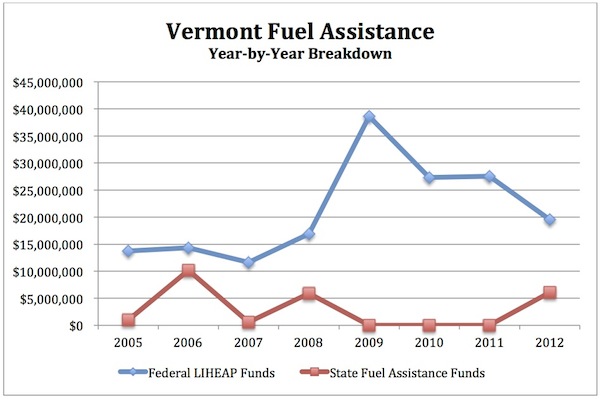
Last year, when Vermont’s LIHEAP funding was cut from $26 million to $19.5 million, Gov. Peter Shumlin and the Legislature filled the void by allocating $6.1 million in state funds. But this year, Shumlin and his administration acknowledged at a press conference on Tuesday that the state is scrounging for funds to keep Vermonters warm.
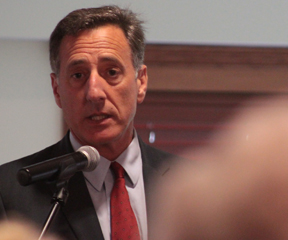
“It’s ugly,” said Shumlin about the reduction in federal assistance. “We cannot in the state of Vermont afford to bail out every single program that this Congress continues to cut. However, we are not going to let Vermonters freeze in their homes.”
The thought of freezing in a person’s own home is exactly what has motivated longtime LIHEAP beneficiary Susan Wind, 55, of Mendon to protest the reduced funding.
“There are people that are going to freeze unless we do something,” said Wind, who is disabled and working three jobs to make ends meet. “If we don’t have fuel, our pipes will freeze, too. And not only will we be freezing, but we will now have no working pipes.”
Wind hopes to press the state for more fuel assistance by staging a protest on the Vermont Statehouse lawn on Sept. 15 at noon. She is calling the event “Running on Empty in Vermont,” and it will feature music and food. For the past month, Wind said she has worked 14-16 hour days to raise $1,800 for the event. (Organizers changed the date from the 8th to the 15th after this story was first published.)
Where did money come from last year?
According to Moffi’s numbers, the $6.1 million in state fuel assistance in FY 2012 made it possible for the Department of Children and Families (DCF) to allocate fuel aid to a record 38,900 households at an average benefit rate of $900 per household. The number of households served in fiscal year 2012 increased by 2,400 households. Beneficiaries received on average $36 more in fiscal year 2012 than they did in fiscal year 2011.
Jim Reardon, the commissioner of the Department of Finance and Management, said $5 million of last year’s funding came from a $7 million fund that the Legislature set aside to offset federal funding reductions. The other $1 million came from the state’s Weatherization Trust Fund, which is administered by DCF.

This past legislative session, said Reardon, the Legislature replenished that $7 million in backup aid. On top of those funds, Reardon said, the Legislature allowed him to roll over $3.9 million “in an unreserved account as a further buffer for future federal funding reductions over and beyond the $7 million appropriation.”
But that money hasn’t yet been allocated for fuel assistance, and Moffi said he isn’t spending any money that he doesn’t have.
“Until the Shumlin administration and the Legislature decide where to spend that money, I can only issue benefits based on the funds I have available,” he said.
The first wave of allocations will come in mid to late November, Moffi said. If additional state funding comes through, he said, beneficiaries would enjoy a bonus in January — just like last year. If not, they’ll see a $357 on average reduction in benefits.
State fuel assistance history
Prior to federal fiscal year 2005, no state funds were used to fill in gaps in federal fuel assistance, according to DCF data.
That year, the state set aside $1 million to beef up the feds’ $13.7 million allocation. The following year the state added $10.2 million — an all-time Vermont fuel-assistance high — to LIHEAP’s $14.3 million (see graph above for eight-year spread).
From the beginning, Moffi said, those funds were meant to supplement low-income Vermonters’ heating bills, not pay for them in full.
“The LIHEAP program is a supplemental assistance program,” he said. “It is designed to help low-income Vermonters (and residents of other states) pay a portion of their heating bill. It’s never had the funds to help pay an entire heating bill.”
According to DCF numbers, the average Vermonter uses 762 gallons of petroleum-based fuels to heat his or her home in the winter. Moffi predicts that the average price for petroleum this winter will be about $3.70 per gallon.
Based on Moffi’s predictions, the average Vermont home will pay about $2,800 for fuel — more than three times the average fuel benefit paid out to low-income Vermonters last year.
Overhauling the program
DCF has planned changes to the state’s fuel assistance program, including a requirement that fuel aid be used during the current fiscal year and a limit on crisis fuel eligibility.
Previously, a LIHEAP beneficiary could use 17 percent of a given fiscal year’s funds to pay off a balance that the beneficiary still owed to a fuel provider from the prior year. Under the new guidelines DCF plans to implement this year, beneficiaries will not be able to pay off a back balance.
“It makes the client responsible for their outstanding bills,” said Moffi. “It’s a way of making sure that all the funds put out this year are helping people meet their needs in the current winter heating season.”
The other major change is to crisis fuel. The state’s crisis fuel program provides at least 100 gallons of fuel to Vermonters who are completely out of fuel and are in emergency need. Those individuals, who are already receiving fuel assistance, will only be eligible for one round of crisis fuel assistance.
Unlike the regular or seasonal fuel assistance program, the crisis fuel program traditionally did not discriminate based on income, providing fuel to anyone in need, said Moffi. The state is looking to cap the program. Individuals who are not income eligible for seasonal fuel assistance and make under 200 percent of the federal poverty line were previously eligible for three 100 gallon assists, will now get a maximum number of two rounds of crisis fuel assistance.
“We want to preserve the (crisis fuel) safety net, but we also want to use those LIHEAP funds as efficiently and equitably as we can,” said Moffi.
The new caps on crisis fuel, he said, will put more funds in the hands of Vermonters who are eligible for seasonal fuel assistance, those individuals earning under 185 percent of the poverty line.
All of these changes are irrelevant, however, Moffi said, if the state doesn’t get adequate federal assistance to operate the program. According to Sen. Bernie Sanders’ office, the Senate Appropriations Committee passed a bill earlier this summer calling for nearly $3.5 billion in nationwide LIHEAP allocations. If that bill is signed into law, Vermont would receive about $19.5 million.
Scott Coriell, spokesman for Rep. Peter Welch, said that “it is unclear what level of funding LIHEAP would receive” because Congress would likely pass a six-month continuing resolution on the federal budget. While Moffi said that by passing such a resolution, Congress is simply passing the burden onto new officials after this year’s elections, he acknowledged that the resolution might bode well for LIHEAP programs across the country.
“Here’s the reality,” said Moffi, “a six-month resolution to the LIHEAP program is a gift because by the time Congress figures out what it wants to do, the northeastern, cold-weather states will have already taken their money and put it out the door. So by the time that resolution runs out, we’ll have already spent the money. And that’s true from Maine to Michigan.”

