


What does it take to unseat a 15-year incumbent who is well-liked inside the Democratic Party and who has executed his job well enough not to have faced a serious challenger his entire tenure?
That’s the question TJ Donovan and his campaign team have been trying to answer since the Chittenden County state’s attorney launched his primary campaign for Vermont attorney general in early May.
The young state’s attorney faced an uphill battle from the start: A poll taken in the spring showed Sorrell beating out Donovan two-to-one.
In a May interview about Donovan’s campaign launch, retired Middlebury political science professor Eric Davis wasn’t sure about the viability of the 38-year-old’s candidacy.
“I think TJ is off to a good start, but what he wants to do is historically unprecedented — no Democratic statewide officeholder has ever lost a primary,” Davis said.
Donovan’s response to the historic odds has been an aggressive campaign strategy that includes attempts at daily headline grabbing. His campaign has energetically tried to break into the news cycle by doling out individual endorsements from high profile unions and politicians from both sides of the aisle, and press releases on policy statements addressing what he sees as the issues of the day — prescription drug abuse, gay marriage rights, elder abuse and higher than necessary incarceration rates for low-level crimes.
His persistence and early efforts paid off. Donovan got at least eight endorsements from individuals and entities that have firsthand experience with the state’s crime problems — Republican mayors Thom Lauzon of Barre and Chris Louras of Rutland, the Vermont Troopers Association and the Vermont Sheriff’s Association – before Sorrell launched his campaign on May 30.
“Donovan used the spring and early summer very effectively to get his name around the state,” Davis said last week.
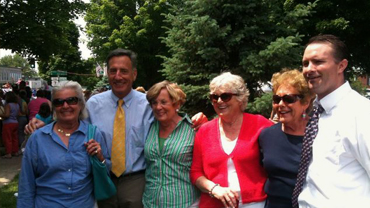
He also got out ahead on the fundraising front, raising a third more than Sorrell by Aug. 15. His friends in the legal profession — more than 50 — have pulled out their checkbooks to support his campaign, while Sorrell has relied on backing from his employees, companies he has investigated and attorney generals from other states.
Though Donovan has steadily secured high-profile endorsements from unions, including the Vermont AFL-CIO and the Vermont State Employees Association, while Sorrell has had a harder time playing what he calls “the endorsement game.” The Vermont attorney general’s campaign hit stride, however, when he got a boost from his former boss, Gov. Howard Dean, who has proven to be a valuable asset. Dean held a press conference with Sorrell in July and was featured in two mailings to voters.
Endorsements, however, have only taken the two Democratic candidates so far. As the debate season has intensified with the primary now just over a week away, the campaign has become more about each man’s record in office and vision going forward.
Since the two rivals aren’t that far apart politically, come from the same Irish political power base in Chittenden County and tend to agree on most of the issues with slightly nuanced differences, the subtext of the race is age: young, eager upstart, versus older, experienced incumbent.
“My sense of the race is that in terms of political organization, Donovan’s organization is superior to Sorrell’s. Donovan has raised more money within the state … he has more endorsements.”
Eric Davis
Ironically, however, the incumbent appears to be the inexperienced campaigner, while the upstart who has been seasoned by Chittenden County contests has the upperhand.
“My sense of the race is that in terms of political organization, Donovan’s organization is superior to Sorrell’s. Donovan has raised more money within the state … he has more endorsements,” Davis said.
Despite a recent boost to Sorrell’s campaign that came when the Democratic Attorneys General Association funded a $99,000 ad campaign through their PAC, the Committee for Justice and Fairness, Davis gives Donovan the edge.
“The reason I say that, is this is going to be a low turnout election … and the conventional wisdom is for low-turnout primaries, organization counts for more than advertising,” Davis said. Turnout could be as low as 30,000 voters, Davis has said. In the 2010 five-way Democratic gubernatorial primary, about 70,000 voters cast ballots.
Sorrell has stumbled in debates and has lost important endorsements, not to mention the imprimatur of party activists. While Donovan has also made a few faux pas, he has been more opportunistic in taking advantage of his rival’s weaknesses.
When Sorrell points to his record over seven terms in office, Donovan questions his stances on public records and investigations of police crimes as well as his effectiveness as the state’s chief litigator and legal advocate for the Legislature.
In an effort to contrast himself with the incumbent, Donovan likes to expound on ineffable qualities — “leadership,” “new energy,” and “engagement” on the campaign trail.
Donovan’s record as state’s attorney
A VTDigger analysis based on interviews with people familiar with the Chittenden County state’s attorney’s office and Donovan’s record shows he has largely been successful in managing big cases, bringing in outside help when necessary, and in turning his progressive vision into reality.
“TJ is a guy who is a really unique person. He’s got a lot of energy and he’s got a lot of drive.”
Robert Kaplan
Robert Kaplan, a partner at Kaplan and Kaplan, describes himself as Donovan’s mentor when he was a private attorney following a brief stint as a deputy Chittenden County state’s attorney.
“TJ is a guy who is a really unique person. He’s got a lot of energy and he’s got a lot of drive,” Kaplan said.
The best evidence of Donovan’s ambition is his major accomplishment as state’s attorney, the creation of the Chittenden County Rapid Intervention Community Court, an innovative program that is designed to reduce crime and incarceration rates in the Burlington area.
The program serves as a complement to traditional court diversion, allowing law enforcement officers to recommend alternatives to criminal charges for people who would otherwise be charged with minor offenses. In many cases, “low-level offenders” – those who commit a first-time drug offense or have mental health issues that lead to crime, among others – can be directed to various community resources, from mental health clinics to addiction treatment centers, instead of the traditional criminal justice system.
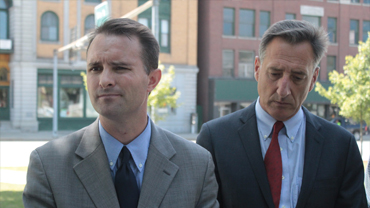
Michael Schirling, chief of police in Burlington and a partner with the office in the Rapid Intervention program, says his department has long held the view that jail shouldn’t be the first step in crime prevention.
“We have embraced for some time the idea that the justice system has to deliver a full continuum of options. That that ranges from education … to avoid crime … and then when that fails to deliver outreach and intervention,” Schirling said.
The Rapid Intervention program, he said, fits right in with that philosophy.
“The idea behind [Rapid Intervention] … was that if there’s an identifiable issue — in particular substance abuse and mental health … if you can stop the cycle of that person going in and out of the system by addressing that and getting them to engage in an alternative approach, and if that balances the need for public safety, then use an alternative approach,” he said.
Donovan described it another way.
“On the road to jail, we should have exit ramps all the way up there, so we make jail truly meaningful for people,” he said, as he waved his hands to illustrate the point. “It’s traditional diversion, it’s rapid intervention, it’s treatment, it’s drug courts, it’s mental health courts, it’s a continuum of services on the front end in the community and so when we get to jail, jail is reserved for those that truly pose a threat of public safety, and it’s meaningful.”
Schirling, who oversees 92 officers and 7,000 criminal cases a year in Burlington, said the program saves time for the police because they don’t have to go to court, and they only have to file initial incident reports instead of affidavits and other court documents.
The Vermont defender general, Matt Valerio, said the program reduces the caseload for his office.
“There’s been enough of that diversion from the system to allow [the Chittenden County state’s attorney’s] office and my office to focus on the more serious criminal cases,” he said.
“So one of the reasons that we’re reducing corrections spending in Vermont is because of the extraordinary success of this program that was hatched and created by the vision and leadership of TJ Donovan, Mary Alice McKenzie and other providers here in Chittenden County.”
Gov. Peter Shumlin
Donovan took a political risk when he started the Rapid Intervention initiative. His attempts to reduce recidivism by sending low-level offenders back into the community for assistance was a “difficult political stance to take,” according to Valerio.
There could be a perception that the Rapid Intervention program makes a community seem “soft” on crime, Valerio said, and can send a message that criminals can get away with it.
Schirling, too, has heard this criticism. “I think the answer is you have to mindfully apply whatever the intervention strategy is at various places in the continuum,” he said.
The key is knowing what to do in any given case, and not using a “one-size-fits-all” approach, the police chief said. “If someone’s been through the system a variety of times and we continue to give them alternatives and not hold them accountable, it could be misused,” Schirling said.
Donovan’s office used state justice reinvestment funds to start the program, and if it fails to save money, it could be seen as a burden for taxpayers. If it succeeds, it could serve as a model program for cutting costs for the Department of Corrections at a time when state spending on prisons increased dramatically from roughly $70 million in 1999 to $140 million in 2009. (Though that spending level has held steady over the last few years, the department is aggressively seeking ways to reduce its expenditures, which come straight from the General Fund.) (Shumlin plans a big haircut for the big house; Corrections commissioner says Vermont’s inmate population has declined)
Lawyers and police alike praise the Rapid Intervention program, but its viability hasn’t been quantified. Does it save money for the state? Does it reduce crime?
Donovan says he thinks it does both, but he wants the numbers to do the talking, so he is looking to Max Schlueter, of the Vermont Criminal Information Center at Norwich University, for conclusive data.
Schlueter is conducting a study, funded by a grant from the federal Bureau of Justice Statistics, but he said it’s too early to draw conclusions. The Vermont Criminal Information Center study is due out in October, Schlueter said.
“We’re still in the process of cleaning the data and obtaining criminal histories … which we would use to determine whether people who use the program are successful or not after they use the program,” he said.
The measure of the program’s success is straightforward, Schlueter said: If a participant hasn’t been charged and convicted of a crime after completing the program, his or her case is considered a success. The study will also track how much time passes between participants’ completion of the program and any new offenses.
If the numbers pencil out and if he is elected attorney general, Donovan says he will make the Rapid Intervention program a statewide initiative.
“This is my position: Let’s give everybody the information and let’s figure out if this is a good program,” Donovan said. “I’m convinced it is, but let’s let the experts work at it. Here’s the thing: Leadership is being willing to try new things and not being afraid to fail, and that’s my argument.”
Donovan has one powerful ally who is willing to make the case — without the numbers. Gov. Peter Shumlin, in a mid-May press conference, said the program is saving the state money, and he wants it to be implemented statewide.
“So one of the reasons that we’re reducing corrections spending in Vermont,” Shumlin said, “is because of the extraordinary success of this program that was hatched and created by the vision and leadership of TJ Donovan, Mary Alice McKenzie and other providers here in Chittenden County.”
High-profile cases
As his Rapid Intervention program moved forward, Donovan had two especially high-profile cases as Chittenden County state’s attorney. The first was a murder in the fall of 2006, just before Donovan was elected.
Michelle Gardner Quinn, a University of Vermont student, was abducted and killed by Brian Rooney. The case made national news, and Donovan’s office secured a conviction soon after he was sworn in.
“It was a great team effort in a case that we truly needed to win,” Donovan said last week. “It was just a tragic tragic case that really tore I think at the fabric of the perception of Vermont, and I’m proud to say that we were able to get a conviction and Brian Rooney is spending the rest of his life in prison.”
In another high-profile case, Donovan didn’t pursue a conviction. When Burlington officials sunk $17 million into Burlington Telecom to keep the failing utility from going bankrupt, he made the decision not to prosecute.
Donovan brought in Bob Simpson, the former state’s attorney, to help with the investigation. While Donovan won’t discuss the details of the case, that decision is looked upon favorably.
Mark Keller, a former Chittenden County state’s attorney who endorsed Sorrell in the AG primary, said he wasn’t familiar with the inner workings of the investigation, but he trusts Simpson.
“For me, if Bob was doing the investigation and Bob came up with this recommendation, then I would not question it,” Keller said.
Kaplan also said he had faith in Simpson’s abilities.
“I know that TJ turned it over to Bob Simpson, who was his predecessor, and whatever happened was whatever Bob’s analysis was,” Kaplan said. “I have a lot of confidence in Bob’s integrity.”
It’s unclear, however, what Simpson’s recommendation was. Simpson, who now teaches at Champlain College, refused to comment. When asked what Simpson’s recommendation was, Donovan woudn’t say.
“There were many people involved, and I’m not going to talk about the internal discussions, but at the end of the day, it was my decision,” he said in a telephone interview. He called back a few minutes later to add, “[The investigation] was thorough, there was a vigorous debate [within the office]. I made the final decision.”
Donovan decided not to prosecute, he said, because he wasn’t confident he could get a conviction.
“You have to prove each and every element beyond a reasonable doubt and have to convince 12 people [the jury] to do that,” Donovan said. Beyond that, the emotional price for community residents and legal costs for city taxpayers would make matters worse, he said, since Burlington would not have been awarded restitution in the case.
Donovan’s career path
Donovan’s campaign started close to home. Standing on a dais at the St. John’s Club on a spring evening on Burlington’s waterfront, the state’s attorney spoke fondly of his father, Thomas J. Donovan Sr., for whom he was named. He said he hoped to emulate his father’s dedication to his community and his family.
“No matter the obstacles, no matter the struggles, he got up every day, went to work, provided for his family, gave back to his community,” Donovan said at the launch.
Thomas J. Donovan Sr. raised his family in Burlington while practicing as a lawyer. TJ Donovan Jr. is now doing the same, bringing up his two young sons in the town he grew up in.
Donovan graduated from Burlington High School in 1992 and then went off to college at Merrimack College in Massachusetts. After graduating in 1996, Donovan took a year off in Vermont, where he took a job he remembers fondly — driving a courtesy shuttle for The Automaster, a Burlington car dealership.
From there, he went to Suffolk Law School and graduated in the class of 2000 and then served for two to three years as an assistant district attorney in Philadelphia. His supervisor at the Philadelphia office, who oversaw about 30 assistant DAs at a time, remembers him years later.

“I can tell you that he was coming right out of law school and he worked 14, 15 hours a day and on weekends,” said Deborah Harley, Donovan’s supervisor at the Philadelphia office. “He really worked hard. Very, very hard worker. Honest, always looking to find the truth.”
After a few years, Donovan returned to his home state. He worked as a deputy state’s attorney in the Chittenden County state’s attorney’s office before he moved to private practice at Jarvis & Kaplan, a Burlington law firm.
He worked as a private defense and civil attorney until he was elected state’s attorney in 2006 in an open contest (Simpson had retired) and he was re-elected in 2010.
Donovan is held in high regard by many in the legal and law enforcement professions who cite his dedication, smarts and management skills.
“If you took a snapshot of the Chittenden County state’s attorney’s office the week before TJ took over and took a snapshot of it now, you wouldn’t even recognize those two entities as being the same,” Kaplan said.
VTDigger contacted 10 lawyers familiar with the Chittenden County state’s attorney’s office and half declined to comment or failed to respond to requests for interviews, including Simpson and two former deputy state’s attorneys.
Two sources said public and private attorneys in Chittenden County would be reluctant to criticize Donovan — on or off the record — for fear of reprisals.
“If you look at my first race in Chittenden County, a tough campaign against John St. Francis. I kept him on as a deputy, there were no reprisals. I kept him on,” Donovan said. “I’m competitive, I campaign hard, but at the end of the day, I shake people’s hands and I move on.”
In 2010, the state’s attorney was sued by John “Jack” O’Connor, a former South Burlington police officer, who claimed Donovan maliciously ended his career over a personal grudge.
The case was dismissed on the grounds that Donovan was immune from prosecution as a state’s attorney, and he was working within the purview of his authority when he raised questions about O’Connor’s integrity. O’Connor appealed the case to the Vermont Supreme Court, where the dismissal was upheld.
“I had some issues with some of his tactics,” Donovan said. “I testified against him in federal court. I was sued. The case went on for a couple years. The case was dismissed and the Supreme Court affirmed the dismissal.”
The campaign for Vermont attorney general
Donovan has nothing to lose in the primary race for Vermont attorney general because he’ll go back to his day job after the primary if he doesn’t prevail. (He doesn’t face re-election as Chittenden County state’s attorney until 2014.)
Although Sorrell has a very solid record of consumer protection, and has been called a “giant-slayer” for his work taking on large corporations such as Entergy, the company behind Vermont Yankee, a stint of high-profile losses in federal court defending Vermont legislation has left the attorney general vulnerable.
Donovan has tried to capitalize on Sorrell’s recent troubles in federal court without engaging in direct attacks.
His campaign strategy is about handshakes and headlines.
At least once, and usually two to three times a week, the Donovan campaign sends out an email blast to the press, announcing an endorsement, event or policy framework. All of the messages have a dual purpose: They get his name in the headlines and they give him a platform to voice his stance on the issues.
Donovan has released at least six policy frameworks throughout the summer, ranging from elder abuse to Taser policy to marijuana decriminalization.
“I think Donovan has used the press effectively to get out the message and get the name recognition,” said Davis.
The campaign hasn’t been without its bumps and gaffes, though.

In June, information came to light about an assault charge Donovan faced after a drunken fistfight as a teenager. The candidate addressed the 20-year-old criminal charges as a “teachable moment.” The charges were expunged from his record after he completed court-ordered community service.
Donovan made a statistical flub very publicly a week later. In a Vermont Public Radio interview, Donovan claimed that one in seven babies born at Rutland Regional Medical Center have an opiate addiction. The statistic was way off, as the press pointed out soon after. According to officials at the hospital, the addiction rate among newborns is actually less than 1 percent, Thatcher Moats reported at the Vermont Press Bureau.
Later in the campaign, Donovan’s play-to-win tactics were on full display. It started when a Sorrell supporter (whose son works in the AG’s office) tipped off Seven Days’ Paul Heintz about a polling call he’d received. He claimed it was a “push poll” – that is, a poll designed not to gauge public opinion but to spread negative misinformation about a candidate.
Donovan’s campaign vehemently denied the accusations, and described them as “baseless” in an email to Sorrell’s camp (which was copied to the press). In spite of his professed interest in transparency, Donovan’s campaign would not release the poll questions. Instead, the press was allowed to view the survey after agreeing to a set of conditions, including a promise not to quote the questions. Reporters were permitted to convey the tenor of the survey.
As the summer has worn on, Donovan’s campaign skills have sharpened. In a classic political move, he latched onto an ambiguous statement Sorrell made during an Aug. 13 debate on WDEV’s “Mark Johnson Show” and simplified it to: Sorrell wants to build jails.
Donovan capitalized later on what could have significantly hurt his campaign: a $99,000 ad campaign by a Washington super PAC in support of Bill Sorrell. Donovan’s campaign hastily called a press conference denouncing the ad and demanded that Sorrell call the PAC off.
These recent missteps and public disputes are an inevitable part of a closely contested race between two rivals of the same party in the final days of a primary.
According to Davis, Donovan might accomplish a feat that hasn’t been accomplished in 66 years in Vermont: unseating a statewide officeholder in a primary election.
“The only other statewide officeholder who lost a primary you have to go back to 1946,” he said from memory. That year, challenger Ernest Gibson Jr. beat out Gov. Mortimer Proctor in the primary.
In 2012, Davis says, it looks like such an anomalous electoral outcome could happen again.
CORRECTION: Ernest Gibson Jr. beat out Gov. Mortimer Proctor in the primary. We originally stated that Proctor beat Gibson.

