

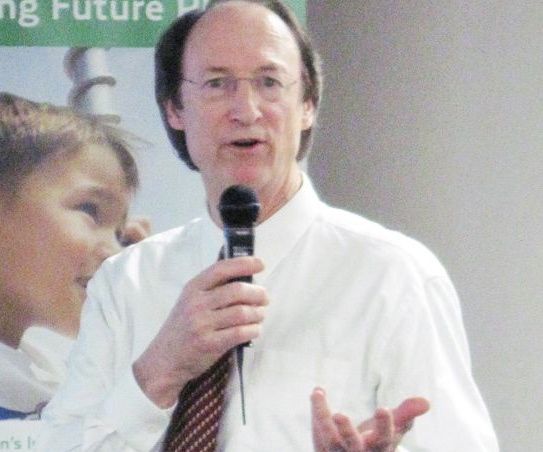
Officials from the Brattleboro Retreat came to the Statehouse on Wednesday to tell lawmakers they regretted they weren’t more forthcoming about an investigation at the facility that took place after a patient died of a drug overdose.
The patient, Jared Fitzpatrick of Middlebury, was at the Retreat for alcohol detox and psychiatric treatment. He died several days after he grabbed methadone from a nurse’s cart. Afterward, state and federal agencies investigated the Retreat to determine what happened. As a result of the probe, the hospital was cited for deficiencies in patient care.
Rob Simpson, CEO of the Retreat, didn’t tell lawmakers about the investigation, the nature of Fitzpatrick’s death or the citations in February when he was called to testify about rumors regarding deaths at the hospital.
On Wednesday, Simpson was back in the Statehouse, this time profusely apologizing to lawmakers. The CEO said if he could give his testimony again, he would.
“I have listened to the tapes myself and if I could do it over, I would,” Simpson said.
The Shumlin administration was also aware of the probe but didn’t inform legislators about the Retreat’s problems.
At the same time the investigation was under way, state officials were pressing for fast passage of the community mental health bill, which creates a decentralized system for state patients with severe psychiatric problems who would have previously been treated at the Vermont State Hospital. The Retreat is the largest private hospital facility in the new decentralized system, with 14 beds. The state will pay for renovations to the Retreat and for services.
In a previous story published by VTDigger.org, lawmakers said they didn’t know about the extent of the regulatory issues at the Retreat until they were approached by the press more than a month after the legislative session ended. The investigations occurred in February and March.
Several lawmakers said they should have been informed, because they were making a decision about a large investment of state money in private facilities.
Sen. Claire Ayer asked the same questions over and over again during the daylong Health Access Oversight meeting: What should lawmakers know, when they should know it and who should tell them.
The CEO cited a number of “mistakes” that he wished he could take back.
“I failed to explain that the initial CMS visit was just the beginning of the process and that a subsequent report would soon be issued,” Simpson said in a statement he read to the committee. “My testimony did not make clear that the CMS review was not complete and there might be potentially standard or conditions of participation findings in an upcoming report. I also did not report back to the committee after receiving the report and I should have. I deeply apologize for this oversight.”
Simpson said the Centers for Medicaid and Medicare reviewed the Retreat’s corrective action plan and a report should be filed very soon. He said he would make the information available to the committee.
The CEO also said he wanted to “set the record straight on two questions.”
“On Feb. 8 I was asked by Sen. Mullin whether the patient death at the Retreat was from ‘natural causes,’” Simpson said. “My colleague Peter Albert and I both responded that we did not know because we understood that the medical examiner’s preliminary findings were inconclusive. A recent media report has suggested that more specific findings were available at the time. If that’s the case, I want to assure the committee we did not know that when we testified and we answered the question to the best of our knowledge.”
He admitted that the Retreat had lost its “deemed status.”
“Unfortunately we found ourselves confused on this point,” Simpson said. “We did not interpret the communication from CMS correctly. But let me step back and make an important clarification: Losing deemed status is not on par with losing CMS certification, nor does it imply an immediate threat to our certification.”
For the time being, the Retreat is no longer admitting adult private patients until issues at the hospital had been completely cleared up, he said.
Simpson pledged to keep do everything he can to inform legislators in future.
Confusion remained though around exactly what information the Division of Licensing and Protection could be made available to lawmakers. Suzanne Leavitt, head of the division, said federal rules preclude disclosure of any information about an investigation until a corrective action plan has been filed by a hospital.
Patrick Flood, commissioner of the Department of Mental Health, told lawmakers they have a right to know when deaths or other “sentinel” events and that information should come from him.
“When someone in the custody of the state dies, especially in an unexpected way, it is a matter that’s legitimate for public inquiry and discussion,” Flood said.
Flood said they would need to discuss what level of “event” would be appropriate to share with the public. He suggested, for example, that elopements might not be worthy of lawmakers’ attention. Simpson said an elopement of a couple hours occurred recently.
Talking about “adverse events” like the deaths, Flood said “we stand ready to provide the information however best you decide to receive it.”
He agreed it is a “matter for public inquiry and discussion.”
Right now the state and Legislature do not have a process, and that is the heart of the problem, according to Flood. Lawmakers agreed they have no clear sense of what level of information they should get and suggested he provide them with some guidelines that they can then discuss to clarify what level of info they want.
Flood also defended the Retreat, saying the hospital had been “an incredible partner in this difficult situation” after the Vermont State Hospital was damaged by Tropical Storm Irene.
He said they had been “incredibly flexible” and willing to solve problems and “there have been some really difficult problems to solve.”
“The Brattleboro Retreat takes the hardest patients. They stand out in what they do,” he said, noting the facility takes patients from other hospitals that those hospitals can’t handle.
The Retreat now has 22 patients that are being treated under state custody though they only signed on for 15.
He said there inevitably will be other problems, but “I have great confidence in the Retreat.”
“None of us can sit here and promise there won’t be another untoward event,” he said.
Editor’s note: This story was updated at 8:07 a.m. with information reported by Andrew Nemethy. It was also updated at 3:03 p.m., adding that an elopement had occurred recently at the Retreat.
