

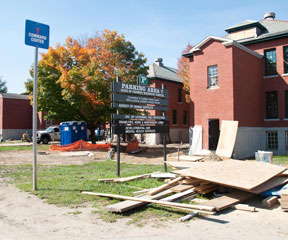
The state has contracted with Burlington architectural firm Freeman French Freeman to design and oversee the rebuilding of the state’s historic Waterbury state office complex. State officials used a special bidding exemption to move ahead with the contract.
Freeman French Freeman was chosen for the landmark project, officials say, because of the extensive expertise it gained after producing a feasibility study in March on the reuse of the flooded complex, which sits on 100 acres in Waterbury village 11 miles north of the state capital.
Secretary of Administration Jeb Spaulding authorized the contract after judging it was warranted under bid rules that allow so-called “sole-source contracts” in unusual circumstances.
State officials produced an extensive memorandum to buttress the decision to sidestep normal bidding procedures. They said rebidding would take two months and cost the state $3.6 million in lost design time, permitting delays, and prolonged demolition.
“We were very careful about this because we didn’t want to jeopardize FEMA” reimbursements for the flooding, Spaulding said. The state is still awaiting a decision on how much FEMA and insurance money will be available to help rebuild in Waterbury.
The Waterbury state office complex has 48 buildings, and some of them date back to 1890, when the facility was built as an asylum for mental health patients. It was extensively damaged when Tropical Storm Irene pushed floodwaters from the Winooski River onto the site Aug. 28, 2011.
Freeman French Freeman President Jesse Beck said his firm had begun work on programming, pre-design and schematics and permit planning for the project.
“We’re extremely excited. It’s a wonderful opportunity,” he said.
Because negotiations on a contract with Freeman French Freeman are still under way, the price tag for the architectural company’s work is not set yet, said Wanda Minoli, who is assistant to Building and General Services Department Commissioner Michael Obuchowski. The department issues and oversees state building contracts and bids.
The contract for the feasibility study issued in January to Freeman French Freeman authorized spending up to $345,000.
The project will take Freeman French Freeman and Boston-based partner Goody Clancy at least two years, Beck said. Goody Clancy has expertise in historic preservation projects and assisted in the feasibility study. Beck said his firm is looking for a project manager and expects to have about six full-time staffers working on the state complex for at least a year and a half.
Freeman French Freeman employs 21 people, and Beck said the firm can easily handle the scope and complexity of the project, which includes demolition of some of the buildings, construction of a new biomass power plant and a new state office building.
Lawmakers this past session called it perhaps the largest project ever undertaken by the state.
Numerous important decisions lie ahead this year, including where to site the new power plant; which buildings should be restored or demolished; and designing the new state office building to house most of the Agency of Human Services, which was scattered to lease spaces after the flooding. Minoli said demolitions could begin in August.
The Department of Buildings and General Services is required to report no later than June 1 to legislative leaders on their request to downsize the original three-story office building proposed by Freeman French Freeman.
Whittling down the overall cost of the total rehab, estimated at $134 million in the feasibility study, is a high priority for lawmakers and the administration of Gov. Peter Shumlin.
The formal authorization to restore and revamp the complex and return as many as 1,000 state employees to work in the town of Waterbury — seen as essential for the hard-hit community’s economic health — is contained in the capital funding bill just passed in April. The bill allocated $12 million in the fiscal year starting July 1 for “planning, design, demolition, flood mitigation, permitting, construction and architectural and engineering costs.”
The bill’s details, drafted after extensive hearings and study by the House and Senate Institutions committees, spell out a process for legislative oversight and review of the plans and create a special legislative committee authorized to “review, approve or recommend alterations” in any designs.
Since the feasibility study was issued, there have been changes that may affect the original reconstruction plans and size of the new state office building.
According to House Institutions Chairwoman Alice Emmons, D-Springfield, the size of the workforce expected to return was reduced by around 200 employees with a decision not to move the full health department from Burlington.
At the same time, the Senate also inserted a provision that called for a feasibility study comparing the costs of moving the education department to the state-owned complex in Waterbury versus a plan endorsed by Shumlin to lease space in a new office building in Barre. There are around 170 education department employees now working in two separate spaces in the capital and Berlin.
Sen. Robert Hartwell, D-Bennington, who heads the Senate Institutions Committee, said the provision to study leasing versus a state-owned office was added to assure taxpayers get the best deal.
“We thought it important to explore all possibilities including relocation of the education department to the Waterbury complex,” Hartwell said in an email.
“Barre is only a done deal if an appropriate arrangement can be made with the state and, in fact, the project is actually built,” Hartwell said. “It has some very good downtown attributes, but we will have to see if it goes forward.”
Emmons said her panel agreed with the provision.“We want to be very clear on what the options are for the tapayers,” she said.
The bill also directed the buildings division to conduct a study of all the state’s leasing costs, an action Emmons said was long overdue and appropriate after the state was sent scrambling to relocate some 1,200 state workers to leased space after Irene.
“It’s been at least 20 years since we looked at it,” she said.
The proposed five-story Barre office site would be privately built on a vacant lot downtown and the state would lease space as a long-term anchor tenant, according to plans announced last January.
Beck said deciding how many employees the new office would house, the energy efficiency of the office and its size and the type of materials used in construction will all factor in the effort to trim costs. Lawmakers stated in the bill they wanted a balance between using “quality Vermont materials” such as granite and marble and keeping costs reasonable.
While the state envisions reuse of the “main spine” of the complex, many ancillary buildings are slated to be demolished, sold or leased as directed in the capital bill.
Lawmakers directed that Stanley Wasson, 121 S. Main St., 123 S. Main St., 5 Park Row, and 43 Randall St. be sold or leased or subdivided.
The fate of three less flood-impacted buildings at the south end of the complex is left to the buildings department. The Ladd and Weeks buildings may either be restored or sold; together they could house around 170 employees. The nearby Hanks building may either be sold or demolished.
Lawmakers gave the buildings and general services department leeway to demolish other buildings as well if needed for flood mitigation efforts or because the buildings are in poor condition.
Among those destined for demolition in the feasibility study are many well-known but antiquated buildings that have seen their best years.
Most prominent is the Brooks building that until last August housed the Vermont state hospital and its 51 patients. Also destined for demolition are: the old carpenters building and the old laundry; the old power house (but not the smokestack); “A” building, “B” building and the Osgood building; 10 North and 10 South; and the so-called “core building” where the new office would be situated.
Those buildings are generally also the ones closest to the floodway and most vulnerable in another flood. Extensive floodproofing and deepening the floodway are both key aspects of the proposed reuse plan.

