

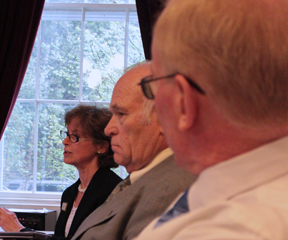
After two days of deadlocked argument over law enforcement access to a statewide prescription drug database, Senate conferees have left the negotiations.
Friday’s arguments hinged on the fate of the section of the bill that defines law enforcement access to a statewide prescription database. Originally the two sides differed on whether it should allow search with a warrant or lower the threshold of suspicion that law enforcement would have to meet in order to get information from the database.
“The Senate walked away,” said a frustrated Rep. Ann Pugh, D-Chittenden.
Friday morning, the House conferees, led by Pugh, proposed removing the section all together and leaving the rest of the bill intact. The bill would then require pharmacies statewide to request a photo ID and enter prescription drug recipients into the Vermont prescription monitoring system (VPMS). It would also require prescribers to be registered with the database and enter information about prescriptions for Schedule II, III and IV drugs.
The Senate presented two proposals. The first further refined the process law enforcement officers would have to go through in order to access the database without a warrant, taking some of the ambiguity out of a process House conferees worried would amount to unconstitutional search.
The second Senate proposal was much shorter – it called for the conference committee to be dissolved and new conferees chosen by both bodies. As the session enters its final days, such a proposal amounts to a death sentence for the bill.
Pugh urged the Senate conferees to consider the House proposal, saving the provisions of the bill both bodies agreed on. Sen. Kevin Mullin, R-Rutland, felt the committee would be doing an injustice to law enforcement if they passed the bill without that provision.
“I agree with you that we’ve done good work,” he said, “but I’m not going to accept the blame when clearly, the Senate has said to law enforcement ‘what do you need to get the job done?’ They’ve told us, and we’re willing to give it to them. So we will not accept the blame.”
After two meetings Friday, it became clear that neither side was willing to budge on the issue.
Sen. Richard Sears, D-Bennington, said the Senate conferees became frustrated after the Senate altered their proposal multiple times and the House conferees stayed firm.
“We moved four steps, they’ve moved none,” Sears said.
Keith Flynn, Vermont’s commissioner of public safety, was also disappointed with the outcome.
“This wasn’t the silver bullet,” he said, “but if it’s a three-legged chair, this was one of the legs of the chair, and the chair’s not going to stand without the third leg.”
Flynn emphasized the three-part approach: education, rehabilitation and enforcement, and said it would only work if all three parts were fully functional. Flynn said law, which will prevail absent an unlikely compromise by the committee, will not allow effective enforcement.
“At the end of the day, regretfully, we don’t have one of the legs on the chair.”

