


This article is by M.D. Drysdale, the editor and publisher of The Herald of Randolph, in which it was first published.
If you’ve been waiting for a whole series of novels set explicitly in Randolph and Braintree and other nearby towns, it’s here, and it’s full of vivid writing.
In The “D Generation Series” you will find familiar local references on every other page — to a road, a town, a business, a neighborhood.
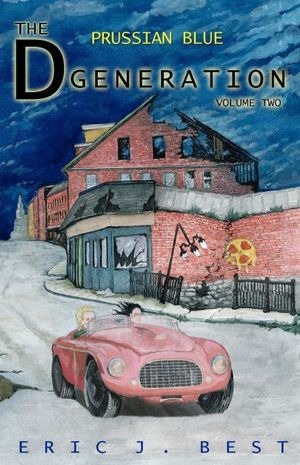
The series is a project — obsession, maybe — of Eric Best, who lived the earlier part of his life in Randolph, graduated from Whitcomb High School in 1989, and now lives again in Randolph. The series debuted in 2010, and the second installment, “Prussian Blue,” was celebrated at a book release party in February.
In a recent interview, Best told The Herald that he doesn’t know how many books there will be, but he has a clear goal: one every year.
The author describes the series as “a Vermont mystery, set in 2056 when the economies of the world are broken, petroleum is banned, China has invaded the West Coast, Vermont is an independent republic, and a plague has wiped out most of the world’s population.”
The name of the series is a brilliant invention — neatly describing the theme of the books while giving a gentle warning that they’re not warm and fuzzy stories. The warning is amplified on the first page, where Best gives his books an “R” rating on numerous counts — including “bad f___ ing languge.”
In fact, one of the more fetching episodes of the first book, if you’re open to that kind of thing, is an argument between the main character James Mann and his hoped-for girlfriend Julia about the relative merits of the “f-word” and the “sh-word.” You get the picture.
Interesting, though, is the fact that in an hour’s interview at The Herald, Best did not utter either one of these popular expressions, nor any other word unfit for a family newspaper that doesn’t even allow the “d-word.”
In fact, Best spoke much more like the person he really is — a stay-at-home parent, partner of Vermont Tech writing instructor Sarah Silbert, and father of 10-year-old Stella, 7-year-old Drew, and 3-year-old Gracie.
The language, violence, drug references, and hard-edged humor in the first two books actually reflect the antithesis of Best’s personal vision, but also his fear that that’s where the world could be headed — that’s what we might D Generate into.
“Sometimes it seems that we are (headed that way),” he said. “I’ve put a lot of thought into it.”
“The backdrop is meant to be a picture of what things could get like,” he explained. “It’s powerful to take things to their logical conclusion.”
In the first book, the general devastation results in what you might expect — terrible poverty and random every-man-for-himself violence. “Prussian Blue” explores what a meltdown of Vermont Yankee would mean for Vermont.
However, though the landscape is bleak, the characters and the writing are not.
“The characters and plot are designed to entertain,” Best insisted.
And Best, though he has never had a writing course, turns out to be very good at it — original, funny, and fond of outrageous but apt similes. The characters, both good and bad, are memorable, and the books are full of language jokes: The violent family that rules much of Braintree is named the Pitts.
Best is serious about his writing.
“I started at 14,” he said. “I had a lot of imagination and didn’t know what to do with it. I wrote pages and pages of godawful stuff.”
After WHS he went through Vermont Tech’s bio-tech program and worked as a chemist for awhile, played in rock bands for awhile, but all the while his writing was getting better, and more disciplined and researched.
He’s completed 300,000 words of a “medieval fantasy,” which some day might be a five-book series. He wrote a book about a stay-at-home dad that he thought might fit the “romance” category at a book-seller’s but wasn’t happy with it.
With the D Generation books, he decided to write “totally for myself, not for any audience, totally uncensored” by others’ expectations.
“I want to visualize life a little different than it is now. There’s a separation between life as it’s become, as opposed to what we want it to be … So many people could care less about what they are doing — and that’s a formula for degeneration.”
Like many authors, he’s finding that the books have their own ideas of how to be written.
“It can be frustrating at times,” he said. “The plot takes on a life of its own. These are the first books I’ve been unable to outline — I didn’t know where the story would go until the last three chapters.”
He already has tentative outlines for three more D-gen books.
“I have too many ideas,” he lamented, but it was a happy lament.
