

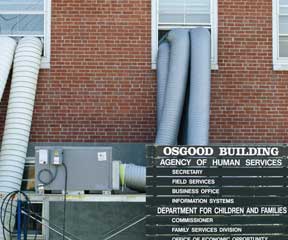
MONTPELIER – The architect evaluating the flooded Waterbury state office complex and its future use said the historic 48-building campus is “in fairly good shape” and has considerable potential.
Jesse Beck, president of Freeman French Freeman in Burlington, offered that encouraging news to lawmakers Wednesday based on preliminary reviews of the office space flooded by Tropical Storm Irene.
Beck said his team “hit the ground running” on Jan. 2 after its selection and has already visited and evaluated every building in the 700,000 square feet of office space at the 100-acre site, which was built as a mental hospital and once housed 2,000 patients. The fact the buildings were in use and maintained as state offices for more than three decades, even though some of the structures were built before 1900, has left them “well taken care of.”
“They do have potential. We’re not finding that we need to tear down the entire complex to make it a really good functioning future complex for the state,” he said.
Beck is leading his firm and another firm that specializes in historic restoration, Goody Clancy of Boston, Mass., along with seven other consultants in a wide-ranging eight-week feasibility review designed to provide the state with a range of options for Waterbury, other potential workplace sites in central Vermont and a look at how all the cost figures stack up. The firm is on a sprint timetable to look at everything from flood mitigation to energy use, heating options economics and usability of the spaces as 21st century offices. The complex housed 1,500 office workers when Irene struck Aug 28.
The decision is of momentous import for the state and for the economically hard-hit community of Waterbury, which also suffered serious flood damage, as well as the loss of state workers, who have been dispersed to other locations for as long as two years. Early cost estimates to restore the complex range from $65 million to $85 million, and the state has already spent more than $20 million to bring back the basic infrastructures.
Beck, who appeared before the House Institutions Committee in the afternoon, said 47 of the buildings had some flooding but it was only on the first floors. The buildings do have historic value, and it is possible to “make them even better,” he said. A large team has been set up and is working at the complex during the evaluation, he said.
He told the panel that the firms are also evaluating a number of other options for state workers in the region. Included are a proposal by Gov. Peter Shumlin to house some 150 workers in the Department of Education in a new building in the city of Barre, as well as sites that have been under consideration in Montpelier, such as the area around the Department of Labor near Montpelier High School.
Shumlin last week laid out a plan to move Agency of Natural Resource workers to National Life in Montpelier, consolidate education workers in Barre, and move some 1,000 Agency of Human Services employees back to Waterbury.
Buildings and General Services Commissioner Michael Obuchowski told the panel that the administration’s proposals for the education department and human services agency had resulted in changes to the scope of the feasibility study. He said he had “a great deal of confidence” in Freeman French Freeman and the other firms that were chosen by his department through bidding to do the work.
In response to questions from lawmakers, Beck made it clear his job is not to recommend any one path but “lay out the facts” and give the state options with cost figures attached. He said that would include looking at all kinds of flood mitigation avenues and estimating risks, which he called “a huge part of our charge.”
Beck assured lawmakers the options include the possibility of “full reuse” of all of Waterbury, notwithstanding the governor’s proposals, as well as putting up brand new office spaces, with all the ancillary issues of access and parking. The feasibility review is also looking at the costs of “greening” the whole site, new “energy envelopes” and mechanical systems, and air testing of the flooded buildings, he said.
According to Beck, the firm’s task is not a short-term solution but to “establish a vision for Waterbury that would turn it into a modern workplace.”
Beck said the architects have met with the leadership of all the displaced agencies and the Education Department about their office needs and goals.
He said the clear message he got was that “adjacency is very important,” noting a strong desire of departments to work together. But he said specific designs and visualizations of what new office spaces would look like were “drilling down” to a task level that wasn’t part of their charge.
Lawmakers stressed several themes to Beck. Montpelier Mayor Mary Hooper, who represents Montpelier in the House and serves on the panel, stressed that vibrant downtowns are a key asset of Vermont, and Rep. Joan Lenes, D- Chittenden, made a similar point saying, “I value the role of Waterbury in the state,” urging Beck to give the full reuse of the historic buildings strong consideration.
Rep. Robert South, D-St. Johnsbury, said the panel was “very excited” to be involved with the study but also said he was in Waterbury the day after the flood and it left a strong impression.
He declared there was no doubt to him that it will flood again, and said any plan should take that into consideration.

