

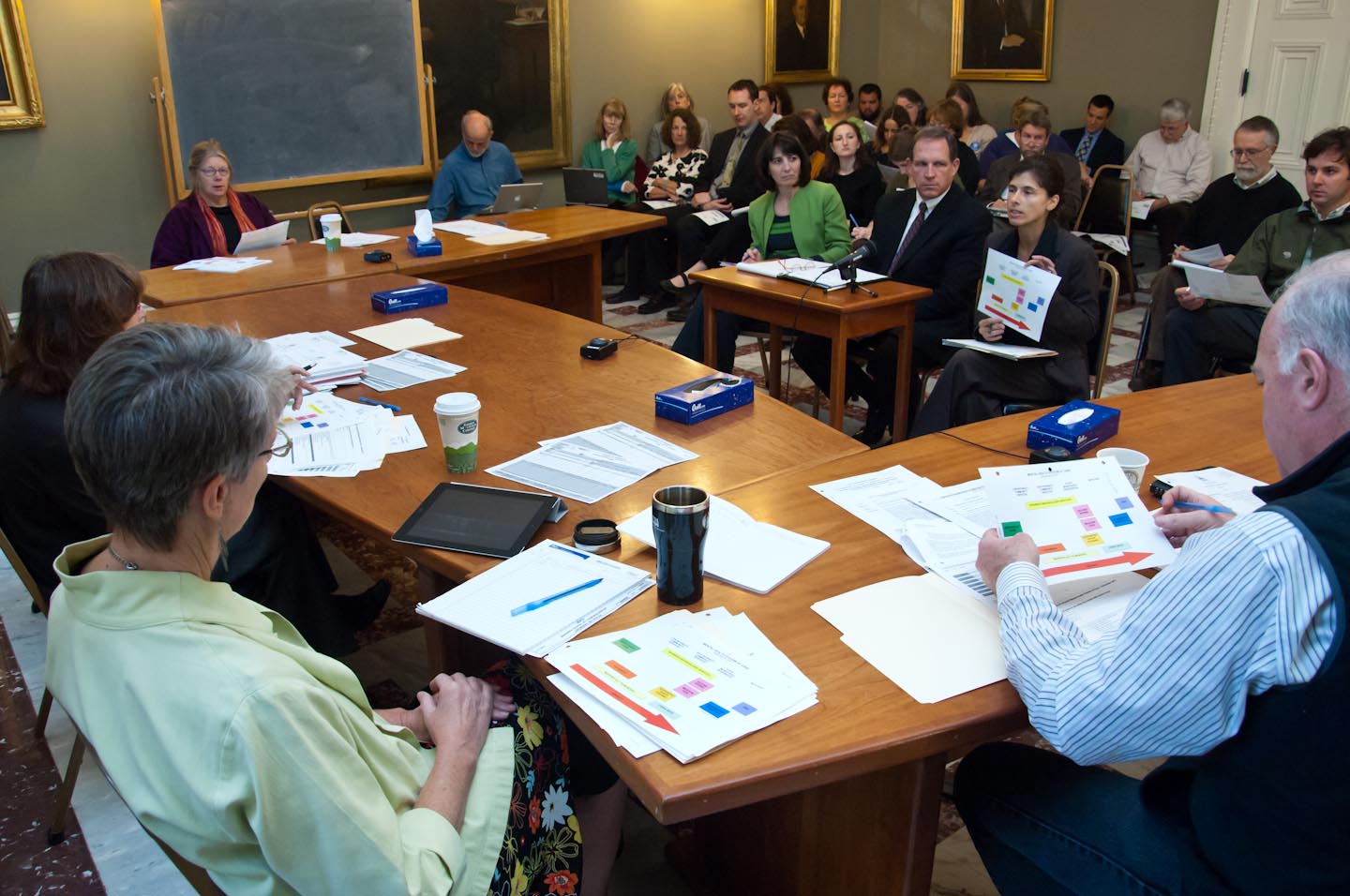
MONTPELIER — A daylong legislative hearing Wednesday detailed the extensive impacts of the emergency closure of the Vermont State Hospital in Waterbury, especially on hospital emergency rooms around Vermont.
Dr. Ed Haak, emergency department medical director at Northwestern Medical Center in St. Albans, said emergency rooms are seeing challenging patients and facing “dangerous circumstances” because of the lack of a place to send patients in severe mental health crisis.
“We’re having to make some very difficult decisions on the edge,” he said, citing four actual recent cases, one of which ended in a person’s death after she left the hospital, he told lawmakers on the Mental Health Oversight Committee at the Statehouse.
“Emergency rooms may be the worst places to treat these people,” he said. Citing the disruptions they can cause for doctors, nurses and other patients and the unsuitability of the wards for handling the cases or providing treatment, he argued the state needs to “have a Vermont state hospital” type of facility.
Patrick Flood, deputy commissioner of the Agency of Human Services, conceded to lawmakers that there was considerable “frustration” at the upheaval in the state’s mental health system. He agreed that having emergency rooms deal with patients in crisis for extended periods “was unacceptable” but promised the state is taking steps to ease the situation, including a new tracking system that will better spell out where patients in crisis can be sent.
At the same time, he also said in the larger picture the state is making considerable progress in figuring out how best to restructure the mental health care system and replace the 54 beds lost after the Waterbury facility was evacuated and closed Aug. 28 because of flooding from tropical storm Irene.
“I believe we’re getting very close to the point we can answer all the questions everybody has,” said Flood. He said he hoped to present legislators with a long-term plan that is a “balanced system” in as little as three weeks.
That “balance” — Rep. Mary Hooper, D-Montpelier, called it a “hierarchy” of care options — will be more community oriented and diverse than what the state had before, according to the plans discussed Wednesday. These include earlier crisis intervention, specialized intensive “wraparound” community care, and beefed up services at existing mental health care facilities, agencies and hospitals.
Flood also told lawmakers that a 10-cell work camp prison facility in Windsor, set off in a separate building, may be the long-term solution for housing those under court-ordered evaluation who are currently being held and treated in the Southern State Correctional Facility in Springfield under less than ideal conditions. He said officials should know in about a month if that alternative, which will need some renovations, could work.
Still unresolved and the subject of a “lot of consternation,” Flood conceded, is whether there will be any kind of standalone state hospital such as Waterbury, even in a downsized form.
That issue has drawn the strongest dissent and concern, not just from hospital emergency room administrators but from some mental health advocates and also the Vermont State Employees Association, which represents the 240 displaced VSH workers now spread around the state at other facilities.
Flood conceded getting considerable “push back” to the state’s plans for a 10-year contract for 14 acute care beds with the Brattleboro Retreat, which took in patients from VSH when it closed.
Those beds would replace some of the 54 that were at VSH. The state is now planning for around 30 replacement VSH acute beds in total.
While the VSH had 51 patients when it closed, Rebecca Heinz, deputy mental health commissioner and interim state hospital director, said 20-25 of those patients were housed at the state hospital only because there was no alternative place to send them. That estimate came from close analysis of VSH patients by the state. Where and how those slots are going to end up remains a critical question.
“There is a lot of change that’s happening right now in our system, ” he said, noting someone had described it as “three Rubik cubes you’re trying to manage all at the same time.”
Two VSH psych techs, Kris Martin of Waterbury and Peter Bartlett of St. Albans, both stressed to lawmakers the experience that VSH staff brought to care and said they were worried about quality and safety of patients as the state explores other options at private facilities.
“I think the only logical solution would be a centrally located new hospital with 30 beds at least,” Bartlett said.
Others who testified Wednesday, while praising VSH workers and all others in the system for responding to the VSH closure, urged a broad rethinking of the entire system.
“I hope we think a little outside the box,” said Ed Paquin, the executive director of Disability Rights Vermont, saying he’s hearing some “good ideas being put on the table.”
Paquin detailed feedback he’s received about how many of the providers the state has had to rely on are doing, noting some culture clashes and differences of procedure at psychiatric wards such as Fletcher Allen Medical Center in Burlington, which has 28 beds and is taking some patients who would have ended up at VSH. But he argued that may be a good thing.
“What can we learn from this interaction? What can we learn from these different styles of working,” he said.
Several mental health providers said their biggest problem is dealing with patients who are involuntarily committed. Dr. W. Gordon Frankle of the Rutland Regional Medical Center, said the hospital faced as many as three patients requiring one-to-one supervision at a time, causing “a significant degree of stress in our staff and the hospital generally.”
Others like George Karabakakis, COO of mental health service provider HCRS in Springfield, noted that emergency room admissions cost roughly $1,000 or more which could be saved if other alternatives were available. He said crisis centers or mobile teams could head off emergency room interventions saving money and also providing better treatment.
Echoing a theme many expressed Wednesday about the complexity and interrelationships of the entire system, he said “Everything is hitched to everything else, everything we do is connected.”
How things connect in the end is up to lawmakers, who will have final say on the proposed shape and structure and funding of Vermont’s mental health system following VSH’s closure. Several Wednesday urged Flood and other mental health officials to use the closure to expand their thinking.
“This is an opportunity to be creative,” said Sen. Sally Fox, D-Chittenden, who chaired the panel Wednesday.
Flood invited feedback from lawmakers considering the many thorny issues that lie ahead, such the geographic location and size of any VSH-type facility and what range of care options should exist and where, as well as cost issues, which all touch the political and legislative realm.
On the cost issue, Flood said Irene may have provided at least one “silver lining.” He told lawmakers that taking into consideration the VSH’s $24 million budget, together with anticipated eligibility for federal 60-40 Medicaid reimbursement denied VSH because of quality issues, the state should be able to pay for the revamping of its system.
“The quick answer is, yes, I think we can afford this,” Flood said.
Clarification: We originally reported that Ed Paquin is the director of the Vermont Coalition for Disability Rights. While Paquin is the president of the coalition, he was speaking at the hearing as the executive director of Disability Rights Vermont.
-30-

