


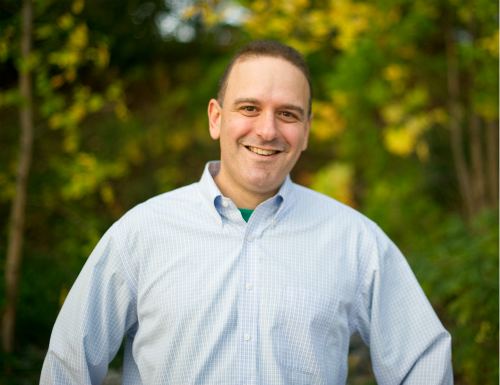
In an interview with VTDigger, the 44-year-old business consultant and performer explained the idea in terms of engagement. “Being able to connect with people, whether it’s on a stage or one-to-one, is not just the icing. It’s an essential ingredient of the job,” he argues. “And I’m the only one who can say he has run a business, created laws and am qualified to be the CMO. I’ve run a marketing business.”
Lorber was the first Democrat to officially enter the race but has since been joined by City Councilor Bram Kranichfeld, Airport Commissioner Miro Weinberger and state Sen. Tim Ashe. On Nov. 13, local Democrats will choose one of these four to face likely GOP nominee Kurt Wright, as well as a possible Progressive candidate – if Ashe loses the Democratic caucus — and any other resident who files enough signatures. Estimates of the likely Democratic turnout at Memorial Auditorium range from 1,200 to 2,000.
Last week, the caucus fight became a bit tougher when United Professional AFT Vermont, Burlington’s largest union, took the unprecedented step of endorsing Ashe before the Democrats make their choice. United Professional President Ben Johnson, reaching farther still, christened the former city councilor and state senator “a young Bernie Sanders.” The union represents educators, nurses and health care professions at the city’s two biggest employers, UVM and Fletcher Allen Hospital.
In contrast, Lorber’s caucus strategy has featured more than 20 “backyard brainstorms,” both at homes and at businesses. “People are sharing their ideas with me, with an emphasis on sharing, not a one-way conversation,” he says. “We need to hear from people. I’m asking them questions. Afterward, I write up a report and share that.”
One of his main arguments is that Burlington’s current challenges require a leader with a combination of public and private sector experience. “We need to restore trust and financial stability while still holding true to the things that make Burlington special,” he says. He’s also mindful of local political realities. “We need to work across party lines,” he says. “I have support from Democrats, Independents and even some Republicans. My tenure in the Legislature has shown that I can do that.”
Beyond all this, however, he asserts that he is the only person in the race with a complete commitment to transparency. “All the candidates are talking about financial transparency,” he notes pointedly. “But I’m the only one who has released my campaign finances. I’ve said where the money is coming from and where it’s going.”
Transparency, he says, is a core personal value – “it’s how I live and work.” A recent example was his opening remarks at the first Democratic candidates debate, a frank and moving story about coming out as gay. In the Vermont House of Representatives, Lorber was a leader in the fight for same-sex marriage.
“I’ve been transparent in my voting, in my campaigns and in my personal life,” he says. The approach was also part of his first legislative success – reigning in escalating prison costs. When then-House Speaker Gaye Symington asked the first-term legislator to take a look at the problem, he met with commissioners and other stakeholders, but ended up feeling he wasn’t learning enough. Moving beyond the usual sources between legislative sessions, he sought out people who don’t make it to hearings in Montpelier: prisoners, and court and corrections workers.
The results became a 42-page report, “53 Voices on Corrections in Vermont,” which Lorber published online in what he calls a demonstration of transparency. The report and his legislative work on the issue “helped formulate solutions to halt the rising costs, saving the state tens of millions of dollars, making communities safer and helping Vermonters find the help they needed,” he claims.
In Burlington, part of his prescription is a more transparent accounting system. “We need to eliminate the ‘just trust me’ financing system we have now,” he charges, “and have timely and regular audits.”
Applying the same standard, he concludes that a proposal by Kurt Wright to eliminate party designations in local elections for mayor and the City Council is not the way to go. “We need more transparency, and eliminating party labels would muddy the waters,” he argues. “We need to be clear about who we are. We get that with more clear identification from candidates. Who is backing you is another indication of where your values are.”
Promoting change and accountability
Lorber’s approach to leadership emerged at least 20 years ago. After growing up in Philadelphia, he attended the University of California at Berkeley, then studied for an MBA at Stanford in the early 1990s. While there, he conducted a “self-initiated” study of top business schools to “hold people accountable on whether they were gay-friendly, using objective criteria.”
In 2002, he conducted a follow-up and found that 86 percent of leading business schools now had gay-friendly groups, up from 50 percent in 1995. The Business Week story on Lorber’s work was called “B-Schools Gain a Lavender Tinge.”
“The report received national and international recognition, and the schools changed,” he recalls. “If that’s how you grade us, they decided, we’ll adopt those policies. And that’s relevant to Burlington. The city needs greater accountability and transparency. This is not a new topic for me.”
After school, he founded Aplomb Consulting, a small business that works with non-profits and health clinics, and also launched a career as a comedian. “I could have followed the same road as some of my classmates to lucrative jobs,” he says. “But I followed my dream and started my own company, and focused on strengthening communities, especially LGBQ communities, people of color, HIV and AIDS. And, in working with oppressed communities, we found we could strengthen them.”
Arriving in Vermont in 2002, he replaced Progressive Steve Hingtgen in 2004 as representative of Burlington’s District 3-3, which covers downtown, the waterfront and part of the Old North End. Since then, he has been re-elected three times, has served on the House Institutions and Corrections Committee and ran for House majority whip in 2008.
Summing up his legislative experience, Lorber points to success “across a variety of subjects, from saving tens of millions through Justice Reinvestment, to Farm-to-Plate legislation, which strengthens the buy-local movement, promotes sustainability and ties into farmers markets. Part of that is also Farm-to-Schools, getting locally grown food to schools and teaching students.”
Of the four Democrats running to replace Mayor Bob Kiss, he has been the least openly critical of the current mayor in debates and interviews. However, he does think change is sorely needed, in Burlington and across the country, and speaks often about the need to “restore trust and financial stability.”
Since the emergence of the Occupy movement, Lorber has attended several Vermont rallies. “I support what we are doing,” he says, emphasizing his feeling of connection. “Here in Burlington and across country citizens are outraged. Where is accountability in Washington, or in this city?
“Humanity should come before profits,” he continues. “And we need open communication. Some people misunderstand marketing and positive spin.” Then he steers the topic back to Burlington and his campaign message, adding: “At some point the truth will come out. The people will find out, and you need to answer to that. The mayor shouldn’t run the city behind closed doors.”
Community, partnerships, and values
In the second Democratic debate this season Lorber challenged his opponents directly on two points. Why weren’t they releasing details of their campaign finances, as he already had? And why not sell Burlington International Airport?
Tim Ashe shrugged off the sale proposal as a non-starter that has been “discussed for decades.” On campaign finance, the response was silence.
Lorber insists that his approach to selling the airport wouldn’t be a surrender to financial crisis, or the same as Kurt Wright’s proposal to privatize the Burlington Electric Department to reduce the city debt. “Burlington Electric is part and parcel of who were are,” he insists. “The Burlington Airport isn’t even in Burlington. It’s a regional asset. It serves the transportation needs of the entire region and the state. Why should Burlington taxpayers shoulder all the responsibilities?
“If we could share this – I call it a Shareport,” he continues, “other communities could share in the responsibility, with management oversight, and receiving some benefits – as they should. Freeing up some assets means we can focus on our own transportation infrastructure in Burlington. For instance, we can make Burlington the urban biking capital of the nation.”
Sharing ownership with other communities isn’t privatization, he argues. “The problem with privatization is that it often undermines workers’ rights and collective bargaining.”
Beyond that, he sees Wright’s BED sale plan as crisis thinking and a surrender to fear. “We’ve heard this before,” he said. “They talk about Social Security being bankrupt, and therefore we should give up our principles. But we’re not in crisis mode here. You don’t mortgage your house to pay off your credit card bills.”
“We need to stop Kurt Wright,” he offered, explaining why he expects to support the Democratic candidate if he fails to win the caucus. Asked to elaborate, however, there was a lengthy pause before he carefully added: “We’ll have an opportunity to have a broader discussion, but I’m not running because I don’t want Kurt Wright to be mayor. I believe I’m the best person, and want to put may experience and values to work.”
Nevertheless, Lorber believes that solutions to the city’s pension fund shortfall and BT’s financial troubles can be found without selling assets, committing “financial malpractice that goes against the values of sustainability and reducing energy.” In the case of Burlington Telecom, he said, that means preserving public ownership “within financial realities.” Local Cable TV rates are lower because BT exists, he insists. “But even if it became a private entity, I would want some public involvement.”
He is more enthusiastic about partnerships with private and other enterprises, seeing possibilities ahead for BED, BT, the airport and local schools that “maximize community benefits and financial results.” A case can even be made for more development on the waterfront, he argues, as long as it is “environmentally friendly and maintains public access and the character of Burlington.” Personally, Lorber would like to see more boating slips. “We can be a destination city for tourism,” he says.
But not all partnerships are equal, he adds. For example, “The approach and results with Lockheed Martin was wrongheaded.”
This relates to Lorber’s focus on “values,” a topic to which he often returns. Among those often mentioned are diversity, sustainability, labor rights, fairness and accountability. “We share a burden when others are victims of sexual and domestic violence,” he says, “whether they are facing homelessness, drug addiction or marginalization. We’re stronger when we work together.”
Looking forward, he said he prefers to focus more on asking questions, collecting facts and addressing concrete problems than defining a long-term vision. “I don’t have a crystal ball,” he jokes. “When I started my business and went into the state Legislature, I had a general vision. But we’re often faced with unexpected challenges. We need a mayor who is nimble and can handle all that comes at him.”
This, he said, takes him back to 2005 and the day he went on a long walk with then-House Speaker Symington. “She asked what committee assignment I wanted,” he recalls. “I said I was a financial person, a number person, and she said the biggest financial problem was corrections, which was growing by 8 to 10 percent a year. And it wasn’t making us safer.“
Then she asked the rookie lawmaker what he knew about prisons. “Nothing,” Lorber replied, “but I’ll learn. And the rest is history.”
The anecdote makes his larger point: what he sees as his ability to succeed and promote change “in areas where I had no background.” Now, Lorber says, he wants to put that talent, along with his business and legislative background, to use as mayor and “make Burlington a model of what a small city can be.”
