

Editor’s note: This article first appeared in the Waterbury Record.
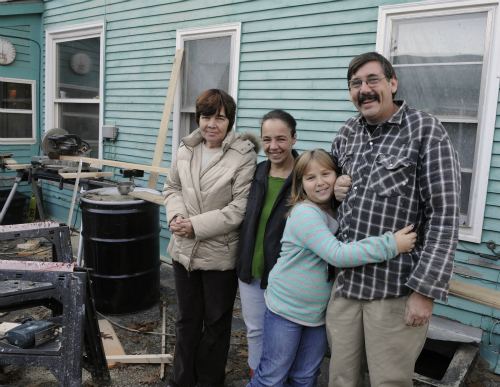
On Monday, August 29, a television reporter approached Dzehva Kadric as she stood in the flooded wreckage of her home at 135 South Main Street in Waterbury. The Winooski River now occupied her basement. Her living room furniture was upside down, saturated with putrid water and covered in mud. And she was smiling.
Why, asked the reporter.
Because this is not the worst thing that ever happened to me, states Dzehva (pronounced JAY-va), 55, a refugee from war torn Bosnia. “I had more hard than this,” she explains to me now in broken English. “Nobody die. I lost things, but I can buy. If you die, you can’t buy life.”
Dzehva has deep experience with loss. The Kadrics are a Bosnian family that had lived for generations in a village in southeastern Europe that was part of the former Yugoslavia. In 1992, Yugoslavia began a violent, tortuous breakup, marked by war and campaigns of ethnic cleansing. Dzehva recalls seeing school busses full of hooded soldiers rolling into her town, which was on the border between Bosnia and Serbia; the busses would leave carrying the town’s boys and men, who she saw with their hands behind their head and staring at the floor.
One night at 2 a.m., she and her family were awoken as their front door was kicked in. It was the police; they had come for her husband Fikret and oldest son, Samir. Fikret and Samir disappeared for three agonizing months, during which time the family did not know whether they were dead or alive. Finally, the men returned. But Dzehva knew it was time to go. All around them, neighbors were being forced to flee their homes. “A lot families were bombed and killed. It was scary,” she recalls.
“For 200 years, my family lived in the same village. Then people come and say, ‘You must leave. You can’t take anything. You must just go’.” A particularly painful part of the experience was that it was her neighbors who took her house and forced her to flee. “One month, we all at the same table talking. Afterward, we fighting each other. It was terrible.”
Overnight, she lost her home, her job, and her possessions as her family fled to Hungary. Suddenly, they were refugees.
That was the first time the Kadrics lost their home. She tells me this story as we sit on a faded plaid couch in her kitchen. The adjoining living room was flooded and is now a mess of plywood and Sheetrock, but volunteers helped replace waterlogged cabinets and flooring so that the family could have a kitchen to cook in and use as common space, while they moved back into their second floor. Dzehva’s 9-year old granddaughter Samira sits on the couch next to me.
I knew that a feature of the war in Bosnia in the 1990s was the widespread ethnic cleansing of Bosnian Muslims by Serbs, who were largely Christian. In an effort to grasp where her family fit into the conflict, I asked Dzehva whether she was Muslim or Christian. She stared silently at me. I assumed she didn’t understand my question. So I posed it to Samira, who is fluent in both English and Bosnian. The bubbly fourth grader gave me a puzzled looked and said nothing.
I suddenly realized the stupidity of my question. Dzehva had understood me perfectly. But fifteen years ago, giving the wrong answer to this question could have gotten her killed. “Me no teach her about the difference between religions,” Dzehva abruptly declares, shaking her finger and breaking the awkward silence. “Everybody the same.”
She holds up her hand with her fingers together. “One hand have same fingers. I can’t say Muslim or Serb give me hard time. Everybody have hard time.”
The Kadrics were refugees in Hungary for four years. Finally, they were told that they would be able to resettle in the U.S. In 1996, the Vermont Refugee Resettlement Program placed them in Waterbury. Their long odyssey from war to peace was over.
Then tragedy struck again. A few months after settling in Vermont, Fikret and Samir landed jobs working the night shift at the Cabot Creamery in Cabot. In May 1997, Driving home in a borrowed car one night, they lost control of the vehicle and it plunged into a brook. Samir, 22, was killed; Fikret was gravely injured. As we speak, Fikret stands quietly off to the side. He has been unable to work since his accident 14 years ago.
Surviving
Dzehva, her surviving son Damir and daughter Safa all took on work to support the struggling family. Eventually, they all got jobs working at the Vermont State Hospital in Waterbury. The women worked with patients as psychiatric technicians, while Damir worked as a security guard. In 1999, Dzehva saved enough money to buy a home at 135 S. Main Street. Five years later, Safa bought the neighboring house at 133 S. Main Street.
After nearly a decade of upheaval and tragedy, the Kadric family had finally sunk new roots.
Then Tropical Storm Irene threatened to uproot them once again.

Dzehva and Safa walked down Main Street to check on the river, and back to the Vermont State Hospital. The river was high, but not flooding. They reassured Damir that they were fine. But at 7:45 pm, Safa went outside again. “I see water coming from both sides,” she recalls, amazed even as she recounts it now. “The river was coming into the back of my house through the State Complex, and coming to the front of my house on Main Street. I grabbed my mother, my father, my daughter and our dogs and got them in the car. My daughter was screaming. We drove through the water and got to Burlington.”
The next morning, the Kadrics returned to find a scene of devastation. Damir forced open Safa’s front door. “Oh my god…” was all Safa could say. There was three feet of water in the house, her prized possession. Her refrigerator was overturned and the contents spilled everywhere. An oil tank had ruptured in the basement. Furniture floated to settle in random places. Mud glazed everything. The family found a similar scene at her mother’s house. An apartment that the family rents was flooded, as was her mother’s basement, her living room and part of her kitchen. A car belonging to Damir sat in the garage with water up to its windows.
The family’s hard fought dream of making a new life in Vermont seemed on the verge of unraveling. Safa had recently lost her job at the state hospital, and Dzehva has been out on disability for a year. They had no money to clean up and repair their homes. They were overwhelmed as they contemplated the disaster.
Bob McNamara, their refugee sponsor and a retired superintendent of schools in the Washington West district, was the first to show up at their houses; he started to clean. Then one after another … and another … volunteers appeared. An army had arrived at their door. Only this time, the people showing up were peaceful, intent only on helping the Bosnian family.
Dzehva has been stunned by the volunteer outpouring. She rattles off the list of helpers – “Ben & Jerry’s, Green Mountain Coffee Roasters, many people from Burlington, Kevin from Blush Hill, and Bob McNamara is here everyday helping. The whole town seems like they helping us.” Dzehva puts her hand over her mouth and shakes her head. “I know people are helpful here. But I so surprised. They do very hard jobs.”
Then came the donations. A washer, dryer and two refrigerators appeared. Monica Martinet, owner of Sally’s Second Act Thrift Shop in Middlesex, showed up with clothes for the family, and an assortment of kitchen items. She is offering free clothes, shoes and books to all flood victims. But she has made an extra effort for the Kadrics.
“It breaks my heart what happened to them,” Martinet tells me. “They’ve had such troubles in their life. I want them to be as whole as possible again.”
“I just want to say ‘thank you everybody,’” Dzehva says. “I hope everybody has lucky life.”
About a week into the cleanup, a tall, soft-spoken man with a distinctive southern accent arrived at the Kadrics. Steve Bennett, 51, pulled up in a pickup truck loaded with construction equipment. He has been a contractor for 30 years in Georgia, but the housing market has died there. His brother, who lives in Moretown, told him he could be helpful if he came to Vermont. Maybe even find some work.
“I basically volunteered a week and worked myself into a job,” he tells me, as we stand inside one of Dzehva’s rental apartments that he has just finished repairing; the freshly painted unit is now ready to rent. In one of the many novel arrangements spawned by the disaster, Bennett now lives with the Kadrics as he fixes their two homes. They pay him $600 per week for three weeks, and he works one week unpaid to pay for his room each month. He’s planning to finish by Christmas.
“I love Vermont, and I love the mountains,” Bennett tells me in a quiet southern drawl. “But I can’t stand the cold.”
Hope takes root
Lately, the daily mix of good and bad news for the Kadrics seems to be tipping toward the positive side. Safa learned that she had flood insurance on her house; Dzehva did not, but FEMA is assisting her. Safa also recently got a job at the Best Western Hotel. The closure of the Vermont State Hospital has left both Dzehva and Damir in employment limbo, but Dzehva has been cooking and selling Bosnian food at the farmer’s market, and she is hoping to find other work.
Safa says proudly, “My goal is to be back in my house by Christmas.”
Her daughter Samira adds, “I hope we have happy times in my house again, like we do on my birthday.”
Just then, her grandmother picks up a letter sitting on her newly repaired kitchen counter. “There is going to be a birthday party for you and Steve at the Congregational Church.” She shows Samira the invitation. The soon-to-be 10 year old beams.
Dzehva Kadrics reflects on her family’s hard journey. “In Europe, my house is just gone. Here, I am able to clean this house. Nobody tells me I have to go. I feeling sad, but it is not so hard like before.”
As Dzehva shows me out through her living room with its exposed walls and subfloors, she stops at a tall, forlorn looking plant sticking up from a five-gallon bucket. “We found this plant in the flood, and we put it in dirt,” she says with gentle smile. It is a rough looking stem that arcs upward from the bucket.
She points to a small green bud that has appeared on the end of the long stalk. “Now,” she says softly, “it is growing again.”
