The Occupy Wall Street movement has been gaining momentum across the United States, and this weekend protests across the country will be backed by organized labor. In Vermont, large crowds are expected to gather in Burlington, Rutland, Montpelier and Brattleboro to hammer home the basic message: The vast majority of Americans – 99 percent – have been “sold out” by banks, Congress and the wealthiest 1 percent.
The Occupy movement’s spokespeople describe their protests as a decentralized, non-violent rebellion against “economic tyranny.” Inspired in part by the Arab Spring, it has grown rapidly through social networks, websites and an alliance of groups and activists.
This Saturday’s events in Vermont, billed as a Mobilization for Jobs and Justice, are linked to America Wants to Work Week, a campaign launched by AFL-CIO unions and community-based allies like the Vermont Workers Center. The Vermont chapters of the American Federation of Teachers (AFT) and the Sierra Club are also among the endorsers.
AFL-CIO President Richard Trumka says the labor movement backs the goals of the protesters. During a conference call with reporters last week, he added: “We are going to support them in any way we can. We’re not going to try to usurp them in any way.”
“This is our time to fight for good family-supporting jobs, and make Wall Street pay their fair share,” explains an announcement for Saturday’s Vermont rallies. “We’ll start the day canvassing with the Workers Center about the jobs crisis and challenges facing our communities. The spreading Wall Street protests show the growing anger and outrage over an economy with 26 million people out of work or underemployed.”
Most Democratic lawmakers have yet to fully endorse the Occupy Wall Street groups in New York, Washington, D.C., Boston and dozens of other cities, while some Republicans denounce the protesters as anti-capitalist or un-American. For Democrats, concerns include the movement’s counter-cultural image, which could alienate some swing voters, and the possibility that provocateurs or a radical faction might lead to property damage or violence.
So far, the movement has been peaceful and disciplined, despite a funky, alternative image. But there have been confrontations. On Oct. 1, police arrested 700 protesters on the Brooklyn Bridge. Earlier this week, more than 100 people were arrested in Washington and Boston for unlawful conduct and assembly.
In Washington, D.C., activists were pepper sprayed while attempting to enter a Smithsonian building to protest weapons spending. The two most aggressive members of the crowd later announced that they were infiltrators who didn’t really support the movement.
There’s something oddly moving about a crowd of smart-phone-addicted, computer savvy people cooperating to create such an utterly low-tech, strikingly human, curiously tribal mean of amplification – a literal loud speaker.”
– Hendrik Hertzberg
The current wave of protests began without a detailed agenda. Rather, Occupy Wall Street initially took aim at “economic tyranny,” focusing on unemployment, controlling corporate greed and getting money out of politics. But as people in various “occupied” communities met in self-organized general assemblies, and sympathetic groups connected the dots between economic woes, America’s wars in Iraq and Afghanistan and environmental threats, the scope expanded into a broad multi-issue mobilization.
Vermont U.S. Rep. Peter Welch, a Democrat, and junior Sen. Bernie Sanders, an independent, have been among the first elected officials to back the movement, and are offering proposals to address some of its grievances.
Welch is fighting the latest attempts to add banking fees to checking accounts. He calls an attempt by Bank of America and Citibank to charge users a monthly fee for use of debit cards “simply shameless,” adding that “at a time when consumers everywhere are struggling to make ends meet, they stick the knife in by charging customers to get access to their accounts. When will enough be enough for big banks?”
Sanders, who praised the protesters for “shining a national spotlight on the most powerful, dangerous and secretive economic and political force in America,” has floated a series of proposals to change the financial system. They include breaking up banks that are supposedly “too big to fail,” a cap on credit card interest rates, low-interest loans to small businesses by the Federal Reserve, ending excessive oil speculation, forcing Wall Street to invest in job creation and imposing a fee for speculative investments like credit default swaps and derivatives.
At Marlboro College, Ralph Meima, director of the Sustainability Management graduate program, has launched an online, “crowd-sourced” Google document that lets contributors around the world help develop an American People’s New Economic Charter. The idea is to create a comprehensive list of legislative, regulatory and social reforms consistent with the Occupy movement.
Crowd-sourcing is an Internet strategy to promote diverse and democratic input. Contributions can vary from the profound to the superfluous. Billed as an “experiment in total inclusion and transparency,” the goal of Meima’s project is “a declaration of the economic changes that the 99 percent want to see come out of the Occupy Wall Street movement.”
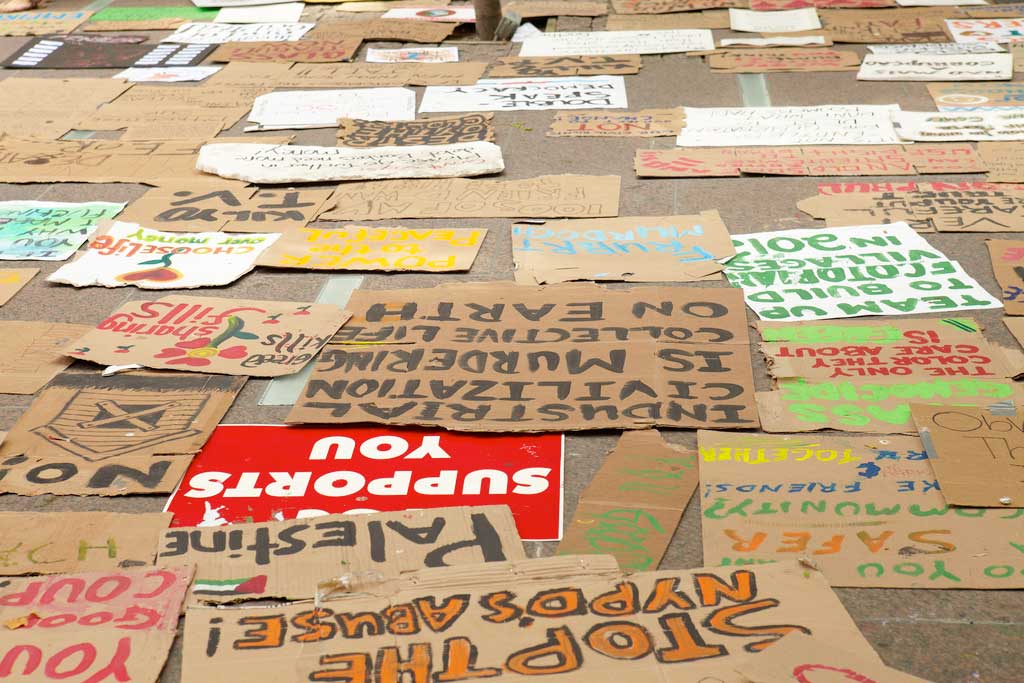
The headline on one Montpelier rally poster gives a sense of the mood: “The War of Wealth.” The schedule for Saturday includes a 3 p.m. solidarity rally at City Hall, a March to the Statehouse at 3:30, and a General Assembly at 4 p.m. Similar events are planned for the same day in Burlington, Brattleboro and Rutland.
Montpelier rally organizers have set up a Facebook link for information. As a follow up, on Monday, Oct. 17, a vigil will be held at the Statehouse from 4 p.m. to 6 p.m. Other Oct. 15 rallies will be held in Burlington’s City Hall Park and Wells Fountain Park in Brattleboro, both at 2 p.m., and at Center Street and Merchants Row in Rutland at 11 a.m.
In recent weeks, protesters have gathered in downtown Burlington and on the University of Vermont campus to support the movement. At a campus teach-in on the steps of the UVM library last week, students expressed solidarity not only with Occupy Wall Street but also with faculty and service-worker unions engaged in contract negotiations. A prime example of “corporate greed” mentioned at that event was former UVM president Dan Fogel’s $410,000 departure package.
“For the first time in a generation, there’s a coalition between radical youth and workers,” noted Helen Scott, an associate professor of English who attended the UVM rally. The turnout on campus was relatively modest. But the crowds at downtown protests on Sundays have grown, from less than 150 on Oc. 2 to around 500 last weekend.
After gathering in City Hall Park last Sunday, hundreds marched up and down the four-block Church Street pedestrian mall. Some held a speakout at the front door of the Citizens Bank. According to Seven Days columnist Shay Totten, Citizens is a subsidiary of the Royal Bank of Scotland, which received U.S. bailout money.
At recent Occupy rallies in Burlington, speakers have also proposed that Vermont should have an “occupation.” Although there has been talk about a local encampment, occupying City Hall or UVM, the most persistent suggestion involves the Vermont Yankee Nuclear Power plant. Burlington Occupy organizer Mathew Cropp called the expected closure of the nuclear plant next March “the biggest thing that unites Vermonters right now. “
“If we’re going to occupy anything,” Cropp suggested to those gathered outside the Citizens Bank, “I suggest we talk about that.” Chanting back, the crowd amplified his proposal.