

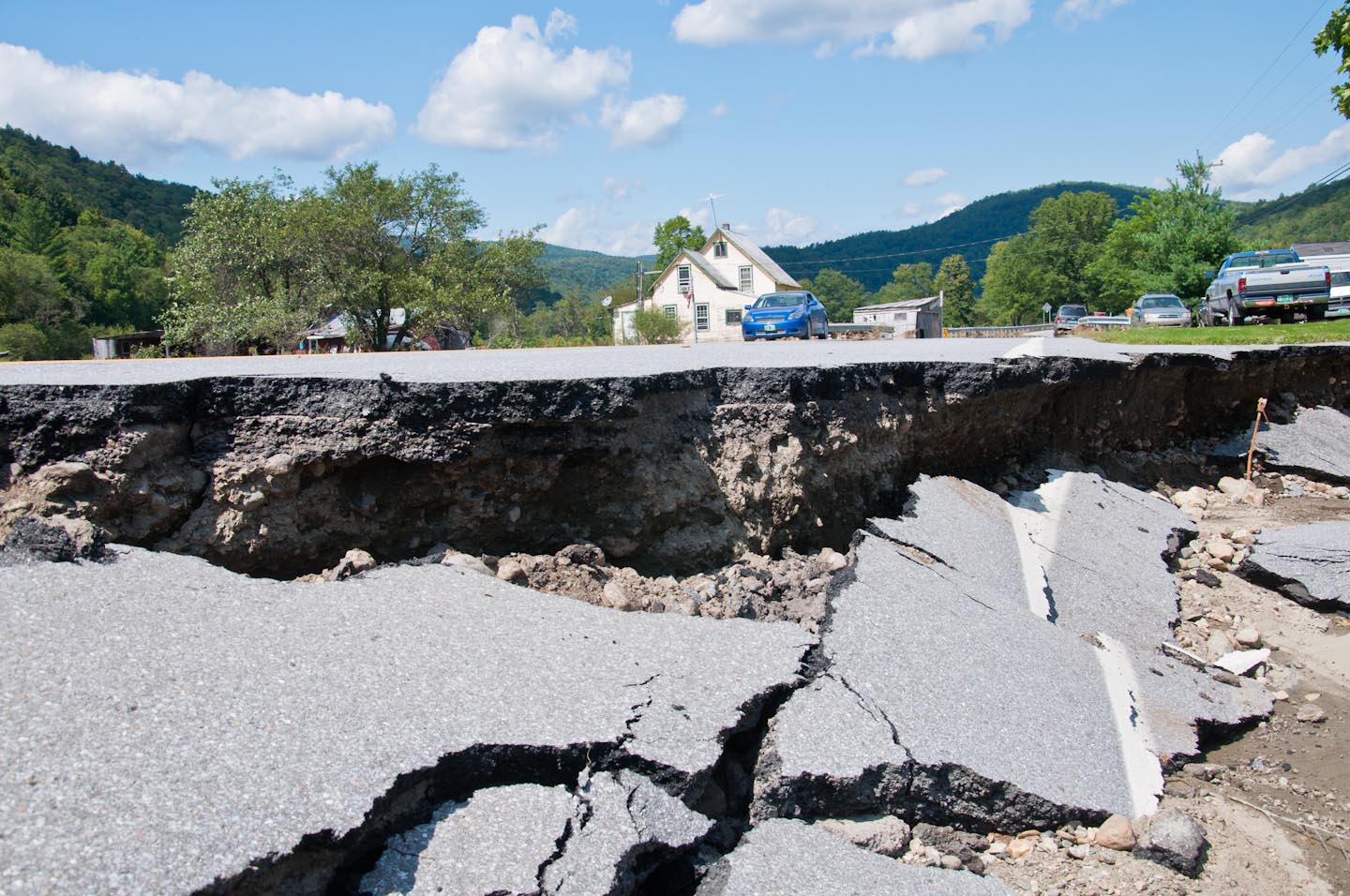
If Congress doesn’t come through with funding to fix Vermont’s roads, the state will face a financial disaster, according to state officials.
The Shumlin administration laid out best- and worst-case scenarios for reporters on Thursday at a “working session” on the Fifth Floor.
In the best-case scenario, the state would need to come up with about $80 million in matching funds for roads and other infrastructure repairs.
In the worst-case scenario, it’s possible, given the current climate in Washington, that the federal government won’t come through with emergency relief transportation funding for state highways, in which case, Vermont could be on the hook for as much as $500 million in costs associated with Tropical Storm Irene.
Gov. Peter Shumlin called the worst-case scenario an “absolute” financial calamity, and he dubbed it “Irene 2.”
“If we do not get a waiver, it will be the equivalent of a second natural disaster,” Shumlin said.
Though the state will receive $100 million in emergency relief, Vermont will not be eligible for any additional federal funding for Irene related state highway repairs without a waiver from the federal government. That means the state would have to find funding for the estimated $464 million in Irene state highway reconstruction projects from its annual appropriation of about $210 million in federal highway “formula” money over a long period of time. The total annual transportation budget is about $500 million.
The governor said this turn of events would set the state’s transportation program back by 10 years.
Sen. Patrick Leahy, D-Vt., and Sen. Bernie Sanders, I-Vt., Leahy and Sanders have introduced an amendment to an appropriations bill that would give the U.S. Secretary of Transportation the authority to grant the state a waiver for the $100 million cap on emergency relief funding. The measure, which was sponsored by Leahy and Sanders, will be taken up in the next few weeks, but because House Republicans are holding up the budget process (not a single one of the 13 budget bills have been approved yet), and demanding cuts in all federal programs, the future of the waiver, which has been standard operating procedure in past disaster crises in other states, is now in question.
If the waiver doesn’t come through, all other projects VTrans has planned would be put off indefinitely because Irene projects would rise to the top of the queue and displace plans for bridge replacements and road repairs around the state. Vermont’s transportation infrastructure is aging and in some places it is badly deteriorated, Shumlin said.
The governor had just returned from a day and a half stint in Washington, D.C., where he had planned to make a case for more money for Vermont.
“It’s imperative that we succeed in Congress in getting this provision through Vermont,” Shumlin told reporters at a “working session” on the Fifth Floor. “New Orleans got it when they were down on their hands and knees, other states got it when they got in trouble.”
Shumlin said there is no way for the state to tax itself out of the problem.
“Reporters will ask, will you support this tax, will you support that tax,” Shumlin said. “My friends, there is not enough money in Vermonters’ pockets if the worst- case scenario happens to tax Vermont’s way out of this challenge. As you know, Rep. (Margaret) Cheney has proposed a 5-cent gas tax, as an example. That would raise $15 million.
“We have a $900 million problem; $500 million being attributed to our transportation program alone,” Shumlin continued. “So you can do the math. We can’t tax our way out of this one. We need the help of Congress. If we don’t have it, it’s going to have a severe impact on Vermonters. It will really result in what I call the second major disaster for Vermont.”
State officials released a new estimate of $935 million for the total amount of damage to Vermont infrastructure. Shumlin cautioned that the estimate is preliminary and could go up or down significantly as the state continues to gather more information.
Brian Searles, secretary of the Agency of Transportation, said the road repair estimate — $480 million for state highways and bridges — does not include “upward pressures” such as improvements in roadways and bridges to prevent future flooding. About $12 million in additional costs for road repairs will be ineligible for FEMA or federal highway emergency relief funding.
Municipal highway reconstruction estimates are now at about $140 million.
Shumlin said it’s very likely that the state will qualify for a 90 percent federal match (the standard match is 75 percent) for public assistance from the Federal Emergency Management Agency. The state and municipalities split the difference, and so towns would need to come up with 5 percent of the funding for projects. The total amount needed for the match from towns would be about $7 million.
“Municipalities are sitting on a better foundation than the state of Vermont,” Shumlin said.
No state highway projects under construction have been delayed, but Searles said planning work for projects has been scrapped for now. The agency is focused on emergency work before winter. To pay for those repairs, VTrans is using annual state highway formula funding until the state receives emergency relief funding from the federal government.
When asked if the state is “really in a bad jam,” Jeb Spaulding, secretary of the Agency of Administration, responded with an emphatic “Yes.”
“You’ll see projects backed up,” Spaulding said. “Some projects we thought would go forward will not go forward.”
The state must also reimburse National Guard members from other states who came to help in the immediate aftermath of the flood, and it appears that the $14.35 million expense will not be eligible under FEMA rules. The Vermont National Guard expenses of $1.57 million are reimbursable and the state match is about $390,000.
Editor’s note: A write-through of this story was posted at 7 a.m. Oct. 14.
