

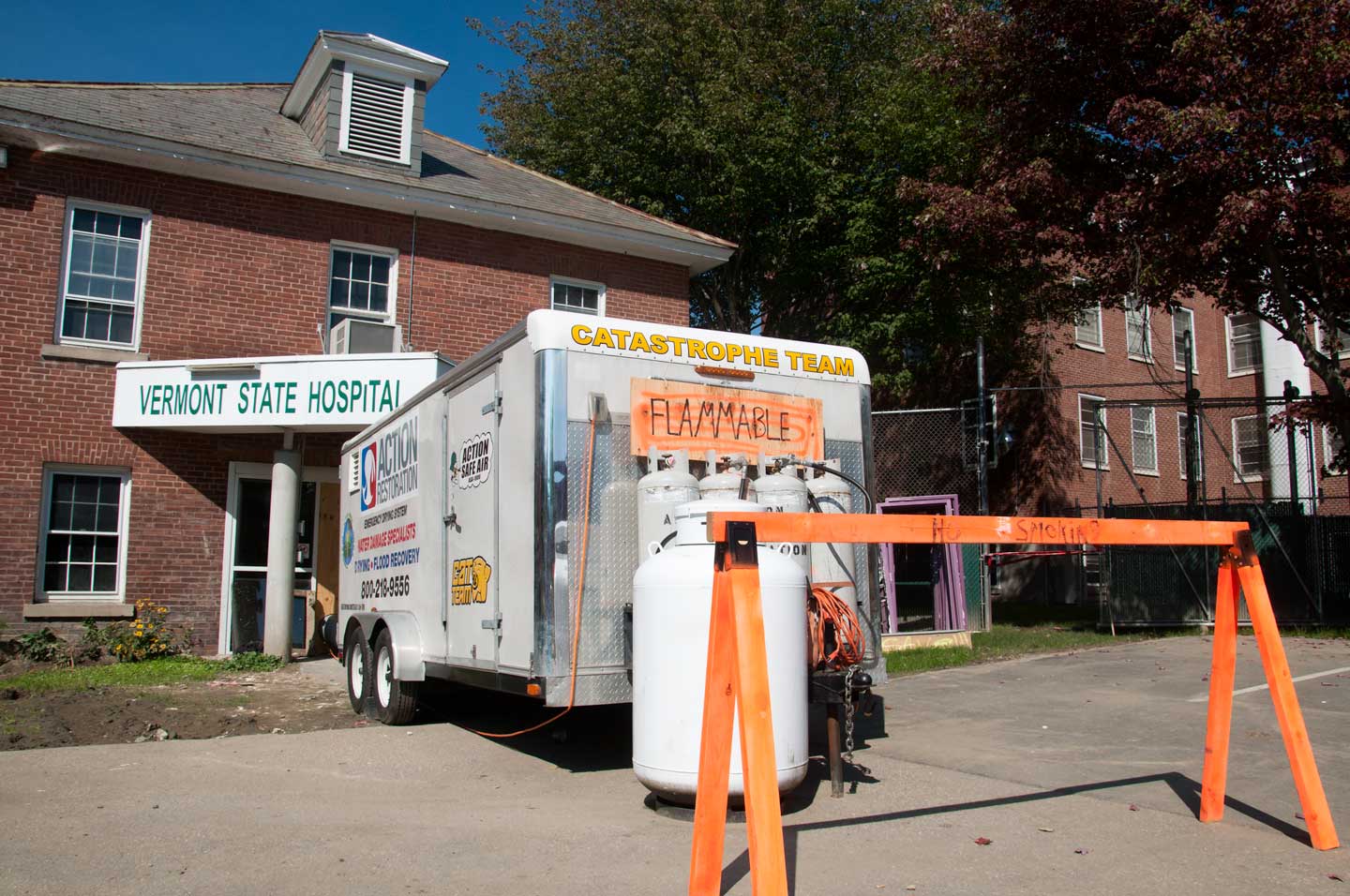
Despite “turning over every stone” to find an interim replacement for the flooded-out Vermont State Hospital in Waterbury, the state so far has come up empty.
The hospital, a critical part of the mental health system that serves those in acute crisis, remains closed because of damage from Tropical Storm Irene, which shut down the entire State Office Complex in Waterbury. A total of 51 patients were evacuated to other mental health treatment facilities around the state during the emergency.
Stresses on the treatment system statewide and on hospital staff continue to mount, and so does concern about the adequacy of patient treatment, according to Christine Oliver, commissioner of the Department of Mental Health. “We continue to be concerned about a lack of a hospital at this point,” she told a meeting of the State Hospital Steering Committtee Wednesday at the department’s temporary offices in the historic Redstone office building in Montpelier, where staffers were relocated after the flood.
“We did not expect that people (patients) would be in these placements this long. That makes me anxious,” she said.
Oliver said the system can’t go on for much longer without an interim solution, even if that means returning patients to the Brooks building at the VSH, an alternative no one likes.
“We have looked high and low, far and wide — nursing homes, hospital wings, convents, church basements, you name it,” she said.
“Quite frankly, we have not been very successful,” she said.
Many mental health advocates, several of whom attended the meeting, had grave concerns about the antiquated State Hospital building before the flooding and have urged smaller and more modern regional options to a centralized hospital. Oliver said the state is continuing work on a long-term plan, but for now it desperately needs to find something in the interim.
“The Brooks option remains on the table because I don’t have the luxury of taking it off the table,” she said,
Citing the time it would take to get any interim plan up and running and the “unsustainable” way patients are being cared for now, she said bluntly, “We really need to get to a decision.”
“Everybody is stretched beyond the point where they thought they could go,” she said, saying that applies equally to facilities that took in patients and VSH staff that is caring for them all around the state.
“I don’t know how they’ve taken it this long,” noting staff are doing overnights and long commutes that have disrupted their lives.
Rebecca Heintz, deputy commissioner and interim director of the State Hospital, echoed that view, saying hospital staff and the system were “fraying around the edges.” She said the patient dispersal, to places such as the Brattleboro Retreat, Second Spring in Williamstown and Fletcher Allen Medical Center in Burlington, has raised legal, management and care issues at some of the facilities.
“Moving forward, I think were going to hit more and more questions,” she said.
Advocates, including Laura Zeigler of Plainfield also raised questions about medication of patients, discharge planning and court hearings.
One of the key areas of concern is the placement of patients under court order for mental evaluation at the Springfield Correctional Center. Five are currently being held there. Oliver and Heintz both said the Corrections Department is doing its best to bridge the gap between a corrections facility and a treatment facility when it comes to thorny issues such as use of cell phones and visitation.
Oliver said it’s not easy when “patients are in a prison who are not prisoners.”
Heintz added: “We really do want to get out of there. It is really not a happy space.”
VSH Medical Director Dr. Jaskanwar Batra said the department is sending its most experienced workers, and overstaffing the unit in Springfield, to try and alleviate any problems.
Kate Purcell, a citizen member of the committee, raised concerns about the mixing of violent patients with those needing tranquility at Fletcher Allen in its one unit, saying neither was in a therapeutic environment.
Batra acknowledged it was not a good situation but said there is only one unit where patients can be at the hospital. Zeigler said she is worried that the result would be excessive drugging of patients who act out to keep them under control in the Fletcher Allen ward.
Oliver’s response was frank: She said the situation was not good before at the State Hospital, and is certainly no better today after its closure.
If no other options emerge, the state has been developing contingency plans to restore the top two undamaged floors of the State Hospital for a scaled-down mental care unit.
Oliver noted that the state is trying to evaluate any interim plan in light of long-term efforts to improve the mental health system for those in need of acute care, hoping they could mesh.
In response to a question from Rep. Anne Donahue, R-Northfield, Oliver said even the best-case scenario for creating a system to replace the State Hospital would take at least two years. Donahue suggested three to four was more realistic, but Oliver noted that the state was feeling unusual pressure.
“We were urgent before. We’re urgent on steroids now,” she said.

