

Sen. Bernie Sanders, I-Vt., in an interview with progressive talk show host Thom Hartmann on Friday, said it would be good for America if Obama faced a primary challenger from the left.
“I think it would do this country a good deal of service if people started thinking about candidates out there to begin contrasting a progressive agenda as opposed to what Obama is doing,” Sanders said.
A guest caller to the program urged Bernie to run, but his office confirmed Monday that the senator who has served Vermont in Washington since 1991, is not considering a presidential run.
“I think there are millions of Americans who are deeply disappointed with the president,” said Sanders.
That dissatisfaction stems from Obama’s concessions in the budget debate with Republicans in Congress. The president, Sanders said, has reneged on campaign promises to protect signature entitlement programs such as Social Security, Medicare and Medicaid that benefit poor and middle-class Americans.
This isn’t the first time Sanders has criticized the president. In December, Sanders engaged in an epic filibuster to block passage of the extension of the Bush tax cuts, which was approved by Obama and the lame-duck Democratic Congress.
“I think you know the names out there as well as I do,” said Sanders when a caller pressed him for specific names of Democrats who might run against the president. Sanders said he hadn’t specifically approached anyone in particular about a presidential run.
The senator has repeatedly stated that he will not run for president.
A website was launched late last year petitioning Sanders to run for president and received over 600 comments in support of a 2012 presidential run, but has since been closed down. The homepage is now all but blank, stating only: “This website has been shut down because Senator Bernie Sanders has decided not to run for President in 2012.”
Mr. Compromise goes to Washington
In contrast to Sen. Sanders’ in-your-face approach to disagreements, Rep. Peter Welch, D-Vt., is renowned in Vermont for his insistence on bringing polity to the rough-and-tumble world of politics (witness his kind and gentler, no-negativity campaign in 2006 against Republican Martha Rainville).
Welch, who has only been in Congress since 2006, is now making a name for himself as the soft-spoken “liberal voice of reason” in the very polarized House of Representatives.
Politico.com featured the congressman in a profile on Monday. The reporters, Marin Cogan and Jake Sherman, noted that Welch gets along with conservative representatives “who should be his sworn enemies in the debt-limit debate.”
They have deemed him the anti-Weiner (Rep. Anthony Weiner who resigned in disgrace over sexting), and they cite his push as the “prescient voice on debt-ceiling issues.” After the breakdown of talks between the president and House Republicans last Friday, Welch issued a statement to the majority party: “Those of us in Congress who do not want to shove the economy over the cliff should be given the chance next week to vote up or down on whether America should continue to pay its bills.
Maples felled in front of Statehouse
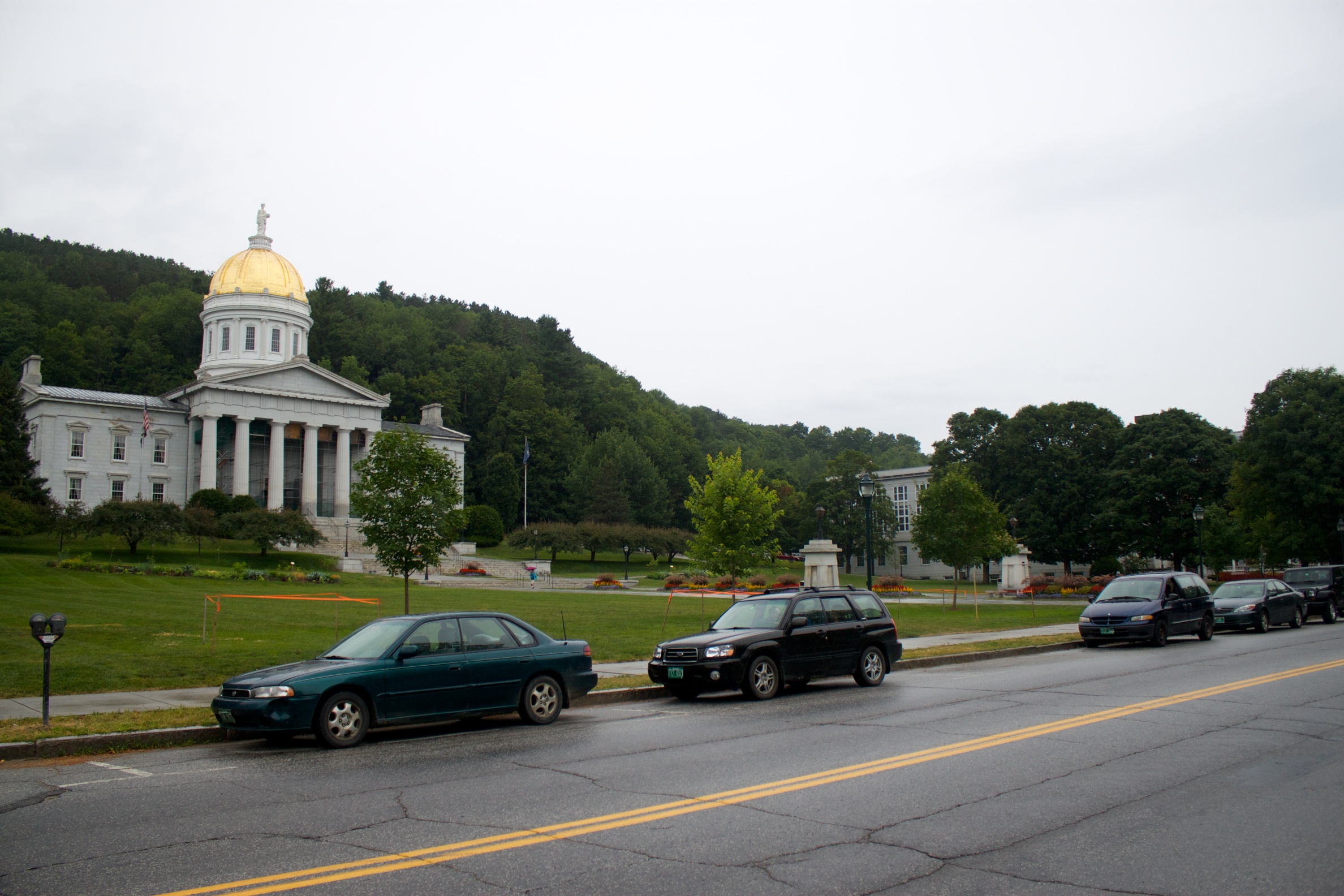
While Congress is battling it out over the budget in D.C., Vermont state officials are struggling to balance something else: trees. After an early July storm claimed one of the trees on the western lawn of the Statehouse, two more trees were removed from the same row last week, giving the popular tourist destination a distinctly lopsided look.
The three sugar maples that had graced the lawn in front of the Golden Dome for 30 to 40 years, were removed because of complications from soil compaction, said State Curator David Schutz. The sugar maple, which is the official state tree, is not well-suited to urban settings, he said.
“We’ve know that all these trees ultimately might suffer from that problem,” he said. To that end, the state planted new trees behind the mature maples about two years ago. Schutz said he had hoped the saplings trees would have had more time to develop before the older trees had to be removed.
Schutz said the two trees removed last week only had leaves on about two-thirds of their branches this year. The third tree, removed earlier in the month, was severely damaged in a thunderstorm.
“I realized that those three trees would have to go, but we aren’t going any further,” Schutz said. There was some debate about what to do about the three trees on the eastern lawn on the right-hand side.
“With symmetry in mind,” Schutz said, “it’s a little tricky now because we’re a little bit out of balance.”
Officials weighed aesthetics against the importance of historical and environmental values. Ultimately, Schutz said, he decided to keep the trees.
Schutz mentioned the possibility of relocating a tree from the line of sugar maples adjacent to the Vermont Supreme Court to a spot on the western lawn in the interest of symmetry. The state would only go ahead with this idea, he said, if officials determined the move could be done safely.
Young’s vehicle “ditched” after joyride
Rep. Sam Young, D-West Glover, found his car in a drainage ditch last week after what seems to have been a Saturday night joyride. Sometime between 3 a.m. and 10 a.m. a week ago Sunday, the blue Subaru Legacy Outback was taken from his cabin.
Young hosted a party at the cabin Saturday night, during which he was charging his cell phone in the car with the key turned on. He went outside to retrieve his phone in the wee hours of the night; when he woke up Sunday morning, the car was gone.
Before finding the car, Young said, “I think the story will eventually come out, and it’ll be interesting, but I don’t know.”
Young found the car the next day in a drainage ditch at the end of a logging road near his cabin. His computer, passport and checkbook were all still in the car, which was “mildly damaged.” He said it looked as if someone mistook the logging road for a driveway. There are no suspects in the incident.
Special ed assistant takes over for architect in the House
Gov. Peter Shumlin appointed Barnard’s Teo Zagar as the man for the job after Rep. Mark Mitchell, D-Windsor, stepped down for health reasons at the close of the last legislative session.
The 33-year-old special education assistant had no prior aspirations to work in politics, but after he heard through the “Barnard grapevine” that Mitchell, an architect, was stepping down, he put his name forward.
“I’m still trying to wrap my head around it,” Zagar said. “I think he (Mark Mitchell) is an amazing guy, and his attitude towards politics is great.”
The newly appointed House member was born in the former Yugoslav republic of Slovenia and has lived in Barnard since 1985.
Zagar works at Woodstock Union High School. He is described by Shumlin as a person who “understands education and special education issues, and has a broad world view and diverse perspective on issues.” However, education is not all Zagar is interested in.
Zagar lives completely off the power grid — his home is powered by solar panels and a gas generator, which is rarely turned on, Zagar said.
Zagar is also a filmmaker who has produced various projects, including a film about Lou Gehrig, the New York Yankees slugger, and a self-advocacy discussion guide about autism.
“There are so many issues I think are important,” Zagar said. “I imagine the first session will be spent working with the party and caucus, but I would also like to work on the future of energy in Vermont.”
Although he is yet to set foot in the Statehouse as a representative, Zagar is already preparing for the next election.
“I think I’ll have to start campaigning right away because I’ve got my work cut out for me. I’m only guaranteed one session,” Zagar said.
An elusive agreement languishes
The USDA failed to respond to a request filed by VTDigger.org under the Freedom of Information Act last month, in violation of federal law.
The request, filed June 14, was for the Programmatic Agreement between the USDA Rural Utilities Service and Vermont Telephone Company regarding the $114 million broadband expansion project VTel is pursuing with RUS funds. The document, which was released to VTDigger.org by the Vermont Division for Historic Preservation, sets out rules for the VTel buildout.
On a phone call the morning of June 14, Laura Dean, historical preservation officer at the USDA, said, “I’m looking at [the programmatic agreement] right now,” and that she planned to send VTel the approved copy later that day.
Once the document has been approved by all parties, it will serve as a regulatory document as VTel works to expand broadband in rural Vermont before its 2013 deadline. The programmatic agreement is a list of rules regarding building around historic sites, the unexpected discovery of such sites, and under what circumstances VTel can proceed.
The agreement states that VTel may move forward with the project in places that entail modification of already existing infrastructure, exempt from historical review. If VTel has to install infrastructure where it doesn’t already exist, the agreement lays out review procedures which must take place before the work can be done.
Both Dean and Devin Coleman of the Vermont Division of Historic Preservation said the agreement was fairly standard, and that it was normal procedure for such a document to be created for a federally-funded project. VTel spokeswoman Sharon Combes-Farr said in an email that the agreement presented “no surprises.”
Dean refused to release a copy of the document because doing so might undermine the official process. Once the process was over and the document was approved, she said, she may release it.
VTDigger later that day sent a letter to Dean via email formally requesting the document under the Freedom of Information Act. Federal law requires a response to such requests within 20 business days of receipt.
Candace Boston at the Office of Government Information Services in College Park, Md., said it is normal for requests to take longer than the legally required 20 days to fulfill. “Even though the law says 20 days,” Boston said, “there (are) only a handful of agencies that respond within the required amount of time.”
Some requests, she said, take up to a year before any information is delivered. The Freedom of Information Act requires that public officials “determine within 20 [business] days after the receipt of any such request whether to comply with such request and shall immediately notify the person making such request of such determination and the reasons therefore …”
Response was required under this language no later than July 13. VTDigger.org has not received any communication from Dean or her office since June 14.
Editor’s note: Taylor Dobbs, Anne Galloway and Eli Sherman contributed to this report.
