

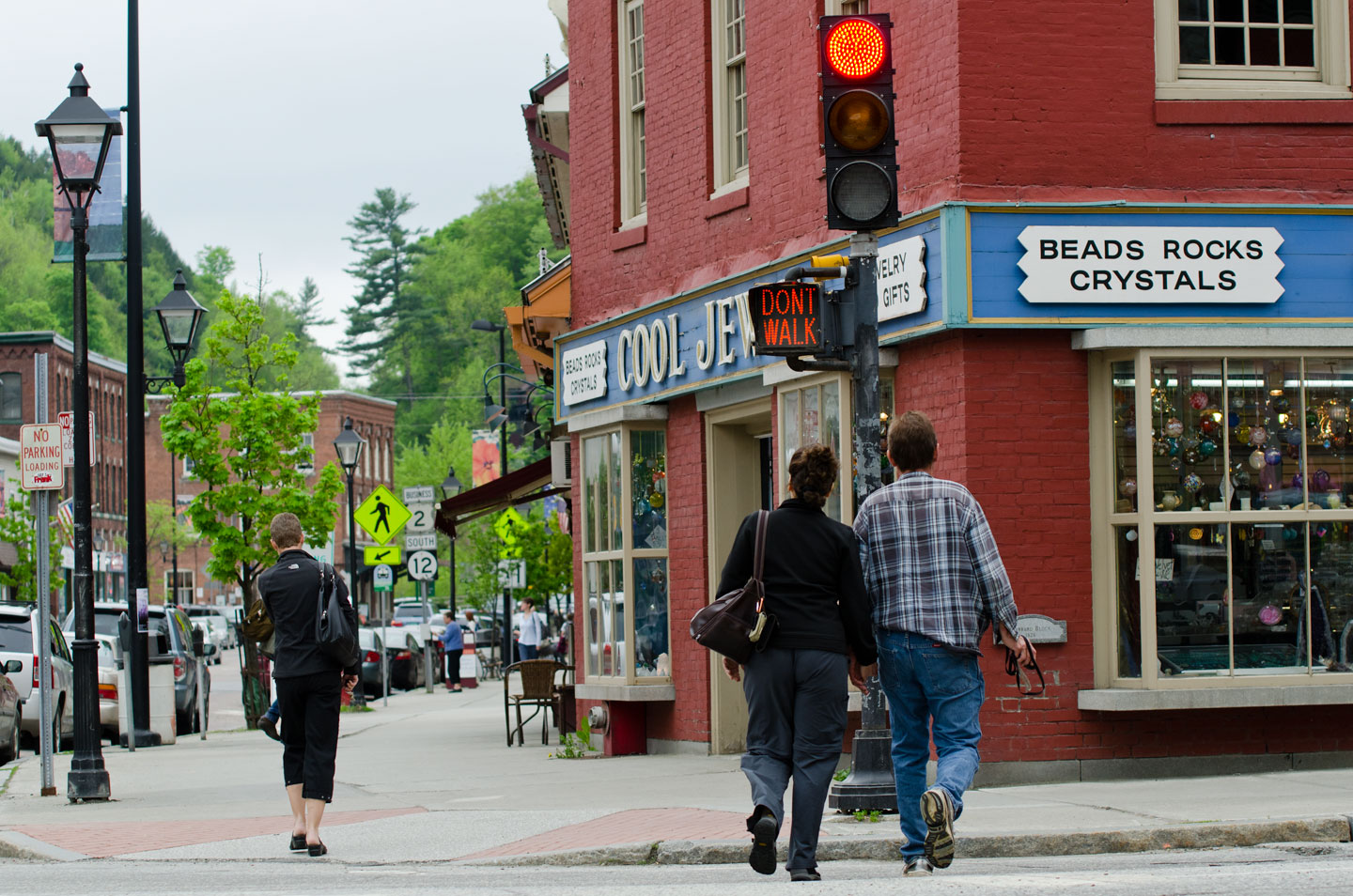
It’s official: “Complete Streets” rules are now in play.
The Complete Streets Act, signed last week by Gov. Peter Shumlin, asks municipalities to make streets safer for pedestrians and bikers. The Vermont AARP was the lead advocate for the legislation, which is particularly aimed at making sidewalks and roads more user-friendly for older pedestrians. Under the new rules towns will be encouraged to incorporate modifications such as wheelchair ramps and extended crosswalk times into downtown transportation projects. In addition, towns and cities will be urged to install new sidewalks, re-stripe roads for bike lanes and add bus kiosks.
The state is not offering funding for additional construction costs related to the act, nor is it requiring the roadway modifications. Instead, the new law asks cities and towns to consider “complete streets” principles whenever roads are under construction. The bill does not apply to unpaved roads.
Not all modifications are meant to be made to all streets, says Jennifer Wallace-Brodeur, the associate state director of state and community development at AARP.
“It’s the process of saying ‘who’s on this stretch of road and how can we accommodate them with the work that we’re doing?’” she said.
A version of the bill was presented in the last legislative biennium, but it was opposed by the Vermont Agency of Transportation and the Vermont League of Cities and Towns.
The earlier version of the bill, H. 741, provided an exemption from “complete streets” modifications if the estimated cost of the changes was more than 20 percent of the total cost of the project or if adequate infrastructure was already in place. The proposal required the modifications when the estimated cost fell below 20 percent of the total project cost.
Cory Gustafson, senior associate of advocacy and information for the league, said that his organization supported the concept of complete streets from the start, but that “20 percent of a big transportation project can be a very big number.” Gustafson said that for some projects, this cost could become far too high, and for others, in which a town is simply building a sidewalk, for example, it could be too low.
The AARP worked closely with the league and VTrans during the session to modify the bill. After the 20 percent cost threshold was removed there was more support for it, Wallace-Brodeur said.
The league’s concerns were satisfied once the statute made the new design rules optional. Towns need to show that they are considering changes when planning a project and then submit an explanation to the state if they decide not to make “complete streets” improvements.
“With the version that passed, we were on board and supportive,” said Gustafson.
Noelle Mackay, commissioner of the Vermont Department of Economic Development, also backed the bill’s passage in the legislature.
“Health and transportation and mobility options, community development, and economic development all fit together,” she said in an interview. The state has made limited funds available for street enhancement projects. The town of Burke, for example, is currently using a grant from the Department of Economic Development to make its roads safer for non-motor-vehicle users.
Mackay said the bill had “broad support from state agencies,” including VTrans, this year.
Attempts to reach VTrans Director of Policy, Planning and Intermodal Development Chris Cole were unsuccessful.
It’s unclear how much funding will be available to help towns meet the state’s “complete streets” objective in the future. Lawmakers anticipate cuts to the state transportation budget in the likely event of reductions to the federal highway funding.

