


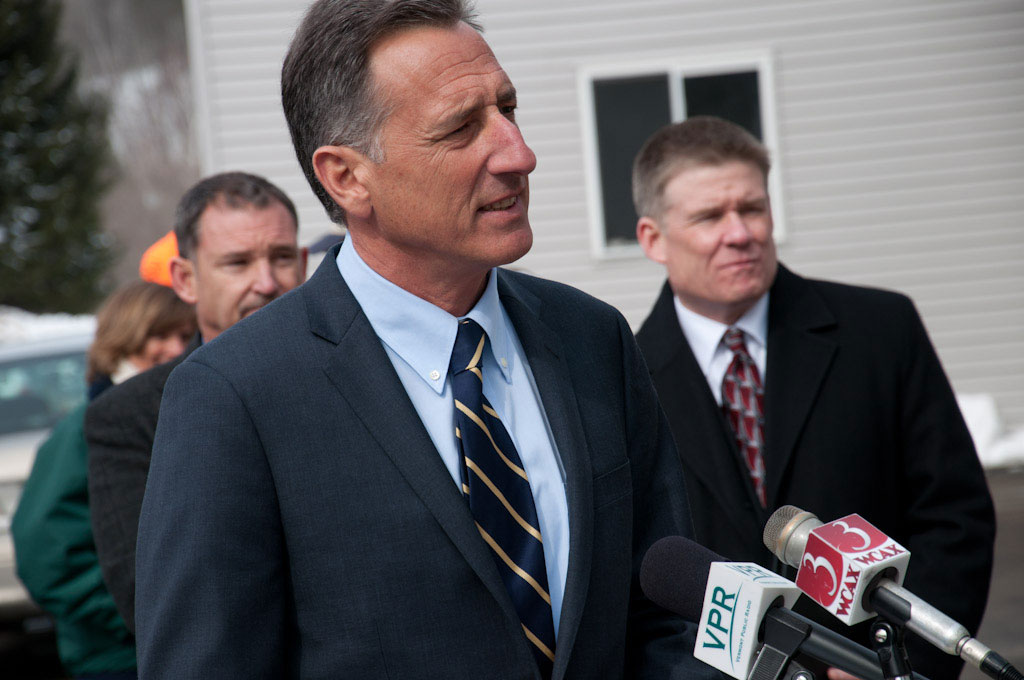
It was a study in contrast: Two governors, from opposite ends of the political spectrum — Vermont Gov. Peter Shumlin, a Democrat, and Wisconsin Gov. Scott Walker, a Republican — testified to a congressional committee on Thursday about their respective state budget deficits and the very different ways in which they are resolving the shortfalls. Both governors are serving their first terms in office and were elected in November 2010.
Since he took office in January, Walker has pursued an aggressive anti-union agenda. In March, he signed legislation to end collective bargaining rights for Wisconsin’s 175,000 state, county and local employees. The move spurred massive protests, in which tens of thousands of unionized workers marched on the capital in Madison, Wis. The constitutionality of the legislation is in question and the matter is now tied up in the courts.
Shumlin, on the other hand, has worked with the Vermont-NEA and the Vermont State Employees Association to hold down costs through a series of mutual agreements. The state’s unionized teachers agreed to a $15.3 million pension deal last year, in which employees contribute more toward retirement. Vermont’s state workforce has been reduced by 10 percent, and the members of VSEA agreed to a 3 percent pay cut.
Shumlin told the Committee on Oversight and Government Reform that he didn’t think it was fair or necessary to eliminate workers’ rights. This year, the newly inaugurated governor proposed resolving Vermont’s $176 million budget gap through a combination of difficult cuts to human services programs and new taxes on hospitals, nursing homes, home health care programs and dentists.
“What is puzzling to me about the current debate about state budgets is that the focus has been not on bringing people together to solve common problems, like we have done in Vermont, but on division and blame,” Shumlin said. “I do not believe that those to blame for our current financial troubles are our law enforcement officers, firefighters, and other state employees whose services we take for granted. The notion that a state trooper making a middle class living with health care benefits for her family, or a snow plow driver who works long hours in dangerous conditions and makes a decent but modest wage, is responsible for this problem is simply false.”
Ranking Member Elijah E. Cummings requested that Shumlin testify at the hearing, “State and Municipal Debt: Tough Choices Ahead.” Cummings predicted in a statement he issued on Wednesday that “Shumlin will also bring a perspective that is markedly different than that of the majority’s witness, Wisconsin Governor Scott Walker, allowing the Committee to obtain a wider and more balanced range of views on these issues.”
Shumlin didn’t disappoint. The story was picked up by the Wall Street Journal and Talking Points Memo, a popular political Washington blog.
It’s the second time Shumlin has been to Washington, D.C., in the last several months. In February, he attended a National Governors Association conference.
Rep. Peter Welch, D-Vt., introduced Shumlin to the committee.
Shumlin’s statement to the committee follows.
Chairman Issa, Ranking Member Cummings, and members of the Oversight and Reform Committee, which includes my Congressman and friend, Peter Welch: thank you for the opportunity to testify today. Governor Walker, it’s good to see you again. While we may have some differences on issues, we have some things in common, not least is that we are both wrapping up our first 100 days in office. I wish you the best as you continue your term.
I would like to start by directly addressing the question of what is causing the current fiscal crises that most of our states are experiencing. Put simply, these crises are the result of the greatest economic recession since the Great Depression. While we can save a debate over the cause of this recession for a different day, there is no doubt that my state and others like mine are facing significant budget shortfalls because our revenues are down and the need for government services is up. Thankfully, the economy is starting to show signs of improvement, and, while we will be left to deal with the impact of the recession for some time to come, the economic forecast is brightening.
In the long term, the most significant cost driver in Vermont is health care. We spend $5 billion on health care in our small state of 620,000, and that number is growing exponentially. Our other area of high spending is corrections, where we struggle with high recidivism rates among non-violent offenders at a price that is high and growing.
Also on our list of long-term fiscal concerns are our state pension and retiree health care obligations for state employees. What we have learned in this area is that there are steps we can take to significantly reduce costs to taxpayers without undermining traditional defined benefit plans, which most objective parties agree provide far better retirement security, serve to retain quality employees, and are more efficient than defined contribution plans.
What is puzzling to me about the current debate about state budgets is that the focus has been not on bringing people together to solve common problems, like we have done in Vermont, but on division and blame.
I do not believe that those to blame for our current financial troubles are our law enforcement officers, firefighters, and other state employees whose services we take for granted. The notion that a state trooper making a middle class living with health care benefits for her family, or a snow plow driver who works long hours in dangerous conditions and makes a decent but modest wage, is responsible for this problem is simply false.
Does that mean that we shouldn’t ask our state employees to do their part to get us out of our fiscal problems? Of course not — we can and should ask everyone to sacrifice, and we’ve done just that in Vermont. We negotiated a 3 percent cut in salary for all state employees, and those at higher income levels have taken a 5 percent pay cut, for two years with no step or other increases. With our public employees, we agreed to higher retirement ages for state employees and teachers, increased contribution rates, and ratcheted down retiree health benefits… all without lawsuits, and without circumventing the collective bargaining process that has strengthened the middle class in Vermont and America.
Our experience in Vermont stands in stark contrast with those of some other states in recent months. In fact, Vermont is an excellent illustration of what states can do when we put aside partisan differences, tone down heated rhetoric between labor and management, and work together for the best interests of our citizens.
Consider the changes to Vermont’s Teacher pension and retiree health plans that went into effect this past July. The state’s annual actuarially required pension contribution decreased by almost 25 percent right away. Long-term unfunded liabilities were reduced substantially. Several years ago, our state employees agreed to similar changes, with higher retirement ages and contribution levels. They have just agreed to another increase in their pension contribution rates starting in July.
These negotiations were long, difficult, and often tense. But they lacked the type of rancor and acrimony that we have seen recently in other places. What made the difference was the ability for both sides to give and take, not just take. I have often said that in Vermont, we find that we get a lot more with maple syrup than we do with vinegar. Maybe it’s because we are a small state where we focus more on our similarities than our differences, but my sense is that if we can make these tough choices in Vermont, we can make them in other states as well.”
