
Rep. Chris Pearson, P-Burlington, and Sen. Anthony Pollina, P/D - Washington, will introduce legislation intended to increase taxes for wealthy Vermonters. Photo by Josh Larkin.
CORRECTION: The top income-earners in Vermont will save $190 million in 2011 alone, not over a two-year period as previously reported.
What does $190 million in tax breaks for Vermont’s wealthiest residents have to do with the state’s yawning budget deficit of $176 million? Not much at the moment, but if two Progressives in the Legislature have their way, income-earners who are in the top tax brackets will have an opportunity make a personal contribution to the budget-gap reduction effort.
In January, the Public Assets Institute issued a report showing that 5 percent of Vermonters — those who earn more than $200,000 a year — stand to save $190 million under the extension of President George W. Bush’s tax cuts. The top 1 percent of Vermont income-earners will see a $100 million reduction in their taxes in 2011, according to the Montpelier-based Institute.
The giveaway to the nation’s wealthiest residents was slated to sunset last year. President Barack Obama and the Congress carried forward the tax breaks through 2013.
Rep. Chris Pearson, P-Burlington, and Sen. Anthony Pollina, D/P-Washington, plan to introduce a bill at a press conference (Thursday) (1:30 p.m. in the Cedar Creek Room) that would raise about $17 million through a small tax increase on the wealthiest 5 percent of Vermonters.
The money, Pollina said, could go toward programs for elderly, disabled and mentally ill Vermonters that are currently under Gov. Peter Shumlin’s budget knife.
By day’s end on Wednesday, 10 House members had signed onto Pearson’s bill. “There is an understanding that most Vermonters don’t support the Bush tax cuts, and we’re in tough budget times,” Pearson said.
The average personal income of those in the top 1 percent tax bracket is about $940,000, according to PAI. Vermonters in the top 5 percent group will see a reduction in federal taxes in 2011 of $150,000 on average as matters stand now.
Under the Pearson-Pollina plan, however, wealthy taxpayers would contribute an additional $10,000 a year on average for income of more than $373,650 a year and an additional $500 a year for Vermonters who earn between $171,850 and $373,650, according to Pollina. The effective rate, Pollina said, would increase 0.8 percent for Vermonters in the highest bracket, and 0.2 percent for those in the next lower tier.
“People have received significant tax cuts on the federal level,” Pollina said. “We’re not increasing taxes. We’re asking the wealthy to take slightly less of the Bush tax cuts.”
The bill will be introduced just one day before the final cutoff for new legislation.
Pollina described the increase as “slight.” Wealthy Vermonters will still be able to buy yachts, he said. “It’s not a broad-based tax,” Pollina said.
Whether the bill will be politically viable is an open question. At a Senate caucus on Tuesday night, Pollina said “the majority of Democrats supported it in their hearts.”
Pollina said the majority of Democrats backed the congressional delegation’s opposition to the Bush tax cut extension when it was first debated. “Anyone who supported Leahy, Sanders and Welch should support this,” the newly elected senator said.
Don’t count on the Democratic leadership, however, to be among them — at least for the time being. Gov. Peter Shumlin, House Speaker Shap Smith and Senate President Pro Tem John Campbell continue to beat the budget-cut drum and oppose broad-based tax increases — despite the “rumblings” in the Legislature about new tax revenues, as Shumlin put it. This rank-and-file discomfort with the budget was to be expected, according to the governor and the legislative leaders.
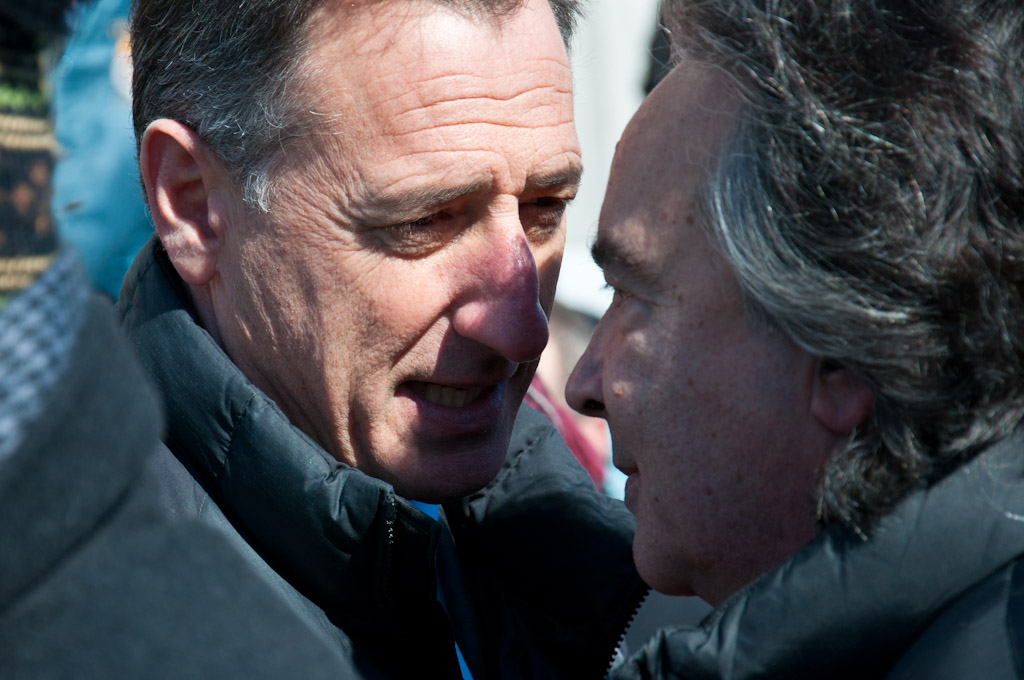
Sen. Anthony Pollina and Gov. Peter Shumlin share a word outside the Statehouse on Tuesday. Photo by Josh Larkin.
In his weekly press conference, the governor chastised Congress for cuts to funding for the low-income heating assistance program, Head Start, community action councils and Planned Parenthood. “We spend more on bombs than we do on hungry children,” Shumlin said.
The governor then went on to defend his own cuts to programs and reiterated that he would not raise taxes to pay for services for the elderly, the disabled and mentally ill.
Shumlin said the federal government can raise income taxes on the wealthy without fear that they’ll leave the country. On the other hand, he said, states like Vermont are vulnerable to out-migration. (The Vermont Blue Ribbon Tax Structure Commission recently debunked the anecdotal stories about the out-migration notion as “myth” in its January report.)
“We all know Vermont is not an island,” Shumlin said. “We all know people will pay a certain amount of tax on the state level, and when those taxes are disproportionate to those in neighboring states, they migrate.”
Shumlin said wealthy Vermonters already pay higher marginal tax rates (8.95 percent) than their neighbors in other New England states. The federal government should be raising taxes, he said, on the wealthiest Americans “who are paying the lowest taxes in anytime in American history.” The state, however, “doesn’t have the flexibility to do that,” he said, “because we all know New Hampshire is to our East and Florida isn’t far away.
“We all know we have a very progressive income tax in Vermont, and I’m proud of that,” Shumlin said. “I helped write the tax code that keeps it progressive. The wealthiest should pay the most. But when you get up around 9 percent, frankly you start to lose more than you’re making.”
Vermont’s tax rates are tiered. The 8.95 percent rate is applied only to income above $373,500 — taxpayers pay much lower rates on income below that level. The top marginal rate does not include itemized deductions. The average effective rate, or the amount actually paid by Vermonters after deductions, is about 3 percent.
When it was pointed out that the effective income tax rate for wealthy Vermonters is 5.8 percent on average — once deductions such as second homes have been included in the equation — Shumlin asked where the reporter got her numbers and remarked that they couldn’t be right. (The information came from the Tax Department and was promulgated in the Vermont Blue Ribbon Tax Structure report.)
“I don’t buy the argument that they’re paying 5 percent,” Shumlin said. “I happen to have been one of those taxpayers, and I can tell you I don’t know how they pay 5 percent.
“All I can tell you is, New Hampshire has a rate of zero, Florida has a rate of zero; that’s who we compete with,” Shumlin said. “I can take you to any county in Vermont and introduce you to Vermonters who are no longer Vermonters, and we need to find the balance between how we can keep them here and pay our bills. Anyone who tells me we are not close to the precipice in terms of what we can ask Vermonters to pay in income taxes I just think isn’t really looking at the facts.”
Republican Gov. James Douglas made similar arguments over the course of his eight-year tenure in office.
“My predecessor was right about some things,” Shumlin said.
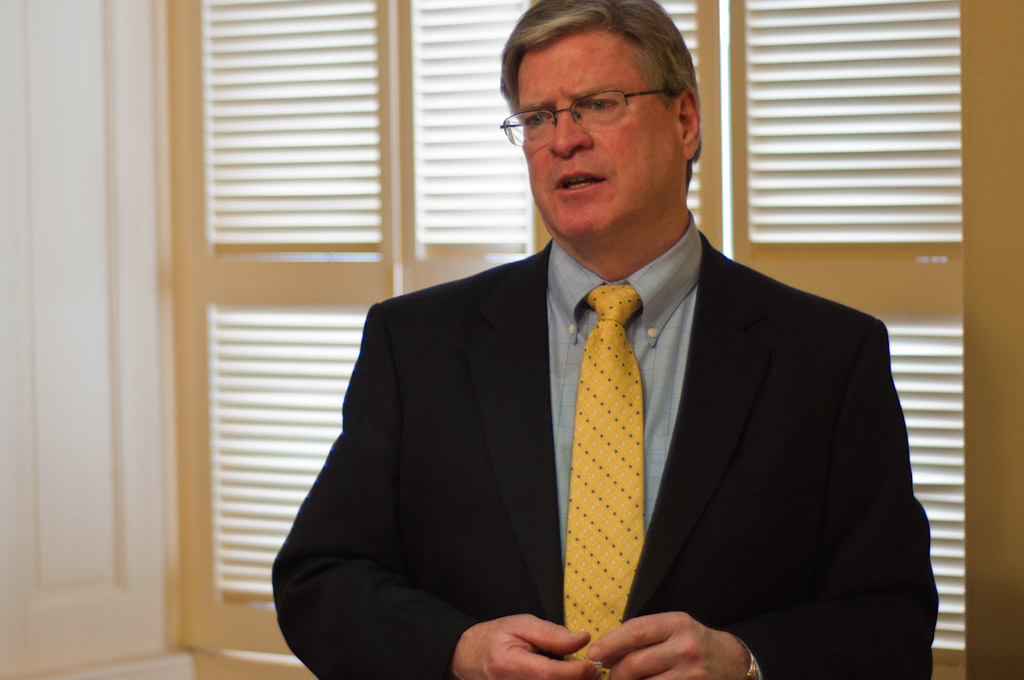
Sen. President Pro Tempore John Campbell says the Legislature doesn't have the information needed to decide whether it can raise taxes or not. Photo by Josh Larkin.
Senate President Pro Tem John Campbell said the Legislature doesn’t have enough information to determine whether it should raise taxes or not. The recently announced federal budget cuts, which, if passed, could go into effect in the last quarter of this fiscal year, would have an impact on how the state moves forward with its own budget. In the context of those reductions in state spending, the senator said, he would consider a tax increase on the wealthy.
“We’re in a situation where we have the federal government abandoning the state when it comes to social services,” Campbell said. “Are we going to let people freeze in the winter and take away care for women?”
As far as the governor’s budget is concerned, Campbell remains committed to putting “everything on the chopping block.”
House Speaker Shap Smith said he isn’t surprised that Pearson has proposed a bill to increase income taxes for wealthy Vermonters. Smith said he isn’t unwilling to consider a tax increase (he supported estate and capital gains tax increases in 2009) but at this point, lawmakers need more time to determine whether that’s necessary this session. “We have been working hard to scrub the budget and find out where the holes are,” Smith said.


Permalink |
Why is it “share the pain” always means pain for the middle and lower economic classes and so the rich and lovely can have a bigger share?
Raise some taxes, cut some spending.
Permalink |
Agreed, Rama, and “We the People” will have to actively engage our legislators to insist they do so. We can call them, drop in on them at the legislature, tell them how we feel … and come out to the State House this Saturday at noon in solidarity with people fighting for jobs, wages, bargaining rights, and –most important–for Democracy nationwide.
Permalink |
Absolutely take this step, and please, in the future, include “Democrats” as supporters of this move as well. Hurrah for Pollina and Pearson and small hopeful noises for John Campbell (to whom we in Windsor COunty will be talking) and to Shap Smith for not outright going along with the Governor. When I heard the Governor’s budget and I realized I’d helped put this man in the job, I thought, “Oh! He is playing bad cop so the Legislature can play good cop.” But as time went on I’ve begun to worry. Thank you, thank you to all legislators who will support this act. The services slated for sutting are a pretty nearly rock bottom anyway — at lease in my field of mental health this is true.
Permalink |
The wealthy are people with money who invest in the economy. Without those investments, the economy would wither and not be able to pay for state government.
The order of business it to first make the economy stronger and create jobs that PRODUCE goods and services and tax revenues, then to tax.
Putting the cart before the horse is unwise.
Permalink |
The major problem with that argument is tax cuts have NEVER helped to grow us out of an economic hole. Quite the opposite – when HW Bush and then Clinton pushed through consecutive tax increases in the nineties the economy improved. When Reagan reversed himself and started raising taxes the economy started to improve in the eighties. When we had near confiscatory marginal income and estate taxes in the 50s and 60s our economy roared.
Oh, and don’t forget we had growing unions in those 50s and 60s too!
Permalink |
“The wealthy are people with money who invest in the economy.”
There is absolutely no evidence that most of the wealth of Vermonters is invested in Vermont. Obviously some of the wealth is here is the form of small and mid-sized businesses. But for the most part, the assets that give rise to interest, dividends, and capital gains are NOT in Vermont (and that’s almost a quarter of all income in VT).
So yes, the wealthy invest in the economy; just not here. Lots of jobs are being created; just not here.
The growth is in China, India, and Brazil. And that’s where the Fortune 500 is as well.
It is a mistake to assume that tax breaks for wealthy Vermonters result in jobs in Vermont.
Permalink |
Yes, New Hampshire has NO income tax rate as Governor Shumlin points out (as did former Gov. Douglas and Lt. Gov. Dubie).
But what they never tell you is that New Hampshire also has some other fees and methods to collect money from citizens (and visitors) that Vermont does not utilize.
What about the fact that New Hampshire has a state-run network of Liquor Stores? These stores are not in the “free market” as they are run by State of New Hampshire. They don’t need to charge sales tax, because they recoup the net profit on liquor sales!
What about the fact that New Hampshire charges road tolls? They collect money not only from residents, but tourists and those that travel through to Boston (i.e. the toll booth on I-93 between Concord, NH and Mass. border, and another one going towards Maine).
What about the fact that New Hampshire charges a lot more for vehicle registration fees?
I am not in total agreement with the Pearson / Pollina bill (but I understand where they are coming from). But I say first let’s try to do what New Hampshire does, other than just say, “NH doesn’t have sales or income tax”. That line is getting very old and tired. New Hampshire has road tolls fees, higher vehicle registration fees and state-run liquor stores. Let’s put that on the table.
Anne, could you please ask Gov. Shumlin to address these 3 specific fees / net profits that New Hampshire DOES have at an upcoming press conference?
http://vtdigger.org/2010/10/28/pulcer-the-rest-of-the-story/
As someone who lives in Rutland County and commutes to Chester and does not use an Interstate (even go to Burlington, Middlebury, Manchester or Bennington), I say put toll booths on I-89 and I-91 to capture toll fees from New Hampshire and Massachusetts residents who use our Interstates in Vermont. The Mass Pike (I-90) has toll sections and I must pay when I use it!
I also suggest that we have a “shared sacrifice question” on the Vermont tax form. I think it’s better to start by first “asking” (nicely) to help out rather than take try to force higher income taxes. I had suggested this for the Federal 1040 form, but this type of question could also placed on the Vermont Income Tax form. Tax filers (citizens) can choose Yes or No, and hopefully enough will say Yes to help towards balancing the budget.
http://vtdigger.org/2010/12/01/pulcer-the-shared-sacrifice-question/
I am a middle-class working person. I am sure the wealthy Vermonters will find a tax dodge or loophole. What is left of middle-class may end up being the actual people affected by the Pearson / Pollina bill (remember legislation usually has unintended consequences).
Permalink |
I wish I’d heard about the press conference in time for me to attend. I absolutely support raising taxes on the wealthy and don’t buy the argument that the wealthy would flee the state. Most people live in VT because they love VT and what the state stands for. Cutting essential services to the most vulnerable Vermonters is not my idea of what our government should be doing, now or ever.
Permalink |
Allowing people to keep money that they earned is not a “give away” as the article suggests. It’s time to cut government spending. Somehow it has become acceptable to take money from someone who earned it honestly simply because they have it. High taxes hinder economic development. Wealthy people obviously have more options than the rest of do. One person thought the wealthy would not leave. Thats true and not true. Some are leaving. I know some of them. Kids are graduating and leaving for the same reason. Out of state companies do not move to Vermont. Heres a question, if you knew you could get away with it, would you steal from a wealthy person? If your answer is no, then why is it ok for government to do it for you?
Permalink |
Pick up a dictionary and look up ‘society’. I think you’ll find it illuminating.
Permalink |
Kids are not leaving Vermont because of taxes.
Permalink |
“Kids are graduating and leaving for the same reason.”
That’s not true. For the most part, young people coming out of college don’t make enough money to worry about taxes. On average, those who earn $35,000 in Vermont pay about $700 per year in state income taxes (and young folks typically don’t own homes so they don’t pay property taxes directly).
On the other hand, wages in NYC and Boston are often 20% – 40% higher than in Vermont. If you graduated with a bunch of education debt, what would you do?
BTW – Census data has shown us for years that middle-aged folks move to Vermont and bring skills and resources (as some are able and willing to earn less because they want to be here).
A lot of what you think is factual is just a myth perpetuated by those who don’t like paying taxes and have the wherewithall to influence the debate and public policy.
Permalink |
Go, Anthony, Chris and Co.
The Right loves to equate taxation with theft, that Big Government (which they largely control) is stealing money that is rightfully theirs, that they “earned.” Well, that concept of ‘earned” is a debatable proposition. Those who are living fat off investments are reaping the rewards of other people’s work. Those who built businesses and got rich – more power to them – didn’t succeed without a lot of other folks working on their behalf. Did all those people who made the success possible “earn” a fair share? Worth analyzing.
And let’s not forget legions of low-wage workers who perform tasks essential to the daily running of the economy but who struggle along on very little. Clerks, day-care workers, EMTs (one of whom may save the life of one of the wealthy and still only pull down about $35,000 a year), all those people who keep things going. Is it okay that they continue to struggle and worry and face even greater insecurity in the future while the people they help support live sleek and warm?
Permalink |
One other thing occurs to me: it’s been argued that, at the national level, the wealthy actually pay a smaller percentage of their incomes in taxes compared to the rest of us. Has anybody performed this kind of analysis – Doug? Paul Cillo? – at the Vermont level?
Perhaps raising taxes on the wealthy would only level the playing field.
Permalink |
John – ITEP does this every few years.
http://www.itepnet.org/wp2009/vt_whopays_factsheet.pdf
Vermont’s tax system is more equitable than most, but the wealthy still pay a lower percentage of income than the middle class.
Permalink |
“Yes, New Hampshire has NO income tax rate as Governor Shumlin points out.”
New Hampshire also has some of the nation’s highest property taxes, especially on second homes. There was a time not too long ago when NH towns were revolting against the property tax to fund schools. The towns, like Claremont, for one, an old and scrappy mill town at the time, were going bankrupt because of the property taxes and went to the NH supreme court over it. I have a friend in Stowe, for instance, who pays about half as much in taxes for ten acres than my brother, who lives in Wilmot, New Hampshire, for the ten acres that he owns. Ron is also right about the fees. I was shocked at how little it cost here in VT to register a car compared to NH. There is also a business profits tax. And, in addition to the booze stores on 89, NH also rans horse and dog tracks to bring in money.
Another thing to remember about NH is that the social services there are half, if not less, than what Vermont has. It is also more difficult to get help if you need it. If you lose your job, for instance, and everything else, there is no vhap or catamount (such as it is) to fall back on. There is a medicaid program, like Vhap (I forget its name), but the income eligibility is even lower and they make you renew every six months. Otherwise, You are on your own. Your tough luck. While poverty is grim everywhere, it is grimmer in NH than here. I’ve seen it.
Permalink |
What was expected of Shumlin as the new governor were a single payer health plan for Vermonters and shutting down Vermont Yankee, and those are the reasons why I voted for him. But I am appalled at his refusal to raise taxes on the wealthy. This country has never experienced such a massive and rapid shift of wealth to the top as now. Shumlin’s own wealth is getting in the way of his seeing the necessity of having the rich pay what they can afford. It is unconscionable to cut social services or any services that provide for the general public good. The legislature needs to do what Shumlin is too timid or self-interested to do. It’s long overdue that we had a real progressive tax structure. My thanks to Pollina and Pearson.
Permalink |
“We all know Vermont is not an island,” Shumlin said. “We all know people will pay a certain amount of tax on the state level, and when those taxes are disproportionate to those in neighboring states, they migrate.”
This is a very good point about state-level tax policy. Shumlin apparently forgot his own advice when he proposed a health care plan supported by a 14% payroll tax. A small tax on wealthy Vermonters is pretty harmless in comparison, yet he balks at it and suddenly becomes fiscal conservative.
Permalink |
‘“Part of my workforce development is to make Vermont ‘the education state,’” said Shumlin, who said that for there to be a strong workforce in Vermont, the children who will be the state’s next generation of workers need to be well educated and education needed to start soon to be more productive.’ (Shumlin: Education law is taking its toll, Times Argus, 02/27/11)
I voted for Shumlin because of the need for government provided single payer health insurance, the need to shut down Vermont Yankee and what appeared to be Shumlin’s declaration of an end to the war against local school districts and the boards that oversee them.
The wart I was willing to let slide for the time being is Shumlin’s wholesale acceptance of the very same neo-CONservate economic ideology – that’s the whine that says “Gee – if only we pander to the rich and lovely, our economy would be great!”
We see Shumlin’s economic malfeasance reflected quite well in his statement regarding eduction: a child’s education isn’t about turning out a well rounded adult who can participate in a healthy society, but instead a child’s education is about providing a worker for the rich and lovely.
I’m not sure if Shumlin’s willingness to suspend healthy and positive values on the economy would make me not vote for him in two years, but I do know a willingness on Shumlin’s part to include economic ideas such as increases in taxes on upper incomes would cement my support for him.
I hate to admit it, but I think I’ve been buffaloed into beleiving Shumlin and I shared some basic human values.