

Vermont is not famous for interesting and innovative architecture, unless your idea of a remarkable new building is one that is trying to look like it was built 200 years ago. So the eyebrows naturally go up when discovering that a new home in Vermont is among the seven coolest houses of the year, at least according to a leading arbiter of such things.
Every spring, Architectural Record magazine announces a list seven of “Record Houses” — “our annual look at the best residential design from around the world,” the magazine proclaims. The 2010 edition includes houses in Japan, California, the Netherlands, Switzerland, China and, somewhat incongruously, Woodstock, Vt.
Still, lovers of Vermont architecture should not get too excited. The architect is from Arizona. The owner lives in Massachusetts. Only the builder, Colby & Tobiason, is local.
Neither should we get too offended. Buildings designed for public or commercial use are fair game precisely because they comprise the spaces we jointly occupy, particularly in a cold climate. But critiquing someone’s private house is almost literally a home invasion.
Still, here we have the work of a prominent American architect, Rick Joy, who stepped forward, along with his client, to seek recognition and, through it, public scrutiny. Here we have an architectural magazine that proclaims the 2010 Record House competition as one whose criteria included “simplicity, modesty, and sustainability, in keeping with today’s culture of restraint.” But here we have a project that seems, in significant part, to be at variance with whatever sense of restraint that suffuses Vermont.
As the magazine points out and lavishly illustrates with photographs that cannot be reproduced here for copyright reasons but can be visited at http://archrecord.construction.com/residential/recordHouses/2010.asp, there is a surfeit of simplicity here if you equate the term with a certain stark, unadorned aesthetic usually described in architectural circles as “modernist.” The current fashion among modernist architects is for houses with linear plans rather than interconnecting rooms – essentially railroad flats with a single hallway running the length of the house to facilitate privacy. Joy’s Woodstock project embraces this trope fully.
Architectural Record oohs and ahs over the fact that Joy, known for flat-roofed “rammed earth” houses in the desert southwest, has here placed a pointy, gabled roof atop his unadorned rectangle, eliminated the eaves (and thus, it is hoped, ice dams in winter) and covered most of the house with shingles. Four of the windows are actually part window and part skylight – in effect, glass with a corner in it. This is another familiar trope, though employed here in novel fashion.
On display in the living room are the steel beams that hold the whole thing up. Using and showing off metal to do the job that timber framing used to do is yet another modernist move that is hardly unprecedented but which, admittedly, hollers the word “simplicity” to those who would visit the owner at his country home or, barring that, read architectural magazines.
Once upon a time, cutting-edge architecture in Vermont paid deliberate tribute to the civilization that is credited with birthing democracy. Designers of Greek Revival buildings of the 19th Century often placed the front door, and thus the main façade, at the gable end of the structure. In other words, the peak of the pointed roof was perpendicular to the front entrance, just as with the Parthenon.
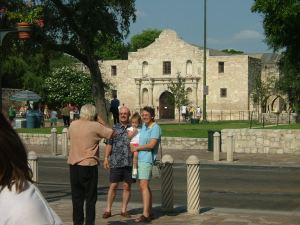
So, too, with Rick Joy’s Vermont project, though no one would mistake it for Greek Revival. Here, both gable-ends are windowless and, part from the entrance door, are covered entirely in rock the magazine identifies has having been dredged from the bottom of Lake Champlain. The effect is roughly as friendly and homey as the Alamo.
Reading up on the building’s owner, one quickly grasps why he might appreciate a home with a get-lost feel to the threshold. Architectural Record describes him as “a young Boston real estate investor with a strong interest in art.” In 2006, the Boston Globe identified him as the heir, along with his brother, to a real estate empire that, in 2006, oversaw $3 billion in real estate and $1 billion in investments. The two brothers came to blows, as publicly chronicled in the media. The older one got the company and, eventually, the younger one got the house (or at least eventually had it built, to Joy’s design). (See www.boston.com/business/articles/2006/06/14/brother_vs_brother/) The Globe story also mentions a $29 million Cezanne and its checkered provenance, a propos of the referenced ‘strong interest in art.’
The point here is not to imply that Joy’s client is an art thief – he is not – or even a bad guy for inheriting a business empire, feuding with a sibling, or landing as the managing director of a private bank based in the United Kingdom, which his blog identifies as his current gig. The point is that, whatever this work of architecture is about, it does not embody simplicity, modesty or restraint.
What’s modest about a house that, with its adjoining and newly built barn, has almost 10,000 square feet of space and occupies a 210-acre parcel of land – placed, by the way, in Vermont’s current use program so as to limit the associated property tax obligation? What’s honest, much less modest, about identifying a structure as a barn when it is built not to house animals but an indoor basketball court, a studio and a guest suite? How is dredging up rock from the bottom of Lake Champlain self-indulgent rather than sustainable?
Vermonters who care about good architecture should embrace rather than eat the rich. Like it or not, it is wealthy people who drive architectural innovation by commissioning custom-designed homes that are relatively unfettered by budget constraints and veto-wielding committees.
As you wait for those innovations to trickle down to the rest of us, don’t assume (as Architectural Record seems too willing to assume) that only big-name out-of-state architects like Rick Joy are capable of adding noteworthy buildings to Vermont hillsides. Owners of such properties in Woodstock need look no further than Main Street to find a distinguished architect, Michael Ertel, spouse of the local probate judge. His Deerbrook residence — see http://ertelarchitects.com/projects/deerbrook_2/ — is similar in plan to Joy’s house but more inviting and beautiful.

Likewise don’t assume that only giant homes are capable of achieving distinction. Of the seven 2010 Record Houses, the most interesting is literally a hole in the ground, designed by Dutch architects Bjarne Mastenbroek and Christian Muller, dug into a hillside in Vals, Switzerland. At 1,700 square feet, it’s less than one-fifth the size of its Woodstock counterpart. This is what restraint really looks like.
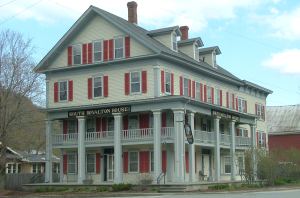
Illustrations: Some better examples of Vermont buildings with gable-end front entrances, from Manchester, Sharon and South Royalton – and one from Texas.
