

Editor’s note: The reporter received permission to use workshop participants’ stories.

“I think, therefore I am”……worried, perplexed, agitated, confused, preoccupied…..and just plain stressed-out and unhappy. Forget Descartes: You may not know your own mind literally; and that’s the problem.
“Don’t worry, be happy” just won’t cut it!
“Yes, I admit I’ve got a thinking problem….” goes the country song.
If only there were AA for the mind—12 steps to end over-thinking, obsessing and self-preoccupation–over-thought and overwrought. But let’s face it, there’s a lot to be anxious, depressed, angry and concerned about here in 2010, with jobs, (if we have one), finances, relationships, health and the vicissitudes of life in general.
It may not be our lives but our minds that are driving us crazy, according to an ancient Buddhist practice called mindfulness, which examines how our minds work and how they can contribute to our misery.
To remedy the stress and emotional distress of mindless living, we may need to just stop living life as emotional automatons—going through the motions emotionally. “Having a great time, wish I were here,” writes Jon Kabat-Zinn, founder of the Stress Reduction Clinic and Center for Mindfulness in Medicine, Health Care and Society at University of Massachusetts Medical School, in his book, “Coming to Our Senses.” It’s the “can’t remember driving the last 20 miles” school of living.
Before you worry that maybe you’ll have to shave your head, wear saffron robes or sing “Hello, Dalai” (Lama), just hit the pause button. “You can benefit from the practice without having to become a Buddhist,” says Dr. Arnie Kozak, a psychologist and clinical instructor in psychology and medicine at the University of Vermont College of Medicine, who does mindfulness-based therapy in Burlington. He also teaches meditation and gives workshops at his “Exquisite Mind” Studio, based on his book Wild Chickens and Petty Tyrants: 108 Metaphors for Mindfulness.
Even in more laid-back Vermont, the livin’ is not necessarily easy. In such an uncertain environment, who can blame us for projecting into the future and sifting over the past for clues to improve our lives and make them less chaotic?
Consistent mindfulness practice helps me to change my relationship with my problems—to struggle less with them and even change my thinking about a situation as problematic.”
~Emily McLaughlin
Take Pamela Rodriguez, an accountant who’s attending one of Kozak’s workshops. She’s about to enter her busy time of year, between the first of February and April 15, when all the work gets done. To say her job is taxing would be an understatement. “The work load and long hours are physically hard on every tax person—even the young, healthy and fit,” she says. She needs some stress relief, as do we all.
Mindfulness practice might be a start, teaching what Kozak calls the “art and skill of living in the present”—how to live “in the moment” to coin an acting term, with awareness and to the fullest as our lives are unfolding, using meditation. We may think this is a no-brainer, so to speak, but then why are we all so miserable?
Because we’re spending way too much time on the left side of our brains, says Dr. Jill Bolte Taylor, a brain scientist and stroke survivor who describes her literally mind-blowing experience in her book, My Stroke of Insight.
The stroke obliterated the left side of her brain, and she was unable to walk, talk, read or write or “recall any of my life”—rendered an “infant in a woman’s body.” The two hemispheres of the brain “process information differently” and have “two distinct personalities,” she says.
The left side is “all about the past and future,” categorizes data of all sorts, picking through endless details and dealing with language—it’s the “calculating intelligence” which gives us our sense of identity—the “I am.” The right side is about the present, thinks in pictures, learns kinesthetically. Through our senses it can describe “what the present moment looks, smells, feels, sounds and tastes like.” When her left brain disengaged, and the “brain chatter went silent,” she found herself in a place of deep inner peace.
“Imagine what it would be like to lose 37 years of baggage. I felt euphoria!”
Her recovery still took eight years. Recovery for Dr. Lorie Valentino—horse vet and “Wild Chickens” workshop participant—will take eight months. She shattered her tibia in a traumatic riding accident last May—the same leg she broke in a previous riding accident five years before. “This was the first horse I was able to really trust since my last accident,” she explains, which made it doubly difficult. When your professional and personal lives are all about horses, sorting out your feelings is a tall order, especially when you factor in an already high-level of professional stress.
Large animal vets need to be able to stand on two feet, which she’s only now just able to do nearly five months into the process. She’s here to help heal from the physical trauma, to process what happened to her and to deal with the emotional fallout that has preoccupied her for months as she has gone through the painful physical therapy. “When you can’t walk, you have a lot of time to think,” says Valentino.
Even when we’re not suffering from an emotional problem we still spend an inordinate amount of time in our heads. The problem with most of us is not that we don’t think but that we “think too much,” says Thich Nhat Hanh, Vietnamese Zen master, mindfulness teacher and peace activist. We could all benefit from taking off our thinking caps once in awhile—not so easy after suffering trauma. And if we are what we think, to paraphrase Buddha, we may want to think twice about thinking too much—especially negative, obsessive thoughts, going over and over old problems and hurts.
No need to hire the thought police. There is a growing body of evidence to suggest that changing your mind might just change your brain.
Scientific American (Nov/Dec 2009) recently reported that “regular deep meditation can change the brain in positive ways,” improving levels of attention, according to studies at MIT and Stanford.
Meditation fires up high-speed brain waves—called sustained gamma rhythms. Scientists “identified cell mechanisms underlying a meditative state” and were able to reproduce them in mice.
Other studies are beginning to suggest that changes in the structure and function of the brain may persist after meditation, Kozak said in his Grand Rounds lecture on mindfulness last month at the University of Vermont School of Medicine. In addition, mindfulness practice that includes meditation has been shown to have a self-nurturing effect—stimulating parts of the brain that are activated in infancy by mother/child bonding. We are befriending ourselves by being mindful, says Kozak—and can’t we use all the friends we can get?
Colleen Steen, professional actress, mountain climber and Renaissance woman, has used mindfulness practice to help her process a bout with cancer, a traumatic brain injury after a riding accident that almost killed her, her childhood abuse, a divorce, and other assorted difficulties. For her, “Mindfulness means being open to all that presents itself to my heart, spirit, body and mind in each and every moment without expectations and judgments, with acceptance and unconditional love—starting with ourselves—and the curiosity of a child.”
In his workshops, Kozak teaches that the first tool we have to bring us into the now is the deceptively simple act of breathing. The second is understanding that the nature of our minds is to be addicted to thinking—planning, labeling, judging, conceptualizing and maintaining a running internal commentary, etc.—which takes us out of the present and fosters unhappiness.
He calls this the “storytelling mind”—stories we tell ourselves about our lives and who we are that shape the way we live, our mental habits, coping skills and unhealthy emotional responses—how we handle difficult situations and emotions. The storytelling mind is “impractical, often distorted or circular, repeating itself ad nauseum,” Kozak writes. (One of its “favorite pastimes is jumping to conclusions.”) We are playing the same mental tapes over and over again. Old info in, old behavior out: It’s that simple. And often that behavior is making us miserable.
Part of the storytelling mind is also the strident self, chief inflicter of misery, a “shaming internal narrative,” says Kozak, that can batter us with a “constant stream of negative self-talk” and criticism, reminding us that we don’t measure up. Part of this is our internalization of others’ criticism—parents or teachers who have been especially hard on us, for example. “Is there any useful information here, or is it just so much noise?” asks Kozak. We need to treat our minds with “skeptical incredulity,” he suggests.
Kozak uses metaphor to teach new ways of understanding our minds. The Wild Chickens of his book’s title, for instance, were creatures encountered by his meditation teacher, a monk who journeyed to remote Thailand on the trip of a lifetime to study and meditate, to find his only company was, well, fowl—the above mentioned noisy chickens. They are a metaphor for the “unexpected, unwanted and annoying distractions we can’t control,” he writes.
And the “Petty Tyrants” are “people who challenge, provoke and vex us, push our buttons and drive us crazy.” Instead of avoiding or bemoaning them, we can think of them as providing a “road map to where we are stuck,” mindfully speaking.
“Consistent mindfulness practice helps me to change my relationship with my problems—to struggle less with them and even change my thinking about a situation as problematic,” says Emily McLaughlin, program assistant at UVM. “One common example is handling difficult work situations where I become very emotional.” Instead of “taking these personally and berating myself,” she can respond rather than react.
New to most workshop participants and mindfulness neophytes is the notion that our minds are not always reliable sources: “Don’t believe everything you think,” Kozak likes to say. ”Most people think that the brain is dumb and the mind is smart,” he laughs, “but it’s really the other way around.”
Kozak takes participants through how mindfulness works by comparing the mind to a “four-floor building.” On the first floor is “what is occurring now…..on the level of sensation.” Using the example of stepping on a nail, he says, you would obviously react, “Ouch, that hurts.” On the second floor is “information the mind distills from the sensation and begins to categorize it.” (“How did that happen?) On the third floor is emotion, where we identify the event of stepping on a nail as either “pleasant, unpleasant or neutral.” (The answer is obvious in the nail example.) And on the fourth floor resides cognition—“the thinking and talking part of the brain.” “You stupid idiot! How could you not see that nail?” our strident self chides.
Kozak adds: “If the nail wound causes chronic pain, it becomes MY Pain—it has a history, a future, and then we begin to tell ourselves stories about our suffering,” which in turn perpetuate more suffering.
Valentino, the veterinarian, for example, went over and over the details of her riding accident in her mind, trying to make sense of a nonsensical, random event. Kozak uses the formula “Pain x resistance = suffering” to illustrate. The more you resist the pain, struggling and railing against it, the more you suffer. Of course, the greater the pain, the more protracted the process. In Valentino’s case, the physical pain was so overwhelming at first it took much of her energy just to function, and as it lessened she could finally address the emotional trauma.
Colleen Steen likes to quote the Dalai Lama: “Pain is inevitable; suffering optional.”
Nina Larosa, a graduate student in mental health and a research assistant at the Mind/Body Medicine Clinic at UVM where she studies the effects of mindfulness on chronic pain patients, describes how she learned to cope with recurring severe headaches. “Before, I would go and lie down in a dark room and wait for them to pass. When I could experience the headaches as unfolding in waves, moment to moment, instead of as a constant solid wall of pain, the less intense they would become. Mindfulness works the same way for painful emotions, too.”
Whatever the degree of difficulty, unless we realize an accident (like stepping on a nail) wasn’t personal and doesn’t reflect on our worth as a human being, we can’t just tend to the wound and move on. It’s easy to see how our minds can take a simple mishap and run with it. In a more complex, painful emotional experience, the storytelling mind may turn that into a permanent fixture of our psyche if we don’t get back to the first floor of the present and physical sensations.
The goal of practice is to “spend most our time on the first floor, not the fourth floor,” says Kozak.
“Mindfulness creates a gap between an occurrence and a response so we can decide how to act,” says Kozak—like having a built-in pause button. “The practice helps me to see more clearly that I have a choice to not react habitually to the emotional feelings and thoughts that arise in a difficult situation,” adds McLaughlin.
Like the day Steen fell in the street, ironically, on the way to meditation. Since her brain injury, she has fallen several times, inexplicably finding herself on the ground. “I fell in the middle of a four-way intersection with cars coming from four different directions.”
She wasn’t hurt, but no one stopped to help her. “Did they think I was just an old drunk or something?” she thought as she later sat in meditation. Then: “Here we go again… what the heck is happening in my brain?…. They say there is no clinical reason for this…. I’m lucky nothing is broken. …..and I didn’t get hit by a car….. But I’m in this safe place now.”
“Those are the kinds of things that were going through my heart and mind during the meditation,” she remembers. I did not attempt to stop any of the thoughts/feelings, nor did I hang on to any one thought. When we let all the emotions flow, without attachment, there is peace.”
Along with the metaphors and exercises based on them, Kozak leads the group in guided mindfulness meditations, to cultivate the right-brain skills that Bolte Taylor describes.
“If you think breathing is boring, just try holding your breath for a minute and you’ll see how bored you get,” says Jon Kabat-Zinn. The breath is the easiest tool to use to teach focus, attention and awareness, “because it’s always with us, explains Kozak. “You’ll be watching and feeling your breathing, and then all of a sudden you realize that you’ve been lost in thinking. “And 99 times out of 100, it’s your storytelling mind that takes you out of the present,” he says.
And while the point of meditation is not to think, noticing what thoughts and feelings keep recurring are important clues to what underlies our behavior in stressful situations.
“I tried other kinds of meditation,” says Rodriguez, the accountant, but they focused on a sound or a mantra. I needed something that kept me in my body, not took me out of it.”
Besides, the breath has an immediately calming affect—what one yoga teacher likes to refer to as “free drugs.”
Meditation has actually improved the health of one of the group members, a former newspaper editor with a heart problem caused in part by 30 years of high-stress work. Having undergone a bypass at the age of 51 and suffered several heart attacks, he has also had bouts with depression.
He has found a significant reduction in the amount of chest pain he experiences under stress since he has begun practicing meditation and mindfulness and finds he can write with greater clarity and speed.
“When I encounter a troubling situation, I first ask ‘How does that make me feel,’ then ‘what does that remind me of?’” Asking such questions help us determine, for example, are we really angry at our spouse’s behavior, or are we angry at our abusive father? Are we mad at our boss, or our overbearing mother?
Mindfulness is like a “spam blocker,” says Kozak. “By becoming familiar with the functioning of your mind….you can quickly recognize ‘junk thoughts.’”
“If I practice becoming aware of what is happening with my body and thoughts on a regular basis, these skills will be sharp when challenges arise unexpectedly,” says McLaughlin.
Valentino says she tried other kinds of therapy in the intervening years since her first horse accident, and this is the first strategy that really worked for her riding anxiety. In a way, the “Wild Chickens” metaphors are more helpful stories we can tell ourselves to support new mental habits and replace the worn-out tapes of our storytelling mind.
Besides promoting stress relief, clear thinking and problem solving—mindfulness is also beginning to have wider applications in business and even sports.
An avid golfer himself, Kozak has written a book on the subject, Swing like You Don’t Care: 54 Golf Axioms, Maxims and Metaphors, which uses mindfulness techniques to address the over-thinking, emotions and perfectionism that often dog aficionados of the game. “Thinking can be your nemesis in golf,” he writes. “If you think, you stink. Maintaining mental focus for four hours is challenging.”
Golf is filled with distractions, he explains–other players, the weather conditions, onlookers and, most of all, the players’ own unrealistic expectations about performance. He teaches a strategy called “Mind Fitness,” which includes meditation. Kozak describes jokingly how he had trouble focusing during a tournament. Mindfulness eluded him ’till he did a headstand, turning mindlessness on its head, and he went on to win the tournament.
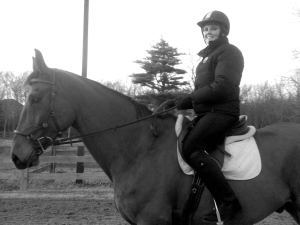
The strategies can be adapted to other sports like horseback riding, where the challenge is to maintain focus on the back of a potentially dangerous 1,000-pound plus flight animal (see sidebar) amid a myriad of distractions.
Speaking of which, a newly mindful Valentino reports that she is riding again just eight months after the accident, “without fear.”
Dr. Jill Bolte Taylor talks about how we can all experience tranquility on demand. We just need to “step to the right” of our left hemispheres.
Barbara Ann Curcio is a former reporter and syndicated columnist for The Washington Post.
Mindfulness Resources
The two most accessible books for beginners are Thich Nhat Hanh’s Peace Is Every Step and Jon Kabat-Zinn’s Full Catastrophe Living, the original bible for the stress reduction program at UMass. YouTube is also a wealth of free audio meditations (Kabat-Zinn, Eckhart Tolle and Jack Kornfield among them). Kozak also has a free “open meditation” every Thursday at the “Exquisite Mind Studio,” at 127 St. Paul St., Burlington.
