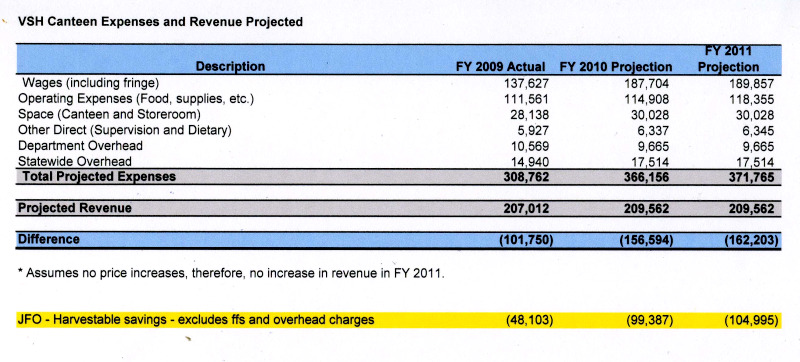
The state says closing the Vermont State Hospital Canteen will cut $156,000 from the budget this year, but nearly half of the savings come from shifts in accounting, according to state budget documents and information from the Joint Fiscal Office and Curtis Sinclair, the Canteen coordinator.
When these costs — fees for space, supervisory overhead and personnel changes, totaling $77,000 — are subtracted, the savings the state can expect to bank on add up to $79,000 for the current fiscal year, FY2010.
The Department of Mental Health lists $57,000 in expenses for rent and supervisory overhead for the Canteen, but the JFO excluded these costs in its calculations because officials say they don’t represent actual savings.
In addition to these overhead costs assessed to the Canteen, a third worker, an activities therapist who was at a much higher pay grade than the rate typically paid to food service workers, was moved from the state hospital rolls and placed onto the snack bar’s payroll a few months ago, adding about $20,000 to the Canteen’s expenses, according to Sinclair and state budget documents.
Michael Hartman, commissioner of the Department of Mental Health, wouldn’t discuss the personnel change in an interview, and he stands by the original budget analysis from the Department of Mental Health.
“I haven’t seen any numbers from JFO,” Hartman says. “They haven’t asked any questions about this. We’ve had our business office make sure we were accurate. The business office has affirmed that these are the numbers that we’re working with.”
Mental health advocates, VSH workers and former patients have rallied around the Canteen because they say the small snack bar in the basement of the Dale building is the one place patients who are locked down on the crowded wards of the Vermont State Hospital can retreat to when they earn special privileges. The activists held a press conference last week at the Statehouse and have launched a letter writing campaign to state officials.
Over the last 15 years, the state has eliminated the gym, the library, a hangout spot called the Hideaway and trips to a camp in Duxbury.
Consequently, patients have few incentives to improve their behavior, advocates say. The closing of the Canteen comes at a time when the hospital, which provides 24/7 care for up to 54 patients, has been operating at 95 percent capacity since June. For the last six weeks, the average number of patients at the hospital was 50, according to the Department of Mental Health Web site.
The state is shutting down the Canteen on Dec. 5, the same day the department moves into the nearby Wasson building, which was recently renovated for $2.5 million, according to Gerry Myers, commissioner of the Department of Buildings and General Services. The state has announced the layoffs of three full-time employees and four temporary staff at the Canteen and two additional full-time workers in the VSH business office.
The Vermont State Hospital employs 170 workers, and its budget this year is $21.6 million. In July the Department of Mental Health lost its bid to regain certification from the U.S. Centers for Medicare and Medicaid Services and that cost the state $10 million in federal reimbursements from the agency. The hospital originally lost its certification in 2003 and again in 2005. The state has been solely responsible for the cost of operating the institution since then.
Funding for VSH comes out of the General Fund, and because of expected tax revenue shortfalls of as much as 10 percent this year, Hartman anticipates more belt-tightening on the horizon. He says he had little choice but to close the snack bar permanently.
“The alternative would be for us to end three jobs in the hospital, which would affect care for patients,” he says.
But the state’s purported $156,000 in savings don’t appear to add up. According to the Joint Fiscal Office, the total “harvestable” savings are $99,000.
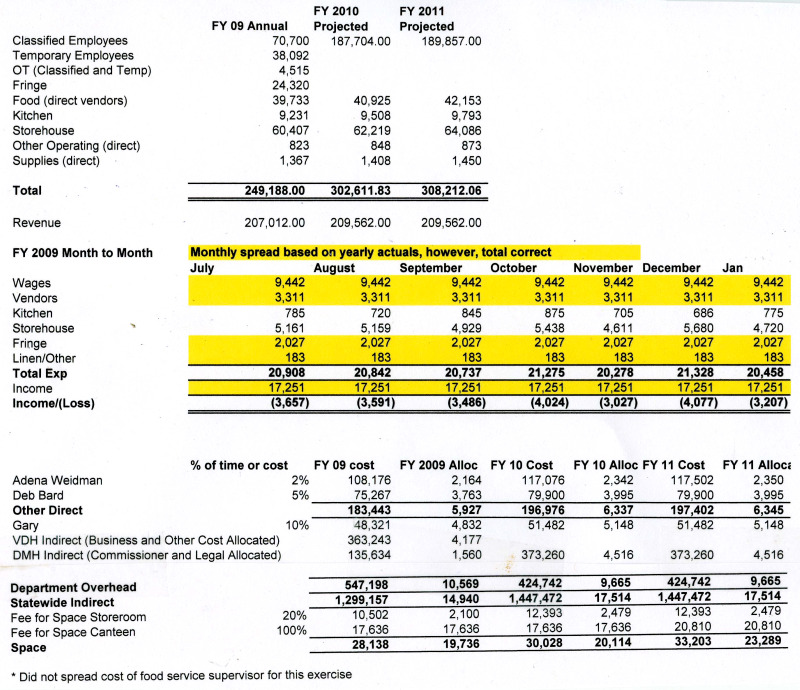
A detailed budget from the Department of Mental Health shows that the supervisory overhead expenses cited for the canteen include $27,179 for percentage salaries from the VSH business office, the commissioner of the Department of Mental Health, the department’s legal team and $17,514 in “statewide indirect” costs. None of the positions listed, however, will be cut by the percentage represented in the overhead total for the Canteen.
In addition, the department has $6,377 in Canteen expenses for a percentage of the salaries of three supervisory employees from the Vermont State Hospital. Two percent of VSH operations director Adena Weidman’s $117,076 salary and benefits, 5 percent of dietician Deb Bard’s $79,900 salary and benefits and 10 percent of storekeeper Gary Carncross’ $51,482 salary and benefits are cited as direct overhead costs. Hartman says these employees will not be taking pay cuts once the snack bar closes.
“I don’t see how that’s relevant,” Hartman says. “They’re going to continue to absorb duties that come along as we make other reductions.”
Another area of savings the state cites is $30,028 that the Canteen, which is part of the Vermont State Hospital, pays in rent to the Department of Buildings and General Services.
Myers, commissioner of Buildings and General Services, says it’s common practice for programs to pay a $12 per-square-foot annual charge for space.
Stephanie Barrett of the JFO says such costs are typically used in applications for federal grant programs, not for state budgeting purposes; Hartman says including these across-the-board department and agency expenses is standard.
“I’m responsible for the Department of Mental Health budget, so that’s my concern,” Hartman says.
Barrett, however, says the state isn’t really saving any money in supervisory overhead or rent. “Vacant space still has to be maintained and it still has to be heated,” Barrett says. “Their cost of operating the entire complex over in Waterbury doesn’t change because the Canteen goes out of business. That’s why that’s not a bookable savings. It’s a savings to the mental health budget but it’s not a savings to BGS.”
Even though the canteen had functioned with two full-time workers for many years, the state shifted a third position onto the snack bar’s food service worker rolls – a $62,941 activities therapist from the hospital. This employee replaces temporary workers and overtime costs of $42,000, according to state figures, but adds $20,000 to Canteen wage expenses.
Until the last few years, the Canteen has been a break-even proposition, according to Sinclair, in part because state workers in the complex frequent the snack bar. A Vermont State Hospital business office spreadsheet shows that the canteen generated a profit of $17,668 in 2004.
Sinclair says he asked his supervisors to let him raise the prices slightly to offset food costs in 2007, and he created a comparison chart of canteen and state cafeteria prices to show discrepancies of as much as $2 per item, but his efforts were rebuffed.
The Canteen’s losses were about $48,000 in FY2009, according to the JFO. In 2008-2009, it lost $33,000 according to a Sinclair’s calculations. The previous year, the deficit was about $8,000, he says.
Sinclair, who managed the café for seven years, is unable to access the financial tracking records he routinely provided to the VSH business office because he was put on administrative leave on June 22 for alleged misuse of his computer. Last week, he was told he will be officially laid off on Dec. 5.
Former patients say the Canteen, which features old Formica tables, pea green walls and worn flooring, gave them a sense of freedom and connection with the outside world as they transitioned out of the hospital. They recall ordering food not typically offered by the hospital kitchen like hamburgers and sodas, and mingling with state workers who frequent the snack bar.
Hartman doesn’t see the Canteen as an essential hospital service because he says his department found that 28 out of 52 patients don’t have special privileges to access the snack bar, which is located outside the main treatment facility, “under any circumstances.” The department determined that on any given day, three patients could go to the Canteen without supervision and 20 patients had access to the Canteen accompanied by staff.
“The canteen is clearly for some patients who feel it was an important place for them,” Hartman says. “I can tell you that I’ve had conversations with other patients who’ve said they never went in there and they didn’t have any desire to be involved in it. Recovery from mental illness is an individual path. And for some people that path ran near or around the canteen.”