


From 1835 to 1841, Lucy Caroline Hitchcock, Ethan Allen’s daughter, enslaved a woman named Lavinia Parker and her son Francis to do housework at her home at Main and Pine streets in Burlington.
On Sunday, in a pouring rain, a small group of Vermont’s religious and racial justice leaders gathered at the site — now home to outdoors store SkiRack — to install two small gold markers in the ground, in recognition of the Parkers, and of the role of slavery in Burlington’s history.
The markers are part of a larger project called Stopping Stones, an initiative that partners with community organizations to research and recognize the wrongs of slavery in the places where those injustices occurred. To date, the group has installed 30 markers in Connecticut, Massachusetts, Missouri, New York, and Vermont.
Ethan Allen was a hero of the American Revolution, leading the Green Mountain Boys in the capture of Fort Ticonderoga. He was one of the founders of Vermont, and he and his brothers bought the land that would become Burlington.
The Rev. Arnold Thomas, a Stopping Stones committee member, said Sunday’s ceremony was not just about Lavinia and Francis Parker, or their enslavement, but about “refuting the notion that Vermont entered the union as a slave-free state” — something he said Vermonters have long patted themselves on the backs for.
In 1835, when Hitchcock brought the Parkers to Vermont from the South, it had already been 58 years since the Vermont Constitution had supposedly abolished slavery.
Sunday’s event was steeped in religious themes, with spiritual leaders from across the state speaking about the evils of slavery and the long-lasting effects it has had on the state.
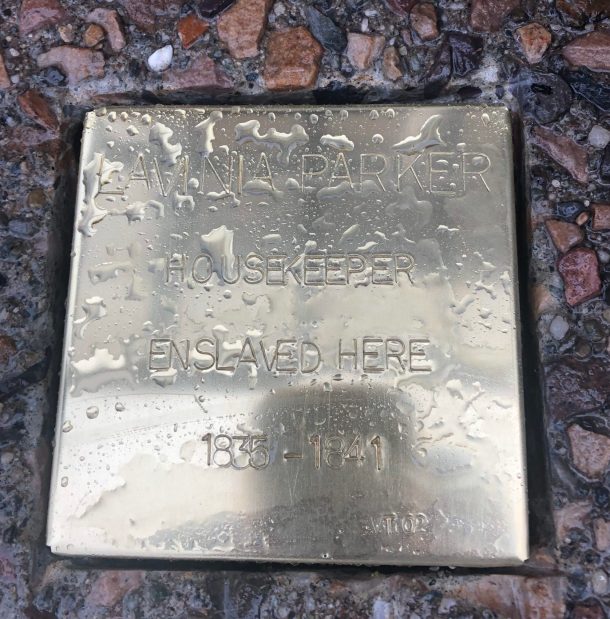
The stones will be a constant reminder to people who walk by to renew their empathy toward those hurt by systemic racism, and to renew their resolve to help fight injustice, said Debbie Ingram, executive director of Vermont Interfaith Action.
“Divine one whom we know by many names, forgive those of us who are descended from slave traders, slave owners, and folk who benefited from the institution of slavery during the centuries in which it flourished,” Ingram said during the ceremony. “Forgive us for even now benefiting from the vestiges of the abomination of some human beings daring to assert that they could own other human beings.”
Kiah Morris, movement politics director for Rights & Democracy Vermont, said slavery still exists today, in the form of unpaid and underpaid labor for undocumented workers, and people oppressed by the prison-industrial complex. Morris also spoke about the transition from slave patrols to the current system of policing, and the generational wealth gap that exists today between Black people and white people in America.
“It’s important to be able to lift the names of Lavinia and of Francis to say: These individuals existed,” Morris said. “They are real, we must cherish their names, and not let them disappear into the periphery of history.”
Dr. Wanda Heading-Grant, vice president for diversity and inclusion at UVM, spoke to the specific injustices that Lavinia Parker faced as an enslaved woman. She said for centuries, people have stood on the backs of people like Lavinia Parker, and people who look like Lavinia Parker.
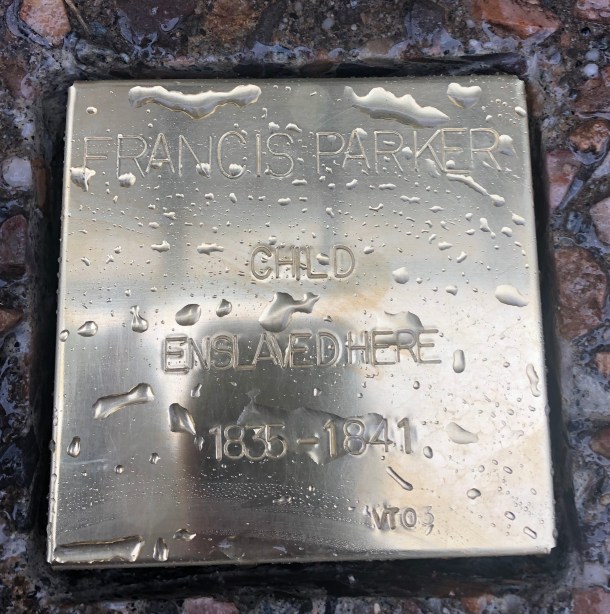
“These things make me say ‘Oh, Lord’ all the time,” she said. “Oh, Lord, oh, Lord, why, why, why. Black and brown women still deserve better.”
Several public officials also spoke, including U.S. Rep. Peter Welch and Mayor Miro Weinberger. Weinberger said he is confident the markers will “really have an impact” in Burlington, and although the project has been in the works for two years, the timing of its completion “couldn’t be better.”
The ceremony’s final speaker was Rep. Hal Colston, D-Winooski. Colston argued that, without slavery, there would have been no capitalism. He said slavery is the very basis on which America’s capitalism was built, and capitalism has helped to uphold the systemic racism that exists today.
“I find it prodigious and poetic that the lives of Lavinia and Francis Parker will be honored in front of an upscale business establishment such as SkiRack,” Colston said. “May people stop to read and reflect about their lives, to understand how we got to this very divisive time because of systemic racism.”


