

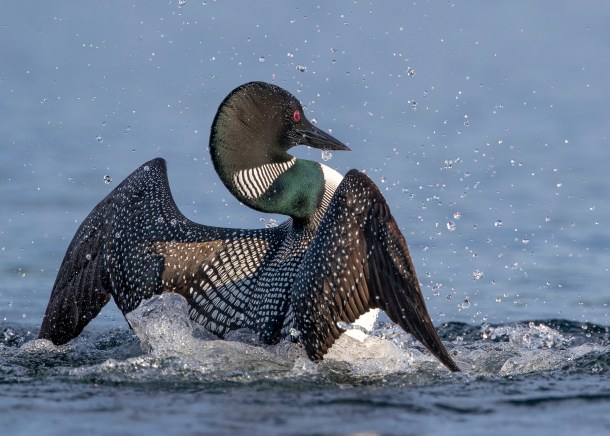
BURLINGTON — Some of Vermont’s most iconic native birds, including the common loon, white-throated sparrow and the hermit thrush — the state bird — are under threat from climate change, according to a new report from the National Audubon Society.
The report found nearly two-thirds of North American bird populations are at increased risk of extinction due to rising global temperatures and extreme weather events caused by climate change.
Using more than 140 million records of 604 bird species in North America, scientists found 389 species are at risk. In Vermont, 199 species were studied and half of are at risk.
The Audubon report comes on the heels of a recent study published in the journal Science which found a net loss of 2.9 billion birds in North America, a 29% decrease, since 1970.
According to Executive Director and Vice President of Audubon Vermont David Mears said, birds make up a large part of the Vermont economy, as Vermont has one of the highest rates in the country of self-identifying bird watchers.
“Birds reflect the ways in which we benefit as a state from an outdoor recreational and tourism based economy,” Mears said, speaking at a press conference at the University of Vermont Thursday. “At the same time, we care about birds because what birds need are what people need.”
Like the proverbial canary in a coal mine, birds are an indicator for a healthy climate, which is why the declining populations and projected future impacts are important factors for climate scientists and Audubon officials.
In a report from the Intergovernmental Panel on Climate Change released one year ago, global temperature rise would need to be limited to 1.5 C by the year 2050 in order to avoid the worst impacts of climate change. Mears said the birds are directly tied to these numbers, as they need the clean air and water humans need.
“If we can achieve net zero carbon emissions by 2050, we can avoid the worst of the impacts,” Mears said.
If these goals can be met, 76% of the species at risk will have increased chances of survival. He praised efforts by Burlington leadership to become a net zero energy city by 2030, and initiatives, like funding recently announced by Sen. Patrick Leahy, D-Vt., to help farmers research better ways to reduce runoff into Lake Champlain. An increased focus on energy efficiency in Vermont is also hopeful, he said.
“There’s a lot of momentum pushing us in the right direction,” Mears said.
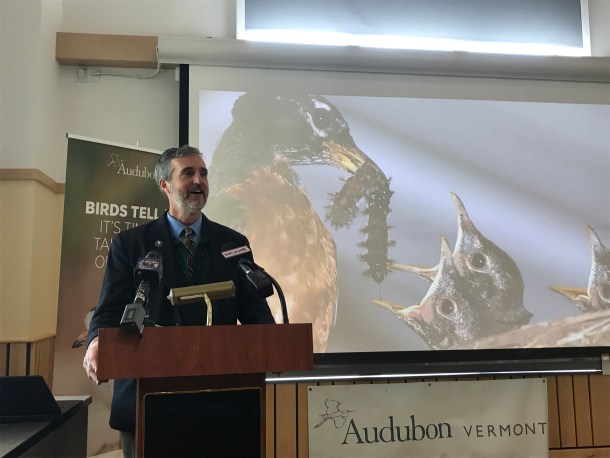
Steve Hagenbuch is a conservation biologist for Audubon Vermont, who warned that Vermont is creeping closer to the 1.5 C mark, which will cause birds to leave the state as their territory may no longer become viable for certain populations. The report estimates 54 species are at risk of territory loss.
The models generated by the Audubon report also calculated the probability of extinction and birds leaving the state at a 3 C mark, which drastically lowers the chance of survival. At a 3 C level, 94 species in Vermont are at risk.
“Among all of the different groups of species we have here in Vermont, it’s the forest species that are shown to be at some of the greatest vulnerability,” Hagenbuch said. More than three-fourths of Vermont is forested.
Birds like the common loon and the hermit thrush are likely to no longer be found in Vermont, but they won’t necessarily be extinct, researchers say.
Mears and Hagenbuch are hopeful these numbers will encourage more people to become involved in bird conservation, and their hope may be answered in the form of a new student organization at UVM.

Rae Bronenkant is Audubon Vermont’s newly installed youth conservation coordinator who, funded through a small grant, has been working with a group of students led by Henry Freundlich, the president of the new UVM Audubon Campus Chapter.
“We must empower today’s youth with the resources and support necessary to spearhead solutions to the climate crisis,” Bronenkant said in a statement.
So far, Freundlich said, over 75 students have expressed interest in joining the new chapter.
The chapter is planning to host birdwatching events around campus and planting native Vermont bushes and shrubs like birch, serviceberry, dogwood and milkweed — a recommendation in the Audubon report.
“With this report comes a lot of information regarding how you can make an impact and change in legislation,” Freundlich said. “Obviously, as part of a university, there’s that microcosm of legislation here so we want to be able to impose maybe some climate legislation in our own club to bring back to [the Student Government Association].”
