

 (Editor’s note: This story is by Matt Hongoltz-Hetling, of the Valley News, in which it first appeared Feb. 19, 2016.)
QUECHEE — The pending appeal of a court ruling that essentially paves the way for a large multi-use project off Interstate 89’s Exit 1 has raised the stakes for both the developer and those who oppose the proposed Quechee Highlands.
Recently the state’s District 3 Environmental Commission complied with a Superior Court order to issue a land use permit to B&M Realty for the construction of more than 100,000 square feet of office, retail and residential space in 10 buildings on a 168-acre parcel near Quechee Mobil and the interstate interchange.
But as it becomes clear that the case could have a statewide impact, an appeal from the Two Rivers Ottauquechee Regional Commission is gaining support from other state and regional forces, according to Peter Gregory, the regional commission’s executive director.
The appeal seeks to reverse a decision by Environmental Superior Court Judge Thomas Walsh, who overturned the District 3 Commission’s initial rejection of the project under Act 250, the state law that governs large developments in the state.
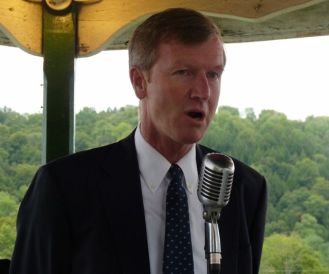
Meanwhile, the time spent sorting out the legal issues is substantially increasing the cost of the development, said Scott Milne, one of the principals in B&M Realty. The appeal, which will be heard by the state Supreme Court, is preventing him from moving forward with the project, which he estimated has cost him $4 million and counting, beginning with his purchase of the property more than 10 years ago.
“It’s costing us a couple hundred thousand a year or ($15,000) to $20,000 every month, not even counting for lawyers and lost opportunity,” Milne estimated.
He said about $1.5 million of the amount he’s invested was borrowed, and that the remaining $2.5 million was put up by himself and his partners, which include David Boies III, a notable lawyer.
Gregory said on Thursday that the project does not comply with the regional plan, which prohibits “principal retail establishments” from being sited anywhere but in downtowns, town centers or designated growth centers in Hartford and 29 other communities that fall under its jurisdiction.
“Allowing retail at that location would be, in our opinion, contrary to state planning law and many of the state investment policies that are available to communities,” Gregory said.
He said that by locating a principal retail establishment at the interchange, the Quechee Highlands project would essentially bleed business and travelers away from the White River Junction downtown area.
“We’ve adopted a plan by all 30 of our communities and we have policies that are consistent with state planning law and suggest that principal retail is not a good use at interstate exchanges and along the highways,” Gregory said.
The ruling from Walsh found that the regional plan failed to define what it meant by “principal retail establishment,” necessitating the court to apply a dictionary definition, which the judge determined to be a project where retail is the “chief, leading or most important use.” Because the retail component of the project phase before the court entailed less than 40,000 of the 115,000 square feet of proposed development, Walsh determined it didn’t meet the definition.
Milne’s attorneys argued successfully before the court that other parts of the regional plan that the district commission determined to be in conflict with the proposed development were merely “aspirational” — not concrete enough to mandate compliance.
The ruling from Walsh read, in part, that while a portion of the regional plan “may evince a worthy aspiration, it fails to establish clear and mandatory criteria, but instead leaves the decision of what is ‘appropriate’ to the Regional Commission. This provision is unenforceable as it fails to provide adequate guidance and allows the unbridled discretion of the regional planning commission.”
The town of Hartford approved Milne’s project, which it found to be in keeping with Hartford’s master plan. The town has since amended its master plan, under pressure from Two Rivers, to conform to the regional plan.
Gregory and Milne don’t agree on much, but they do agree that the argument has shifted in a way that increases the stakes beyond the proposed Quechee Highlands development.
Milne’s contention that the language in the regional plan is aspirational could weaken other regional and local plans.
“The language in our regional plan, we believe, is not aspirational,” said Gregory. “It’s specific. It’s directive and prescriptive. If language that is that clean and unambiguous is still not enough to be useful in Act 250, I can’t imagine what kind of language could be useful.”
Milne said the stir demonstrates the power of the case to change the game of regional planning.
“Peter Gregory is running around to other planning commissions, all these regional commissions, working together because they’re afraid they’re going to lose this,” Milne said. “If we win in court another great legacy will be mandated improvements in the way that organizations like Two Rivers operate.”
Milne criticized the structure of Two Rivers, where a one-town, one-vote principle is unfair to towns with larger populations.
“You get into a situation where you’ve got Hartford, which is about 30 percent of the population of the regional district, and they’ve got, like, 3 percent of the vote,” Milne said.
Gregory said that the appeal will draw supportive filings from other regional commissions, the Vermont Agency of Natural Resources and the Preservation Trust of Vermont.
Bridget Asay, solicitor general for the Vermont attorney general’s office, said the office will provide counsel to the state Agency of Natural Resources.
Parties involved with the case will be asked to meet a variety of filing deadlines between March 11 and June 1, at which point arguments can be scheduled, according to Asay.
Milne said that he expects a decision will be made sometime this year.
“We’re optimistic the court is going to rule in our favor,” he said.
If the court upholds the Superior Court decision this year, Milne said, he will likely break ground next year.
He said the businesses that have expressed interest in the project have included a medical device manufacturer and a company involved with block-chain technology, a digital technology that stores information-based assets.
