

BURLINGTON — The Burlington City Council held the second of three public comment hearings on the city’s three proposed redistricting plans this week, but no one showed up.
That doesn’t mean the city’s plan to redraw its political boundaries is going unnoticed.
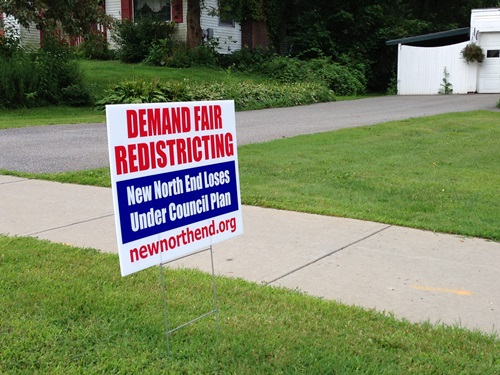
Jim Holway, a New North End resident and founder of 05408.org, an organization advocating a “fair redistricting plan for the city’s New North End,” said he intends to press the issue up until December, the month the council is scheduled to agree on a plan.
The purpose of ward redistricting is to redraw electoral district boundaries that ensure equal representation on the City Council. Currently, Burlington’s seven wards (with two councilors each) are not all within 10 percent equality in population, which violates the U.S. Constitution.
The city last updated its district boundaries in 1993. Because of population growth in the past 20 years, the ratio of voters to council members across all wards has changed.
The city is considering three ward plans: four wards with 12 councilors; six wards with 13 councilors; and eight wards with 16 councilors. Click here to see maps of the proposed wards.
Two of the plans would lump Wards 4 and 7, also known as the New North End, into a single ward with three councilors.
Holway’s organization is concerned that this “supersized ward” will affect the election dynamic for potential candidates.
Because of the large area of the potential ward, it would be difficult to traverse both sides of North Avenue, the street that runs through the two wards, during the winter months to campaign door-to-door.
As a result, campaigns would have to use more television and radio advertisement instead of the traditional council campaigning, Holway said. This would require more money, disadvantaging Progressives on the council who have fewer resources that the major parties, he said.
The same sort of campaigning would be necessary in the proposed four-ward plan, under which all wards would be increased in size with three councilors assigned to each ward.
“In order to do that kind of campaign, you have to have a lot more money,” he said.
The third redistricting proposal is an eight-ward plan with 16 councilors, two for each ward. This plan aims to address the growing student population by adding another ward in the Hill section.
According to 2010 U.S. Census numbers, Ward 1 residents are under-represented, the city’s most populated ward that houses many University of Vermont and Champlain College students.
This means that the ward’s two councilors, Sharon Foley Bushor, an independent, and Kevin Worden, a Democrat, represent too many people.
The population per each ward should be about the same, with a 10 percent buffer. Ward 1 deviates from the ideal proportion by 25 percent with 767 too many residents.
The eight-ward plan would address this population increase by adding a ward in what is largely a student-occupied area of the city.
Councilor Joan Shannon, D-Ward 5, is on the city’s Ward Redistricting Committee. She said many of her constituents do not want to see the size of the council increase because it may slow the decision-making process and extend the regular meeting times.
She said none of the plans are perfect. The council will hold one last meeting Sept. 9 before it decides on a plan to put on the March ballot. That plan may or may not be one of the three plans under consideration.
“There is nothing that would restrict us from putting any plan on the table,” Shannon said.
After voters approve a plan, it will be submitted to the Legislature for formal adoption as a change to the City Charter. The soonest the new plan could go into effect is March 2015.

