

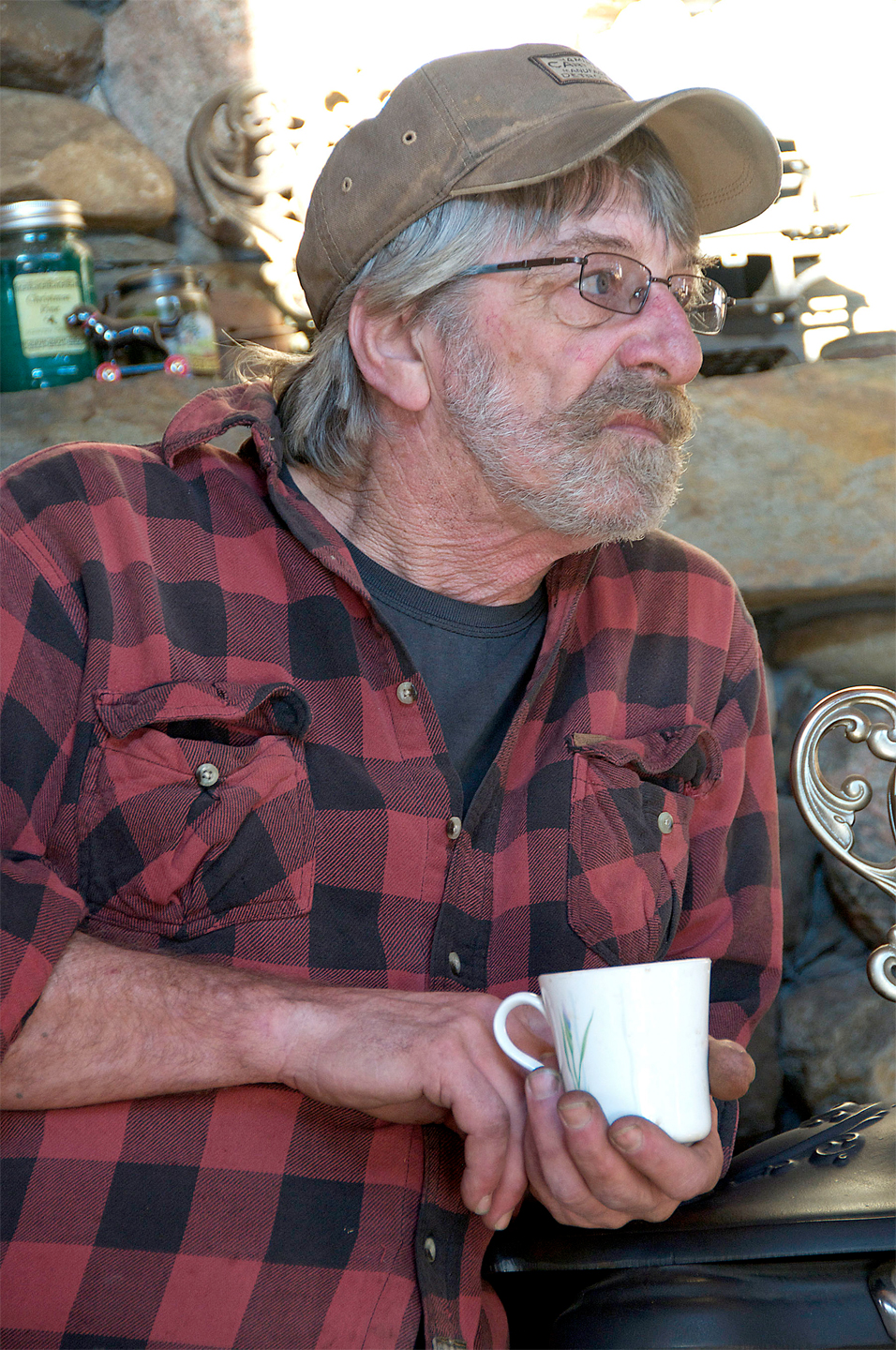
Editor’s note: In This State is a new weekly column by Andrew Nemethy, Bryan Pfeiffer and Dirk Van Susteren about Vermont’s characters and innovators, its unique ideas and quirky places. The three authors, who will take turns writing the column, formerly worked as reporters and editors for the The Times Argus and Rutland Herald and have contributed to other publications in Vermont and around the country.
In winter, Bill Wilber’s yard in West Glover is the image of an old photograph, with its contrasting blacks and whites and its grays. On a sunny afternoon, his work shed, barn and piles of logs cast dark shadows on the white landscape. Sam, an amiable black lab, is easy to spot as he wanders about sniffing and checking things in the snow. And then there are those black stoves, scores of them, iron potbellies, elongated box stoves, Franklins, ornate cook stoves, you name it, with their dark bodies and snow-covered crowns poking up in a field.
You want the sepia tones of an aging snapshot? That would be his cedar cabin with its porch piled high with firewood, so high it might suggest a redoubt to some. He burns this wood to heat and cook.
Bill Wilber is a wood-stove guy through and through. A sign at the front of his 22 acres on Phillips Road announces it succinctly: “Stoves.” Not “Wood Stoves” or “Wood Stoves Repaired” or “Antique Wood Stoves Repaired, Bought And Sold.” Such multi-word messages, though accurate, would go beyond purpose.
Wilber’s sign is to give direction, not advertise.
Nor does Bill Wilber, 62, waste language on discourse. He’s not big on the personal narrative breezily delivered, though he’ll open up with someone in the right situation. “Sometimes I relate more to stoves than to people, and that’s just the way it is,” he confesses.
Twenty-eight years ago, while traveling through the Northeast Kingdom, Wilber found his forested spot. When he saw the land, with its mix of softwoods and hardwoods, and potential for mountain views, his mind’s eye flashed “homestead.” He had been “burning out,” he says, working 16-hour shifts doing maintenance at the old Georgia Pacific Paper Co., in Brattleboro, and he wanted something different.
He bought the property, moved north, and with guidance from a neighboring farmer who owned a sawmill, built his cabin.
What happened next surprised even him. He had hauled a few wood stoves from his home near Brattleboro. He needed money. And as good luck would have it, “I soon sold a Perfection gray enamel cook stove to a fellow in Plainfield, who wanted it more than I did.”
Then he sold a second stove to someone in Island Pond, a third to someone in Windsor.
Presto, a career was launched.
“This was the last thing on my mind,” he says. “You move away from home, and you wonder what you are going to do. … Things just snowballed.”
Take a walk on Bill’s property and you will find scattered about, from the 19th and early 20th centuries, in various styles and conditions, stoves with elegant, utilitarian, optimistic even whimsical names, such as Pearl, Majestic, Barstow, Findlay’s Tortoise Cook, Round Oak Warrior and Glenwood.

“We do lots of Glenwoods,” says Wilber, explaining that its dozens of models, made in Taunton, Mass., were among New England’s favorites. “But there were hundreds of other stove companies 100 years ago,” he adds.
Keep walking, and you will encounter a Charm Crawford, a Glendale, a Household, an Old Colony and the remains of a Home Comfort, the Midwest classic, manufactured in St. Louis, once considered the Model T of home ranges. From the Detroit Stove Works Co., covered in snow and rusting, is the one-time beauty with the fetching name, Live Oak Jewel.
Of course, there are a few abandoned Vigilants and Defiants from the Vermont Castings Co. in Randolph. They were there when we needed them during the energy crisis in the 1970s. But most of the stoves on Wilber’s property are generations older. They warmed parlors and schoolrooms and general stores, and cooked dinners, long before fuel oil, natural gas and electricity took over.
By Wilber’s reckoning, counting a batch in his barn, he has more than 350 stoves, many of which are broken down and of little value, except for parts. But you also get the sense he has difficulty just letting some go. Nostalgia is part of the business.
“You get some people with a stove in their family for two or three generations. It’s a piece of junk, but they just want to keep it going, so maybe they can pass it onto their grandchildren, and I think that’s sort of neat,” he says.
Wilber, wearing his Carhartt baseball cap, is working in his shed now with his only employee, a neighbor, Mike Bevis. For years Mike repaired boats in Rhode Island and helped build submarines in Connecticut. The two confirmed that business is steady but that in this economy they are doing more repairs than sales.
The place is cluttered with hammers, screwdrivers, nuts, bolts, wrenches, Visegrips, welding equipment, a forge and cans of Thurmalox, a high-heat black paint that’s applied onto stoves with an electric sprayer. From the ceiling hang temperature gauges pulled from ovens, and strings of lifters, which are the handles used to lift burner lids.
“Bill is very knowledgeable,” says Bevis as he repairs a stove under fluorescent lighting. “You get him going, and you get information.”
What sparked Bill’s interest in stoves? He says getting into the business was serendipitous, but truth is he had a wood-stove upbringing.
At his boyhood home in Winchester, N.H., his mother cooked on a six-burner Magee, the product of a foundry in Boston that produced anchors and other maritime equipment. As a youngster, he learned how to deal with iron and other metals from his grandfather, who worked for a lumber company, sharpening and hammering out dents in saws.
He recalls drives to the dump in the early ’50s with his granddad in an old Ford pickup to look for stoves to fix and sell, and occasionally meeting the black bears that considered the town dump their restaurant.
He even had a relative who provided posthumous inspiration: a great-great-granduncle who was a traveling salesman for the Glenwood Co. before retiring in 1910. “I have the books he used to make sales … giving dimensions, weights and describing the different accessories that went with each model.”
Wilber usually stays at home to do the job. Customers arrive with a stove on a truck. With chains and a front-end loader he will wrestle the appliance off the bed and somehow push it into his shop.
But he’ll make the occasional long-distance house call. A few years back, he spent time at Plymouth Notch repairing a stove at the Calvin Coolidge Homestead. Two summers ago he delivered a Glenwood to a family in Great Falls, Mont., driving his extended-cab truck halfway across the country with his dog Sam in the back seat.
During a coffee break in his cabin, with Sam comfortably napping in a cushioned chair, Bill shows off his own cook stove, a black beauty, an 1888 Glenwood B, Number 7, which in his mind was the best of the best, beautifully detailed with flowers and wreaths, a perfect size for heating his cabin and cooking either oatmeal or roasts.
“This is a very good stove, but it doesn’t have a temperature gauge for the oven, so I have to figure when something is done,” he says.
He adds: “You have to know your stove.”

