

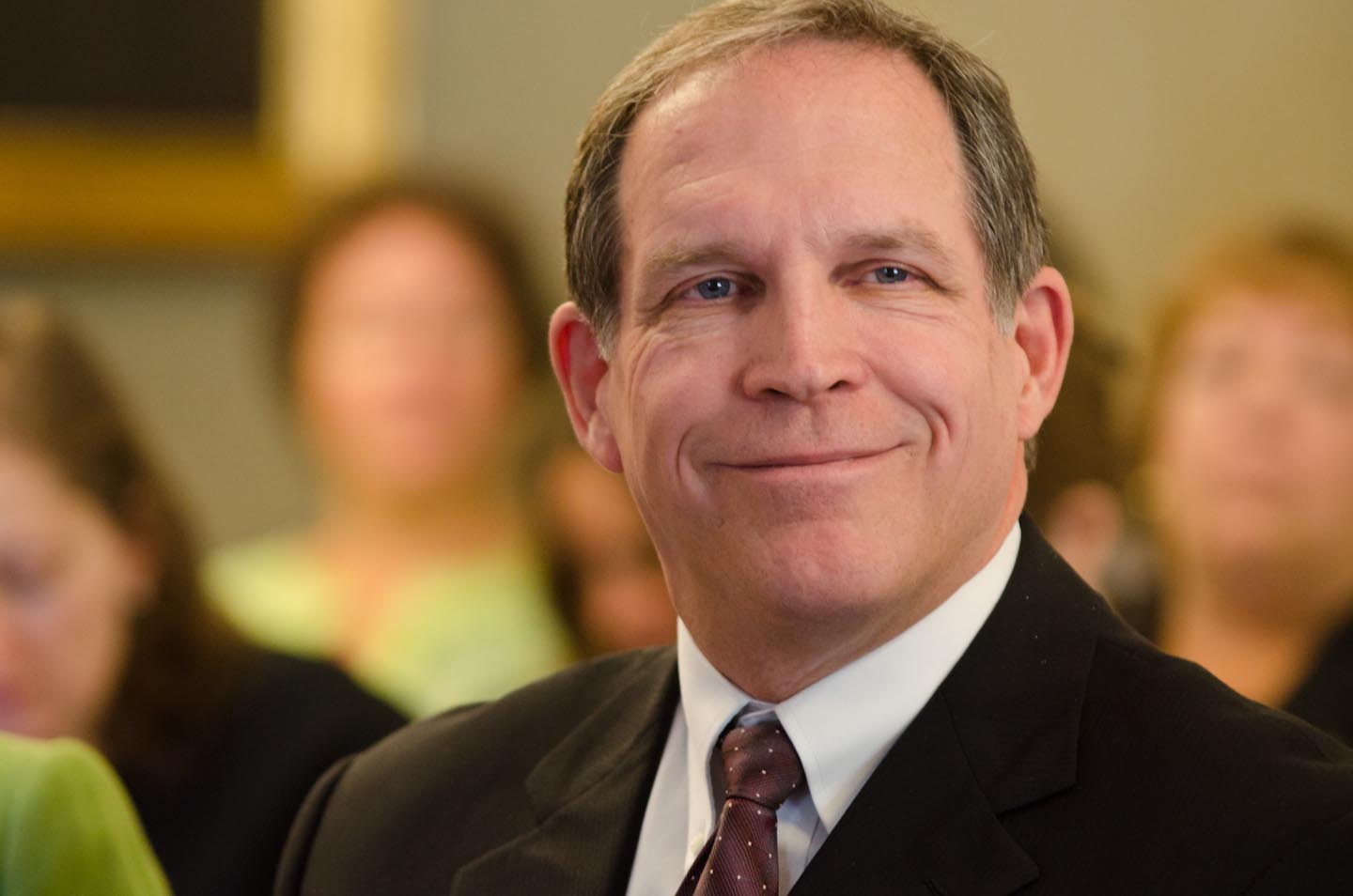
MONTPELIER – The Vermont State Employees Association has thrown up a major roadblock to the state’s newly announced decision to decentralize acute mental health care.
VSEA President John Reese said VSEA will use “any and all means at our disposal” to oppose Gov. Peter Shumlin’s proposal to replace the state’s 50-bed hospital, which was damaged in the Tropical Storm Irene flood, with a 15-bed facility in Central Vermont.
Shumlin announced on Dec. 13 that he wants to spin off care for severely ill mental health patients from one facility to a handful of private regional hospital facilities on Dec. 13.
“We are not confident that the plan put forth by the administration is going to provide the necessary level of care for individuals around the state,” Reese said Thursday.
Reese said the administration didn’t consult with mental health professionals in drafting the plan, and he suggested the smaller facility may be driven more by cost considerations than an obligation to provide the best care. That point was pungently made when Dr. Jay Batra, the medical director at the now-flooded out state hospital in Waterbury and a psychiatric professor, testified in the Legislature endorsing a 48-50 bed state hospital replacement the same day Gov. Shumlin announced his plan to move in the opposite direction.
Dr. Batra has since said he was not consulted on the governor’s proposal.
Reese said he’s “confused as to why the administration has come up with this plan,” especially considering the administration itself had previously announced its support for one centralized hospital for treatment with 40-50 beds, a view he said was also taken by Shumlin when he was running for governor.
Administration Secretary Jeb Spaulding said the state simply disagrees with the union on the best way to treat patients with acute mental illness.
State officials decided in the “long view” a community-based care system was the best method for treatment. Spaulding said the state had to move quickly to deal with a stressed system following the closure of the Vermont State Hospital.
“I think you’ll find the vast majority of those interested in mental services all agree as well,” he said, adding “it doesn’t mean it’s unanimous.”

Conor Casey, the VSEA legislative coordinator, said the VSEA will consider what legal options it has in light of contract provisions that cover situations when the state seeks to “privatize” care.
He said the organization will vigorously oppose the proposal in the Legislature.
“We’re going to fight this thing every way we can,” Casey said. “We feel it’s a very bad policy decision. We feel a central facility is the best option.”
Some 240 employees were at the state hospital when it was flooded out Aug. 29 by tropical storm Irene and they are now working at facilities around the state under a cobbled together system created after the state hospital closed.
Casey said a larger facility would provide patients with access to higher quality care and preserve a highly trained work force attuned to the needs of patients who need acute mental health care.
The VSEA’s vocal opposition comes after an emotional and disputatious meeting Friday at the Montpelier VFW hall that drew around 100 state hospital employees to talk with Spaulding and then-Mental Health Commissioner Christine Oliver. (Oliver this week switched her post to become Deputy Secretary of the Human Services Agency and Patrick Flood, who has been the administration’s point man on the state hospital, left that post to take Oliver’s position.)
VSEA staffer Doug Gibson attended and said some staffers were in tears and others were frustrated though civil. He said among front-line state hospital staffers there is “unanimous” agreement that the plan is a “travesty” and the state is going in the wrong direction – and not just because jobs are at stake.
“People are seeing what this privatized system will look like,” he said. “In some instances, they’re not liking what they’re seeing,” he said.
VSEA plans to present an alternative proposal.
The administration’s proposal calls for replacing the 54-bed state hospital with a new 15-bed state-managed facility near Central Vermont Medical Center; 14 inpatient beds at the privately run Brattleboro Retreat; six at the Rutland Regional Medical Center; and up to 5 beds at the Windsor Correctional Facility to handle patients under court jurisdiction.
Mental Health Commissioner Flood has indicated that beyond those 40 beds, a raft of new community care beds will be added providing more mental health beds in the system than were at the state hospital. Mental Health officials have testified in the Legislature that as many as 20 of the 51 patients at the state hospital when it was flooded didn’t need to be there but were awaiting other placements, part of their argument that a larger new state hospital isn’t needed.
Shumlin’s plan also relies on a broad continuum of additional community services, including transitional beds for people moving off acute care, improved emergency services, housing vouchers and peer support, as well as an expanded case management system.
Some lawmakers appear to agree with the VSEA view that one central hospital is the best option for treatment of severely ill patients, while others have indicated they are open to what the governor has proposed. Flood indicated Wednesday that the administration intends to come in with a specific bill that will outline programmatic and financial steps the Legislature must approve.
Casey asked why the drafting of the plan was done in secrecy without reaching out to VSH staff. He said the union was “caught completely off guard” by the governor’s proposal and only learned about it in media reports after the announcement.
VSEA officials are not critical of all aspects of Shumlin’s proposal. They praise the beefed-up community care aspects but insist the most acutely ill need to be treated in a specialized facility with staff trained to deal with them. Dr. Batra has testified that the state needs the mental health equivalent of a “level I trauma center,” making the analogy that a broken leg can be treated at the local emergency room but major trauma needs to be treated in a specialized facility.
Dr. Batra’s assessment is correct, according to Gibson, who said VSH employees have reported that the private facilities can’t handle abusive patients.
“The hospital staff has years and years of training. They have the techniques to handle the situation,” he said. In a post on the VSEA website, Gibson wrote that the Shumlin plan will “throw away a century-plus of caregiving expertise down the drain.”
Casey said the governor’s proposal also underestimates the numbers of mentally ill patients who are now being sent to corrections facilities who need to be taken care of in a central state hospital. He said VSEA officials are hearing from corrections employees that they are being forced to deal with mentally ill prisoners who should not be in the jails and need treatment.
“They don’t have the training they need” to deal with them, he said. The state’s proposal to have up to five beds at the Windsor prison facility for people under corrections department control is “absolutely insufficient,” he said.
One of the issues disputed between VSH staff and Spaulding at Friday’s meeting was Spaulding’s contention that the state is limited to building 15 beds or less for any new mental health facility if it wants Medicaid funding participation. Spaulding said he remains convinced that is the case, though he was challenged about it the meeting.
Spaulding said a number of issues remain to be decided in the governor’s proposal, including who will pay for any new construction or physical alterations at the Brattleboro Retreat and Rutland Regional Hospital and details of a state contract with those institutions on how they will handle Vermonters in mental health crisis.
Spaulding said he understood the anguish of VSH employees who are commuting long distances to their jobs now and facing uncertainty about their jobs. He said the state would make every effort to try and keep them in the mental health system or in other state employee positions.
“I realize it’s a very emotional issue,” he said.
For his part, Reese said the VSEA is urging VSH employees to speak up and voice their concerns to lawmakers. He predicted the governor’s proposal faces “a long bumpy ride.”

